Fuel is one of the biggest operating costs for businesses that depend on vehicles. For transport companies, logistics firms, contractors, delivery businesses, SACCOs and organisations with field vehicles, even a small amount of unexplained fuel loss can become expensive when repeated across several vehicles over many months. The challenge is that fuel loss is not always easy to detect from receipts, driver explanations or manual records alone. A vehicle may consume more than expected because of idling, poor driving habits, mechanical problems, route changes or deliberate fuel theft, and without reliable data it can be difficult to know the difference.
This is where a fuel monitoring system becomes valuable. Instead of relying entirely on estimates, businesses can use telematics data to compare fuel usage against distance travelled, vehicle activity and refuelling patterns. The objective is not simply to accuse drivers when fuel figures do not match expectations, but to give fleet managers better information so they can identify unusual patterns, investigate them and make decisions based on evidence.
Why Fuel Loss Is Difficult to Detect
Many businesses still manage fuel using receipts, fuel cards, odometer readings and driver reports. These methods are useful, but they can leave gaps. A receipt may confirm that fuel was purchased, but it does not always show how that fuel was actually used. Similarly, an odometer reading tells you how far a vehicle travelled, but it does not explain whether the engine spent long periods idling, whether fuel was siphoned or whether the vehicle consumed more than normal because of a mechanical problem.
The challenge becomes greater when a business operates multiple vehicles. A manager may be reviewing fuel expenses for ten, twenty or fifty vehicles, each travelling different routes and carrying different loads. Without a monitoring system, it can be difficult to determine whether higher fuel consumption is justified or whether something unusual is happening.
For this reason, unexplained fuel loss often continues for months because each individual discrepancy appears too small to investigate. However, when those small losses are repeated across an entire fleet, the financial effect can become significant.
How Fuel Monitoring Works
A fuel monitoring system is designed to measure or estimate fuel levels and usage and combine that information with vehicle tracking data. Depending on the system installed, fleet managers may be able to view fuel level changes, refuelling events, consumption trends and sudden drops that could indicate possible fuel siphoning.
The most useful part of the system is not a single reading, but the ability to compare different types of information. For example, if fuel levels drop sharply while the vehicle is stationary, that may require investigation. If a vehicle consistently consumes significantly more fuel than similar vehicles operating comparable routes, the business can examine driving behaviour, maintenance condition or possible misuse.
Fuel monitoring becomes even more powerful when combined with GPS tracking because the fleet manager can see where the vehicle was when a suspicious fuel event occurred. This makes it easier to investigate whether the vehicle was at an authorised fuel station, customer site, depot or an unexpected location.
Detecting Possible Fuel Theft
Fuel theft can happen in different ways. Fuel may be siphoned directly from the tank, removed during loading or parking, or falsely reported as having been purchased when it was not. In other cases, drivers may collude with fuel attendants or manipulate manual records. These situations are difficult to prove if the business relies only on receipts and verbal explanations.
A fuel monitoring system can help identify patterns that deserve attention. For example, a sudden unexplained drop in fuel level while the vehicle is parked could indicate that fuel was removed. Repeated discrepancies on the same vehicle, route or driver may also suggest that something needs to be investigated more closely.
The purpose of the system should not be to assume wrongdoing every time a reading changes. Fuel levels can fluctuate because of road gradient, sensor calibration and normal vehicle movement. What matters is identifying repeated or unusual patterns and then verifying them using other information such as route history, driver reports and fuel receipts.
Fuel Monitoring Can Also Reveal Operational Waste
Not every fuel problem is theft. In many fleets, fuel is lost through inefficient operations rather than deliberate misconduct. Excessive idling, harsh acceleration, unnecessary detours, poor route planning and badly maintained vehicles can all increase fuel consumption.
A driver who keeps the engine running for long periods while parked may not be stealing fuel, but the cost to the company can still be substantial. Similarly, a vehicle with an engine problem, underinflated tyres or poor maintenance may consume significantly more fuel than expected.
By combining fuel data with GPS information, businesses can begin to separate these different causes. If a vehicle is using more fuel because it spends long periods idling, route and ignition data may help explain the pattern. If fuel consumption rises suddenly after a mechanical issue develops, maintenance teams can investigate before the problem becomes more expensive.
This makes fuel monitoring useful not only as a security tool, but also as an operational efficiency tool.
Comparing Fuel Consumption Against Distance Travelled
One of the simplest ways to evaluate fuel efficiency is to compare fuel used against distance travelled. A fleet manager may know that a particular truck, van or car normally achieves a certain fuel consumption range under typical conditions. If that vehicle suddenly begins using far more fuel while travelling similar distances, the change deserves attention.
However, the comparison should be fair. Fuel consumption can vary because of traffic, load, terrain, driver behaviour and vehicle condition. A heavily loaded truck climbing steep roads will not consume fuel at the same rate as the same truck travelling empty on a flat highway.
For this reason, fuel data should be interpreted alongside route and operating information. The strongest fleet management decisions come from looking at several indicators together rather than judging a vehicle or driver from one number.
Why Fuel Monitoring Is Useful for Contractors and Logistics Companies
Fuel monitoring is especially valuable for businesses that operate vehicles far from the office. Construction companies, logistics firms, agricultural businesses and contractors may have vehicles working at remote sites where supervisors cannot physically monitor every refuelling event.
In these situations, GPS and fuel monitoring give management greater visibility without requiring constant phone calls. A manager can review where the vehicle travelled, how long it operated, when it was refuelled and whether fuel usage appears reasonable for the work completed.
This can improve accountability because drivers and supervisors know that fuel use is being measured against actual vehicle activity. It can also reduce unnecessary disputes, since the business has data that can be reviewed when questions arise.
For companies working on multiple projects, this information can also help allocate fuel costs more accurately between sites, departments or contracts.
How Fuel Monitoring Supports Better Budgeting
Accurate fuel data can improve financial planning. Instead of estimating fuel costs from historical averages alone, businesses can use actual consumption data to understand which vehicles, routes and activities are most expensive.
A company may discover that one route consistently uses more fuel because of congestion or poor road conditions. Another vehicle may be more expensive to operate because it is older or requires maintenance. A particular driver may achieve better fuel efficiency than others because of smoother driving habits.
These insights can help management make better decisions about vehicle replacement, route planning, driver training and maintenance schedules. Over time, the savings from better decisions can be more valuable than simply detecting fuel theft.
Fuel Monitoring and Driver Accountability
Fuel monitoring can also improve conversations between managers and drivers. Without data, discussions about fuel usage can become based on assumptions. A driver may be blamed for high fuel consumption even when the real cause is traffic congestion, a mechanical issue or an unusually heavy load.
With telematics information, both parties can look at the same operational data. If a vehicle travelled the expected route, carried a heavy load and spent several hours in congestion, higher fuel consumption may be reasonable. If fuel disappeared while the vehicle was parked and the engine was off, that tells a different story.
This evidence-based approach can create a more professional fleet management culture. The goal is not simply to monitor drivers more aggressively, but to improve transparency and make decisions using reliable information.
What Businesses Should Check Before Installing Fuel Monitoring
Before installing a fuel monitoring system, businesses should first identify the problem they are trying to solve. Some companies are mainly concerned about fuel theft, while others want to reduce consumption or improve reporting. The right system should match those priorities.
Businesses should also consider the type of vehicles in the fleet, the size and design of fuel tanks, the operating environment and how frequently managers need reports. Installation quality is also important because inaccurate sensor placement can lead to misleading readings.
After installation, the system should be tested and calibrated properly. Managers should avoid making major decisions from a few days of data. It is better to establish a normal operating pattern and then monitor changes over time.
Finatrack Fuel Monitoring System
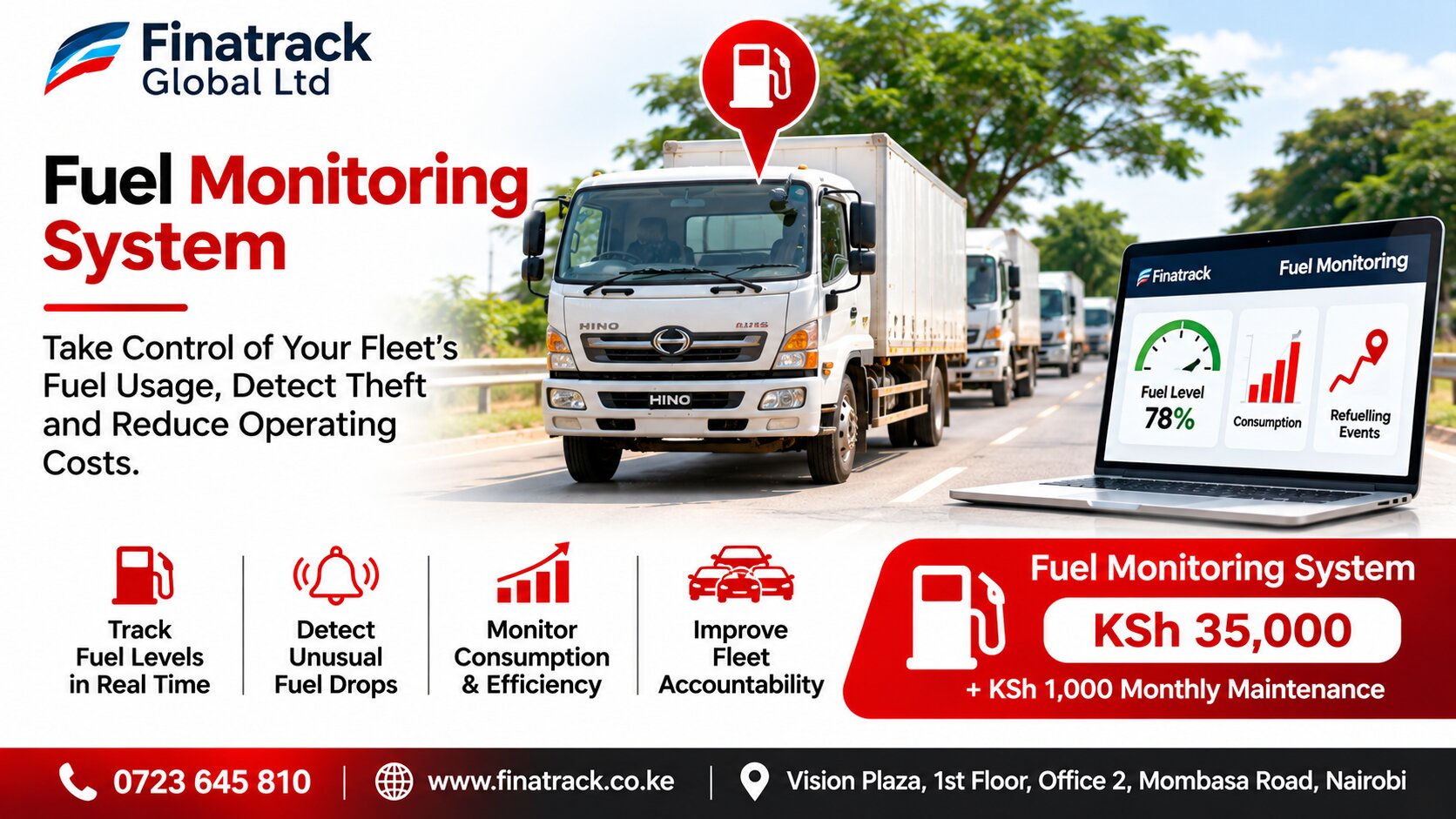
Finatrack Global Ltd provides fuel monitoring solutions for businesses that want greater control over fuel usage and fleet operating costs. The system can help fleet managers monitor fuel activity, identify suspicious changes, compare consumption against vehicle movement and improve accountability across their operations.
Our Fuel Monitoring System is available at KSh 35,000 plus KSh 1,000 monthly maintenance. It is suitable for logistics companies, contractors, commercial fleets and other businesses that depend heavily on vehicle operations.
Finatrack also provides GPS tracking, AI dashcams, advanced car alarms, wireless tracking devices, motorcycle trackers and other fleet management solutions that can be combined with fuel monitoring to create a more complete vehicle management system.
Better Fuel Control Starts With Better Information
Fuel theft is expensive, but so is operational waste. The biggest challenge for many businesses is not simply that fuel is being lost, but that they do not have enough information to understand why.
A fuel monitoring system gives fleet managers a clearer picture of what is happening inside their operations. When fuel data is combined with GPS tracking, route history and vehicle activity, businesses can investigate suspicious losses, improve driver accountability and make better decisions about maintenance and efficiency.
For enquiries or installation, contact Finatrack Global Ltd on 0723 645 810, visit www.finatrack.co.ke, or visit our office at Vision Plaza, 1st Floor, Office 2, Mombasa Road, Nairobi.
The goal is not just to buy less fuel. It is to understand where every litre is going.