Many Kenyan businesses begin with one vehicle and a simple way of managing it. The owner may know who is driving, where the vehicle is expected to go and approximately how much fuel it should use. As the business grows and more vehicles are added, however, informal management through phone calls, WhatsApp messages, fuel receipts and driver explanations can become increasingly difficult to control.
This is usually the point where GPS fleet management begins to make commercial sense. A tracking system gives management a central view of vehicle activity and provides information about location, trips, mileage, ignition activity and other fleet events depending on the solution installed. For an SME, the objective is not to introduce unnecessary technology but to gain better control over assets that are becoming increasingly expensive to operate.
A small business does not need fifty vehicles before fleet tracking becomes useful. Even a company operating three or four vehicles can experience fuel wastage, unauthorised trips, delayed deliveries and difficulties determining where vehicles are during the working day. The right time to introduce GPS fleet management is therefore better determined by the problems the business is experiencing than by the number of vehicles it owns.
One of the clearest warning signs is when management spends too much time calling drivers to ask where they are. If customers regularly request delivery updates and the office has to call the driver before answering, the business has limited fleet visibility. GPS tracking allows authorised employees to check the vehicle’s current or most recently reported location directly from the tracking platform.
This can improve customer communication while reducing unnecessary interruptions for drivers. A delivery driver navigating Nairobi traffic does not need repeated phone calls asking whether they have reached Industrial Area, Westlands or Mombasa Road. The office can monitor routine progress and contact the driver when there is an actual operational reason to do so.
Another sign is when management no longer knows whether reported journeys accurately reflect how vehicles are being used. A salesperson may report spending the day visiting customers, while a delivery driver may explain that delays were caused by traffic. Without independent journey information, management has little evidence beyond the employee’s explanation.
Trip history provides greater clarity by showing where the vehicle travelled and how the journey developed. Management can review routes, stops and approximate travel periods and then compare those records with the work that was scheduled. GPS information should not automatically be used to accuse employees, but it gives the business a factual starting point when explanations do not match expectations.
Fuel expenditure is another major signal that an SME may have outgrown informal fleet management. A business can continue collecting fuel receipts every week without understanding why one vehicle consumes much more fuel than another. As the fleet grows, small differences in consumption can become substantial monthly expenses.
GPS tracking provides mileage and journey information that helps management understand how fuel expenditure relates to actual vehicle activity. If fuel costs increase significantly while the distance travelled remains relatively stable, the company has a reason to investigate mechanical condition, excessive idling, unnecessary trips or driver behaviour. The tracking data does not automatically identify the cause, but it helps narrow down where management should look.
Businesses with larger commercial vehicles may also consider dedicated fuel-monitoring equipment where appropriate. Depending on the vehicle and installed system, fuel-level monitoring can provide additional visibility over refilling activity and changes in fuel levels. Combining this information with GPS trip records gives management a much stronger basis for controlling fuel costs than receipts alone.
Unauthorised vehicle use is another common challenge as SMEs expand. When the owner personally managed one vehicle, it may have been obvious whenever the car was being used. Once several vehicles are assigned to employees, drivers or departments, evening and weekend journeys can become much harder to notice.
Trip history can show whether company vehicles continue moving outside approved working periods. An occasional after-hours journey may have a legitimate business explanation, but repeated personal use can increase fuel consumption, servicing requirements and depreciation. Clear vehicle-use policies combined with GPS information make it easier for SMEs to maintain consistent control.
Geofencing can provide further support where businesses operate from defined locations. A virtual boundary can be created around an office, warehouse, construction site or another important operating area. Depending on the tracking system, management can identify when vehicles enter or leave those locations and use this information to understand how company assets are being deployed.
This can be particularly useful for SMEs operating project vehicles. A pickup assigned to one construction site may be expected to remain around that project for most of the week, while a delivery van may be expected to return to the warehouse every evening. Repeated movement outside those patterns gives management an opportunity to investigate before unnecessary mileage becomes normal.
Growing businesses should also consider GPS fleet management when one person can no longer remember the operating history of every vehicle. With two cars, an owner may remember when each vehicle was serviced and approximately how much distance it covers. Once the fleet reaches ten or fifteen units, relying on memory becomes unreliable.
Mileage information from the tracking platform can support better maintenance planning. One company car may accumulate significantly more kilometres than another because of the territory it serves, meaning both vehicles should not necessarily be treated as though they have identical workloads. Understanding actual utilisation helps management schedule servicing according to real vehicle activity.
Preventive maintenance can reduce unexpected downtime. A van that breaks down during a delivery may cause customer delays, lost employee time and additional recovery expenses. For a small business with only a few vehicles, losing even one unit temporarily can affect a significant portion of available transport capacity.
GPS tracking can also help management respond more efficiently when a breakdown occurs. The vehicle’s location can be checked on the platform and shared with a mechanic or recovery provider, reducing dependence on the driver describing unfamiliar roads or landmarks. If the business operates several vehicles, management may also identify another unit that is already nearby and can assist.
The need for better dispatching is another indication that an SME may benefit from fleet management technology. A field-service company may receive an urgent customer request and automatically send a technician from the office even though another company vehicle is already operating much closer to the customer. Without visibility, the business cannot easily know which resource is best positioned to respond.
A central tracking platform can help management identify the nearest suitable vehicle and coordinate work more efficiently. This can reduce response times while avoiding unnecessary kilometres. Over time, better dispatching can contribute to lower fuel consumption and allow the same fleet to complete more productive assignments.
Sales teams can benefit from the same approach. A growing SME may have representatives working across different parts of Nairobi, yet the sales manager may not know which employee is closest to a new customer enquiry. Vehicle location can provide operational context that helps the company respond faster without repeatedly contacting every representative.
A business should also consider fleet tracking when customer complaints become difficult to verify. A customer may claim that a delivery driver never arrived, while the driver insists they were at the premises for twenty minutes. Without journey information, management may struggle to establish what happened.
GPS records can show whether the vehicle reached the area and approximately when it was there. This does not prove that goods were delivered or that the customer was contacted, but it provides valuable supporting information that can be combined with delivery notes, phone records or other business documentation.
Security is another major reason SMEs begin tracking their vehicles. A company vehicle represents a substantial investment, particularly when it also carries tools, merchandise or specialised equipment. If that asset disappears, the financial impact can be far greater for a smaller business than for a large corporation with significant fleet reserves.
GPS tracking can provide current or recent location information when unexpected vehicle movement occurs. Depending on the solution installed, ignition alerts, geofence notifications and power-related events can provide additional information that helps management recognise unusual activity. These features become particularly valuable for vehicles parked away from the owner’s direct supervision.
Higher-value vehicles may require more than one security layer. A professionally installed wired GPS tracker can provide the primary monitoring system, while a separate wireless tracker or tracking tag can provide additional backup visibility if the main device is interfered with. Alarms and immobilisation systems can also complement tracking depending on the vehicle and level of risk.
A growing SME should therefore think about vehicle security before a theft occurs rather than treating tracking only as a recovery tool. The strongest fleet strategy combines visibility with clear procedures for who responds to alerts and what action should be taken when unusual activity appears. Employees should not personally confront suspected thieves simply because a vehicle’s position is visible on a tracking platform.
Driver behaviour may become another concern as the business adds employees. When the owner drives the only company vehicle, driving standards are relatively easy to control. Once several drivers are operating vehicles independently, management may have less visibility over speeding and other behaviours that can increase road risk.
Depending on the tracking system installed, fleet managers can review repeated overspeeding, harsh braking and acceleration events. These records can support driver coaching and safer operating policies, although individual events should always be considered within the context of Kenyan road conditions. Patterns across several journeys are generally more useful than one isolated incident.
Safer driving can also affect operating costs. Aggressive acceleration, high speeds and repeated harsh braking can contribute to higher fuel consumption and faster wear on tyres, brakes and suspension components. Improving driver behaviour can therefore support both safety and financial performance.
An SME may also need fleet tracking when management starts considering whether to buy additional vehicles. Employees may complain that company vehicles are always unavailable, leading the owner to assume another vehicle must be purchased. Tracking data may reveal that the existing fleet is simply being allocated inefficiently.
One department may have vehicles parked for long periods while another struggles with transport availability. Better allocation can sometimes solve the problem without immediately creating another loan, insurance premium and maintenance obligation. Tracking therefore provides useful information before the business commits additional capital.
The opposite conclusion can also be valuable. If vehicle utilisation records show that every unit is operating intensively and the business is still struggling to meet demand, management has stronger evidence that expansion is justified. Decisions about fleet growth can then be based on actual usage rather than impressions.
This becomes increasingly important because the cost of owning a vehicle does not end with the purchase price. Insurance, fuel, tyres, maintenance, tracking and depreciation continue throughout the life of the asset. An unnecessary vehicle can therefore become a long-term cost rather than simply a one-time purchase.
Reporting is another reason SMEs should move beyond informal vehicle management. As businesses grow, the owner may no longer have time to review every journey individually. A good fleet tracking platform should make it easier to identify useful information such as mileage, trips, stops and selected driver events without spending the entire day watching vehicles on a screen.
Management can then focus on exceptions. A vehicle that travelled significantly farther than others, remained stationary for unusually long periods or repeatedly operated after hours can be investigated. This is far more efficient than trying to manually supervise every vehicle throughout the day.
Fleet management software can also support accountability between branches. A growing SME may have vehicles assigned to Nairobi, Nakuru or other locations, making direct supervision increasingly difficult. A central tracking platform allows authorised head-office managers to maintain visibility without physically visiting every branch.
Access should nevertheless be controlled. The company may want the overall fleet manager to see every vehicle while branch managers only view vehicles assigned to their locations. Clear access permissions help protect sensitive location information while ensuring the right employees can perform their work.
Mobile access becomes important as well because SME owners and managers are often moving between customers, branches and meetings. The ability to check vehicle information from a phone means fleet visibility does not disappear when management leaves the office. A web platform can then provide a larger environment for reviewing reports and managing several vehicles.
Businesses should not wait until every manual management method has completely failed before implementing tracking. Introducing a system earlier gives employees time to understand how it works and allows management to establish policies before the fleet becomes more complicated. Waiting until twenty vehicles are already poorly controlled makes implementation more difficult.
At the same time, SMEs should avoid purchasing technology they do not need. A small business may begin with real-time tracking, trip history, ignition monitoring and geofencing before adding more advanced capabilities as requirements grow. The system should be scalable rather than unnecessarily complex from the beginning.
The quality of the hardware and installation remains critical. Fleet software cannot provide reliable information if trackers regularly lose power or communication because of poor wiring. Professionally installed devices should be securely mounted, correctly powered and properly tested before vehicles return to normal operations.
Businesses should also understand how the system behaves when mobile network coverage becomes weak. A vehicle operating in a rural location may temporarily stop appearing live even though the tracker continues recording information. Depending on the equipment and configuration, stored journey records may upload after communication returns.
This is why fleet managers should learn how to read statuses such as online, offline and last update. An offline vehicle does not always indicate theft or tracker failure, but an unexplained outage lasting several days should not be ignored. Understanding normal tracking behaviour makes unusual events easier to identify.
Technical support should therefore be part of the purchasing decision. A growing SME may add vehicles, replace units or experience tracker problems over time. A tracking provider should be able to support these changes without forcing the business to rebuild its entire fleet system.
The ideal time to adopt GPS fleet management is ultimately when lack of vehicle visibility starts affecting costs, customer service or management control. If you are repeatedly calling drivers, struggling to explain fuel expenditure, questioning after-hours journeys or finding it difficult to know which vehicle is available, the business may already have reached that point.
For some SMEs this happens with three vehicles, while others may operate slightly larger fleets before the pressure becomes obvious. The number is less important than the complexity of the operation. Once vehicles are moving independently and management can no longer confidently explain how they are being used, a structured fleet tracking system can provide valuable control.
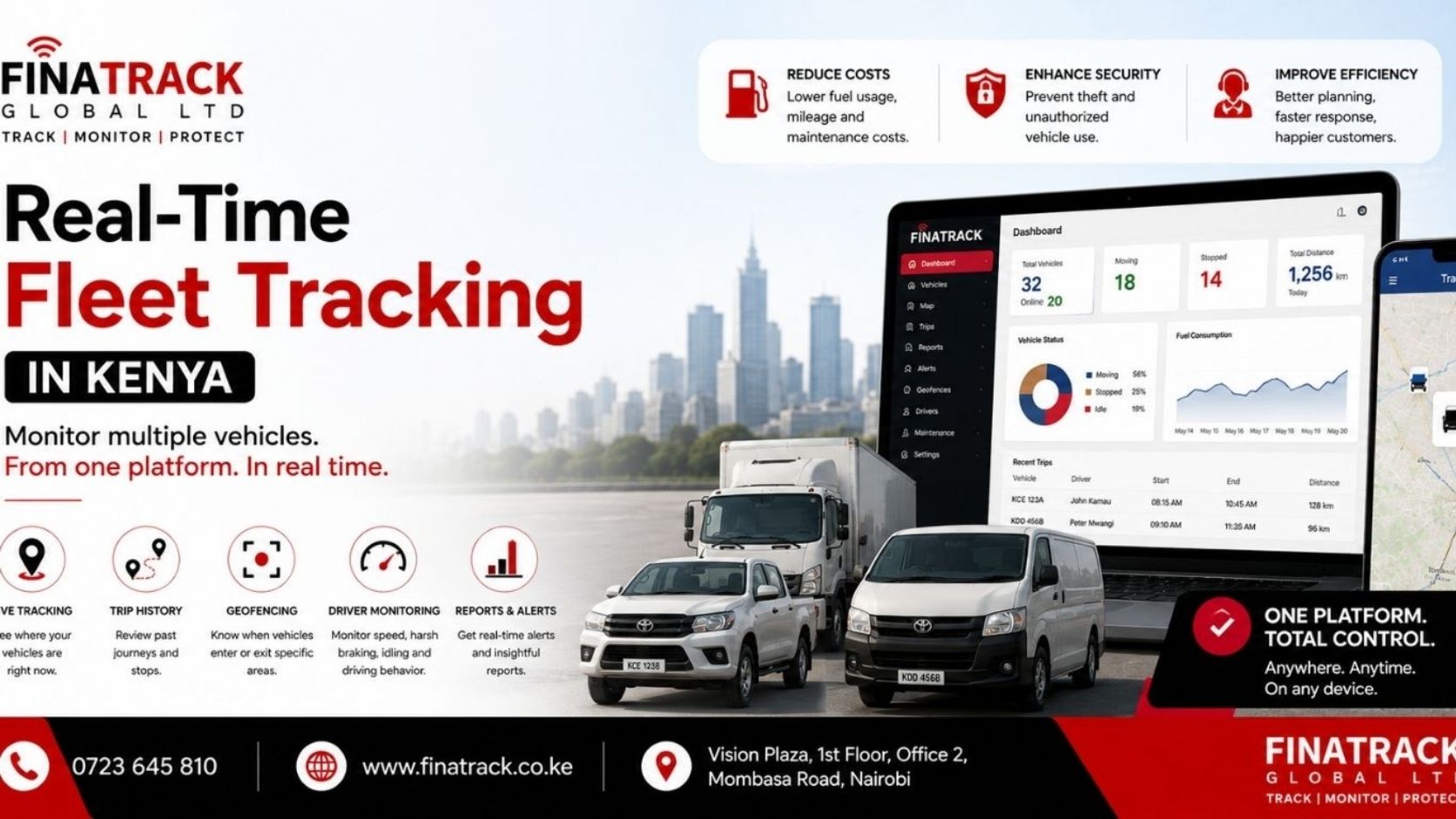
Finatrack Global Ltd provides professionally installed GPS tracking and fleet telematics solutions for SMEs and larger businesses operating vehicles in Kenya. Depending on the organisation’s requirements, solutions can include real-time location, trip history, geofencing, driver monitoring, fuel monitoring, AI dashcams and additional vehicle-security technologies.
Professional installation can be arranged at the customer’s convenient location or at Vision Plaza, 1st Floor, Office 2, Mombasa Road, Nairobi. SMEs looking to improve vehicle visibility and fleet control can contact Finatrack Global Ltd on 0723 645 810 or visit www.finatrack.co.ke to discuss a solution that can grow alongside the business.
GPS fleet management should not be viewed as technology reserved for large transport companies. When vehicles begin consuming too much management time, creating unexplained costs or becoming difficult to coordinate, even a growing SME can benefit from having one reliable source of information about how its fleet is actually being used.