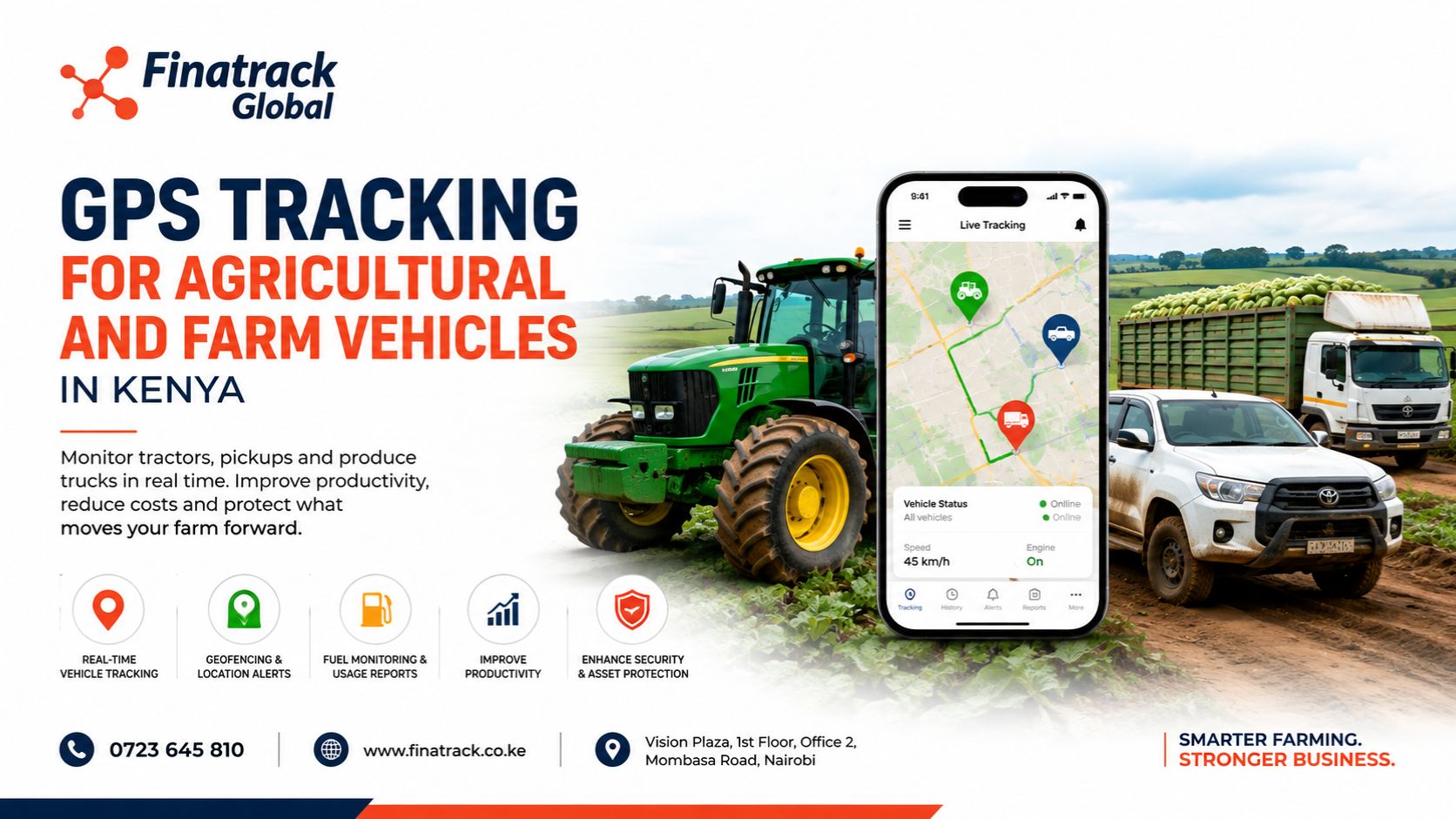
Agriculture depends increasingly on vehicles and machinery that spend much of their working life far from the farm office. Tractors prepare fields, pickups move supervisors and inputs, while trucks transport produce to collection centres, processors and markets. Once these assets leave the main yard, however, farm owners and managers can quickly lose visibility of where they are, how they are being used and whether they are operating according to plan.
That lack of visibility can become expensive. A tractor may spend hours operating in an area where it was not assigned, a pickup may make unnecessary private journeys, or a produce truck may take longer than expected to reach the market. When management relies entirely on telephone calls and driver explanations, it can be difficult to distinguish normal agricultural challenges from inefficient or unauthorised vehicle use.
GPS tracking provides farm owners with an independent way of monitoring mobile assets. Through a phone or computer, authorised managers can check the location of fitted vehicles, review previous trips and monitor movement depending on the tracking system installed. This gives management a clearer picture of what is happening across farms, collection points and transport routes without requiring constant physical supervision.
The value becomes particularly clear on large farms where vehicles may operate several kilometres away from the main office. A tractor assigned to one section of the property can be monitored remotely, while a pickup carrying farm inputs can be checked as it moves between stores, fields and suppliers. Management does not need to call every driver simply to establish where the vehicle is.
For agricultural businesses operating several farms or leased fields, that visibility becomes even more important. Vehicles may move between different properties throughout the week, sometimes across counties. Tracking creates a central view of those movements and makes it easier for management to understand which assets are working at each location.
Geofencing can provide another useful layer of control. Virtual boundaries can be created around farms, warehouses, processing facilities or other authorised operating areas, allowing management to identify when a vehicle enters or leaves selected locations. A tractor expected to remain within the farm, for example, should attract attention if it unexpectedly begins travelling along a public road late in the evening.
Such movement does not automatically mean something is wrong. Equipment may legitimately be transferred between farms or taken for repairs. The advantage of GPS tracking is that management receives information early enough to confirm whether the movement is authorised instead of discovering it after the asset has already travelled a considerable distance.
Unauthorised vehicle use can be particularly costly in agricultural operations because company vehicles are often stationed close to employees or remote work teams. A farm pickup intended for operational duties may gradually begin being used for private journeys after working hours or during weekends. The additional kilometres can be absorbed into normal farm expenses without attracting immediate attention.
Trip history makes these patterns easier to identify. Managers can review where vehicles travelled, when journeys began and where significant stops occurred. Repeated movements outside approved working areas or operating times can then be investigated using actual vehicle records rather than assumptions.
The cost of unnecessary movement extends beyond fuel. Every additional kilometre contributes to tyre wear, servicing, suspension maintenance and depreciation. For vehicles operating on rough rural roads, unnecessary journeys can accelerate mechanical wear even faster.
Tractors present a slightly different management challenge because productivity is not always measured by distance. A tractor may travel relatively few kilometres while working for many hours inside a field. Location and movement records can still help management verify whether the equipment reached the assigned area and how it moved during the working period.
This visibility can become useful where tractors are shared between different fields or farms. If several managers are requesting the same machine, tracking information can help establish where it currently is and whether it has completed the previous assignment. Better information can reduce unnecessary waiting and improve utilisation of expensive agricultural equipment.
Produce transportation presents another challenge altogether. Once harvested crops leave the farm, delays can have commercial consequences, particularly for perishable produce. Fresh vegetables, fruits, flowers, milk and other sensitive goods may lose value when transport takes significantly longer than expected.
GPS tracking allows management to follow the progress of produce trucks and identify unexpected delays along the route. If a vehicle remains stationary for an unusually long period, the farm or distribution manager can investigate before the delay becomes more serious.
The same information can improve communication with buyers, processors and collection centres. Rather than repeatedly calling the driver to ask how far they have travelled, management can check the vehicle’s progress and provide more informed arrival estimates.
For agricultural exporters and larger commercial farms, this can strengthen logistics planning. Harvesting, packaging and transport frequently need to be closely coordinated, and one delayed vehicle can disrupt operations further along the supply chain.
Vehicle security is another important concern. Farm vehicles and machinery may operate or remain parked in relatively isolated areas where there is limited physical security. Tractors, pickups and trucks can represent substantial investments, making unexpected movement something that management should know about quickly.
A professionally installed GPS tracker can provide location information when a vehicle becomes difficult to account for. Movement and ignition alerts, where available and appropriately configured, can also provide early warning if an asset begins operating unexpectedly.
Higher-value assets may benefit from layered security. A wired GPS tracker can act as the primary system, while a wireless tracker or tracking tag provides an additional layer of location capability. An alarm or immobilisation solution may also be appropriate for pickups and other vehicles depending on the security requirements.
The idea is not that one device can eliminate vehicle theft. The stronger approach is to reduce reliance on a single security measure, particularly for vehicles that routinely spend nights in remote areas.
Fuel management is another major issue for agricultural fleets. Tractors and heavy vehicles can consume significant quantities of diesel, making fuel one of the recurring operating expenses that deserves close management attention. When consumption rises unexpectedly, management needs more information than fuel receipts alone.
A dedicated fuel monitoring system can provide additional visibility for suitable vehicles by showing changes in fuel levels and helping identify refilling or unusual reductions. When this information is viewed alongside GPS location data, managers gain greater context about where significant fuel changes occurred.
This can help distinguish legitimate consumption from situations requiring investigation. A sudden drop while a vehicle is working intensively in the field has a different context from an unusual reduction while the vehicle is stationary in an unexpected location.
Fuel information can also help management compare vehicles performing similar work. If two trucks operate comparable routes but one consistently consumes considerably more fuel, the business has a reason to investigate driving behaviour, mechanical condition, loading patterns or other operational factors.
Driver behaviour can influence these costs as well. Excessive speeding, harsh acceleration and repeated sudden braking can increase fuel consumption and accelerate vehicle wear. For produce trucks travelling long distances, poor driving can also increase the risk of accidents and cargo damage.
Telematics information can help managers identify repeated patterns rather than relying on isolated reports. A single harsh braking event may simply mean the driver responded correctly to a hazard, but consistent aggressive driving can justify coaching or closer supervision.
Speed monitoring is particularly important for agricultural vehicles travelling between farms and markets. Drivers may feel pressure to deliver produce quickly, especially where delays can affect freshness. Faster delivery should never come at the cost of unsafe driving.
GPS records can also help agricultural businesses investigate incidents. If a truck is involved in an accident or management receives a complaint about a company vehicle, trip and movement information can provide useful context about the journey.
Where AI dashcams are installed, video may add another layer of information. This can help businesses better understand road incidents and review driver behaviour when accounts differ.
Fleet data can also improve purchasing decisions. Agricultural businesses sometimes add vehicles because managers believe existing assets are constantly busy. Tracking may reveal that certain tractors, pickups or trucks spend substantial periods unused while others are heavily utilised.
This can help management decide whether another vehicle is genuinely necessary or whether better scheduling could increase the productivity of the existing fleet. For businesses operating expensive machinery, avoiding an unnecessary purchase can represent a significant saving.
The same records can support maintenance planning. Vehicles that accumulate more kilometres or operate more frequently may require attention sooner than assets that are lightly used. Actual utilisation information therefore provides another input for deciding when vehicles should be inspected and serviced.
Agricultural businesses should nevertheless use tracking technology responsibly. Employees and drivers should understand that company vehicles are being monitored for legitimate purposes such as security, fleet management, operational efficiency and cost control. Clear internal policies reduce misunderstandings and create consistent expectations about how company assets should be used.
Access to tracking information should also remain restricted to authorised personnel. A farm manager, fleet supervisor or security officer may require access, while employees with no responsibility for vehicle management may not. Good password management and proper access controls help protect sensitive operational information.
Installation quality remains critical, particularly because agricultural vehicles operate in difficult conditions. Dust, vibration, rough roads and long working hours can expose tracking equipment to environments very different from ordinary private cars.
Professional installation helps ensure that equipment is positioned securely, powered correctly and tested before being placed into daily operation. Managers should also be shown how to use the tracking platform so that the information collected translates into practical decisions.
For a small farm operating one tractor and a pickup, GPS tracking can provide basic security and visibility. For a large agricultural business with multiple tractors, trucks and field vehicles, it can become part of a broader fleet-management system supporting logistics, fuel control, security and utilisation.
Agriculture already depends heavily on measuring what happens inside the farm. Farmers monitor rainfall, inputs, yields, labour and production costs because decisions improve when information improves. Vehicles should be managed with the same discipline.
Finatrack Global Ltd provides professionally installed GPS tracking, fuel monitoring, wireless tracking, tracking tags, AI dashcams and vehicle security solutions for agricultural businesses and commercial fleets in Kenya. Installations can be arranged at the customer’s convenient location or at Vision Plaza, 1st Floor, Office 2, Mombasa Road, Nairobi.
For farms, agricultural companies and produce transporters seeking greater control over their vehicles and machinery, contact Finatrack Global Ltd on 0723 645 810 or visit www.finatrack.co.ke.
A tractor may be working kilometres away from the office and a produce truck may already be heading to market. Management should not have to guess where either one is.
Recommended SEO focus keyphrase: GPS tracking for agricultural vehicles in Kenya
SEO title: GPS Tracking for Agricultural & Farm Vehicles in Kenya | Finatrack
Meta description: Learn how GPS tracking helps Kenyan farms monitor tractors, pickups and produce trucks, improve security, manage fuel and gain better control over agricultural fleets.