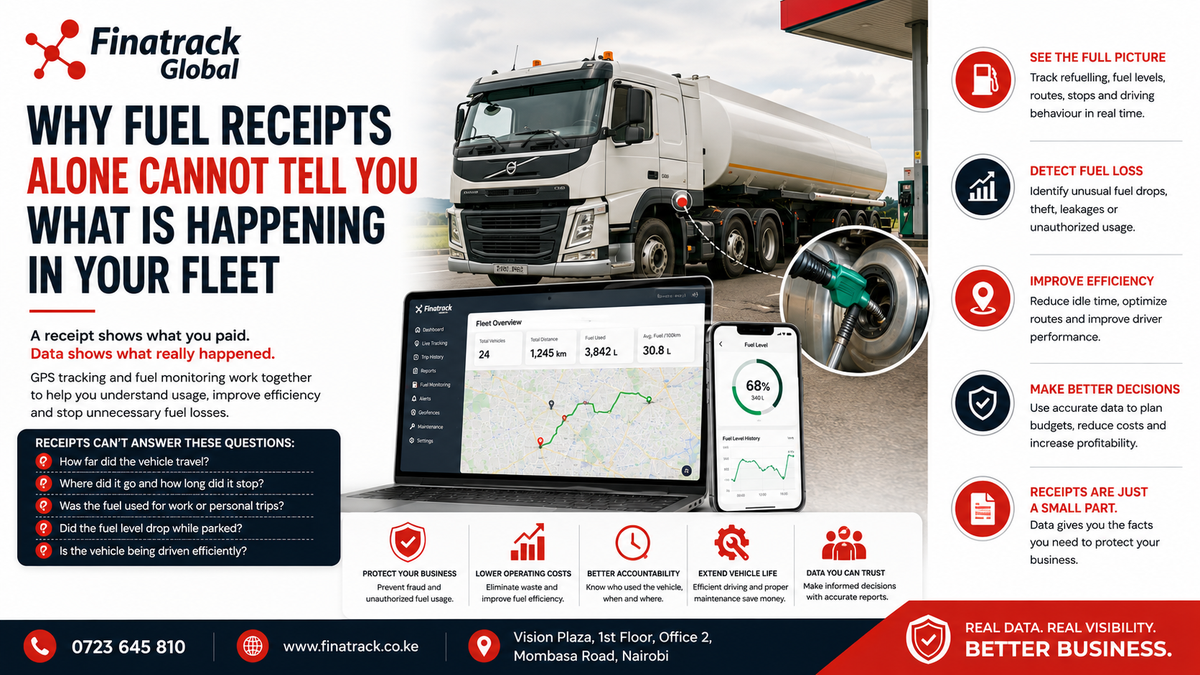
Why Fuel Receipts Alone Cannot Tell You What Is Happening in Your Fleet
Fuel receipts can tell a business how much money was spent at the pump. What they cannot always explain is what happened to that fuel after it entered the vehicle.
For companies operating trucks, vans, pickups and other commercial vehicles, this distinction matters. Fuel is often one of the largest recurring fleet expenses, yet many businesses still manage it mainly by collecting receipts, checking card statements and comparing monthly totals. When consumption rises unexpectedly, management may know that more money has been spent without understanding why.
A receipt can confirm that 100 litres of fuel were purchased at a particular station. It cannot by itself confirm how much fuel was actually added to the vehicle, how the vehicle was driven afterwards or whether the fuel level later dropped unexpectedly. It also cannot tell management whether the vehicle spent the day completing productive work or travelled kilometres that had little to do with company operations.
This is where many fleet investigations become difficult. A truck may consume considerably more fuel this month than it did last month, but several explanations may be possible. It may have travelled farther, carried heavier loads, spent more time in congestion, idled excessively, developed a mechanical problem or been driven more aggressively.
Without vehicle movement data, management may struggle to separate these possibilities.
The most visible number on a fuel report is usually the amount purchased. The more important business question is whether that amount makes sense when compared with the work completed by the vehicle.
A van that consumed KES 20,000 worth of fuel while completing many customer visits may be operating normally. Another vehicle may consume a similar amount while spending much of the week parked or making relatively few productive journeys. Receipts alone do not show that difference.
GPS tracking adds context by showing how vehicles are actually being used. Management can review trip distances, routes, stops and working patterns and compare that information with fuel expenditure.
If fuel spending increases at the same time that vehicle mileage increases significantly, there may be a reasonable operational explanation. If fuel expenditure rises while the vehicle’s activity remains almost unchanged, the situation deserves closer examination.
This does not automatically mean fuel has been stolen. Poor fuel economy can result from several operational and mechanical factors, and good fleet management should investigate before reaching conclusions.
Driver behaviour can have a major influence on consumption. Frequent harsh acceleration, unnecessary speeding and inefficient driving can cause a vehicle to use more fuel than another vehicle performing similar work.
A fuel receipt will never reveal how the accelerator was used after the driver left the station.
Telematics information can help management identify repeated driving patterns that may be contributing to higher operating costs. The objective should not be to judge drivers based on one isolated event, but to understand behaviour over time and determine where training or operational improvements may be needed.
Idling is another cost that is easy to overlook.
A company vehicle can consume fuel while producing no additional kilometres. Drivers may leave engines running while waiting for loading, customers, colleagues or instructions. Some idling is operationally necessary, particularly for certain commercial vehicles, but excessive idling can quietly increase fuel expenditure.
Fuel receipts simply show that the fuel was purchased. Tracking and telematics information can help management understand whether the vehicle was moving productively or spending long periods stationary during the working day.
Route efficiency creates another blind spot. Two vehicles completing similar assignments may consume different amounts of fuel because one travels significantly farther than necessary.
The driver may be taking inefficient routes, making unnecessary stops or completing unauthorised journeys between assigned jobs. None of these activities will appear on the receipt from the petrol station.
Trip history allows management to see where the vehicle actually travelled. Over time, repeated unnecessary kilometres can be identified and route planning can be improved.
This matters because the cost of unnecessary mileage extends beyond fuel. Every additional kilometre contributes to tyre wear, servicing, depreciation and other maintenance costs. Fuel inefficiency may therefore be an early sign of a wider fleet-management problem.
After-hours vehicle use can also affect fuel reports. A company vehicle may complete all of its authorised assignments during the day and then continue being used for personal journeys in the evening or during weekends.
By Monday morning, the business simply sees a lower fuel level.
Without trip records, the extra consumption can easily be absorbed into the company’s operating costs. GPS tracking can help authorised managers identify movement outside expected working periods and verify whether those journeys were legitimate.
For larger commercial fleets, dedicated fuel monitoring can provide another level of visibility.
A properly configured fuel monitoring system can help management observe changes in tank levels, refilling activity and significant reductions that may require investigation. When those fuel-level changes are viewed alongside vehicle location and trip information, managers gain much stronger context.
For example, a substantial increase in fuel level at an authorised station during a scheduled refuelling event may be entirely normal. A significant reduction while a truck remains parked at an unusual location may deserve immediate attention.
The strength of the system comes from combining different pieces of information.
Fuel data without location has limited context. Location data without fuel information may show where the truck was but not explain what happened inside the tank. Together, the two can provide a much clearer operational picture.
This is particularly useful for businesses operating trucks with large fuel tanks. When hundreds of litres are purchased at a time, even a relatively small percentage of unexplained loss can translate into considerable money across several vehicles and months of operation.
A business does not need to lose an entire tank of diesel before fuel control becomes financially important.
Small irregularities repeated regularly can be more damaging because they may continue unnoticed for a long period.
Suppose a fleet has ten trucks and each vehicle records only a small amount of unexplained fuel consumption during the week. Individually, the amount may appear too small to investigate. Across the entire fleet and over a full year, the accumulated value can become significant.
Better information allows management to identify these patterns earlier.
Fuel monitoring can also help businesses evaluate the performance of different vehicles. Two trucks performing similar duties may consistently report different fuel consumption patterns.
One vehicle may have a mechanical problem. Another may be carrying heavier loads. The difference may also be related to driving behaviour or route conditions.
The purpose of fleet technology is to give management enough information to investigate intelligently rather than guessing.
Maintenance should not be overlooked when analysing fuel consumption. An inefficient engine, tyre-pressure problems or other mechanical issues can contribute to increased fuel use.
Tracking and fuel data cannot diagnose every mechanical fault, but they can help reveal that a vehicle’s consumption pattern has changed. That change can prompt management to inspect the vehicle before the problem becomes more expensive.
Fleet managers should therefore avoid using fuel-monitoring information only as an anti-theft tool.
The larger opportunity is cost management.
Businesses can use the information to understand how vehicles are driven, where unnecessary kilometres are being accumulated, how long engines remain idle and whether consumption is consistent with actual work performed.
This can improve budgeting as well.
When management understands the relationship between routes, mileage and fuel use, forecasting becomes more reliable. A company can estimate what a particular contract, delivery route or project should reasonably cost rather than simply reimbursing fuel expenses after they occur.
For transport and logistics companies, this can influence pricing decisions. A business that does not understand its true fuel cost may quote customers too little and slowly erode its margins.
For construction companies, unexplained fuel consumption can increase the cost of projects. For field service businesses, unnecessary movement can reduce the number of customers technicians can serve in one day.
Different industries experience the problem differently, but the principle remains the same.
A receipt records a purchase.
It does not measure efficiency.
Businesses should also establish clear internal procedures around refuelling. Drivers should understand where vehicles may be fuelled, how transactions are recorded and what information must be provided when unusual consumption occurs.
Technology becomes much more effective when supported by clear fleet policies.
Management should also use fuel and tracking data fairly. One unusual event should not automatically result in accusations against a driver.
Traffic conditions, vehicle loads, terrain, customer delays and mechanical factors can all affect fuel consumption. The objective should be to identify patterns and investigate them with appropriate context.
Reliable data can actually protect good employees.
When fuel spending rises for legitimate operational reasons, trip information can help demonstrate that the vehicle travelled farther or worked more intensively. Instead of relying on suspicion, both management and drivers have information to support the discussion.
For businesses running only a few vehicles, this can improve everyday cost control. For companies operating dozens of trucks, pickups or vans, the financial impact can be much greater.
As a fleet grows, management cannot realistically understand fuel performance by looking at a pile of receipts at the end of the month.
It needs visibility into what happened between one refuelling event and the next.
Finatrack Global Ltd provides professionally installed GPS tracking, fuel monitoring and fleet telematics solutions for businesses operating vehicles in Kenya. These solutions can help authorised managers review vehicle movement, trip activity and fuel-related information depending on the system installed.
Professional installation can be arranged at the customer’s convenient location or at Vision Plaza, 1st Floor, Office 2, Mombasa Road, Nairobi.
For businesses seeking better control over fleet fuel expenditure and vehicle utilisation, contact Finatrack Global Ltd on 0723 645 810 or visit www.finatrack.co.ke.
Your fuel receipt tells you how much you paid.
Your fleet data should help you understand what you received for that money.