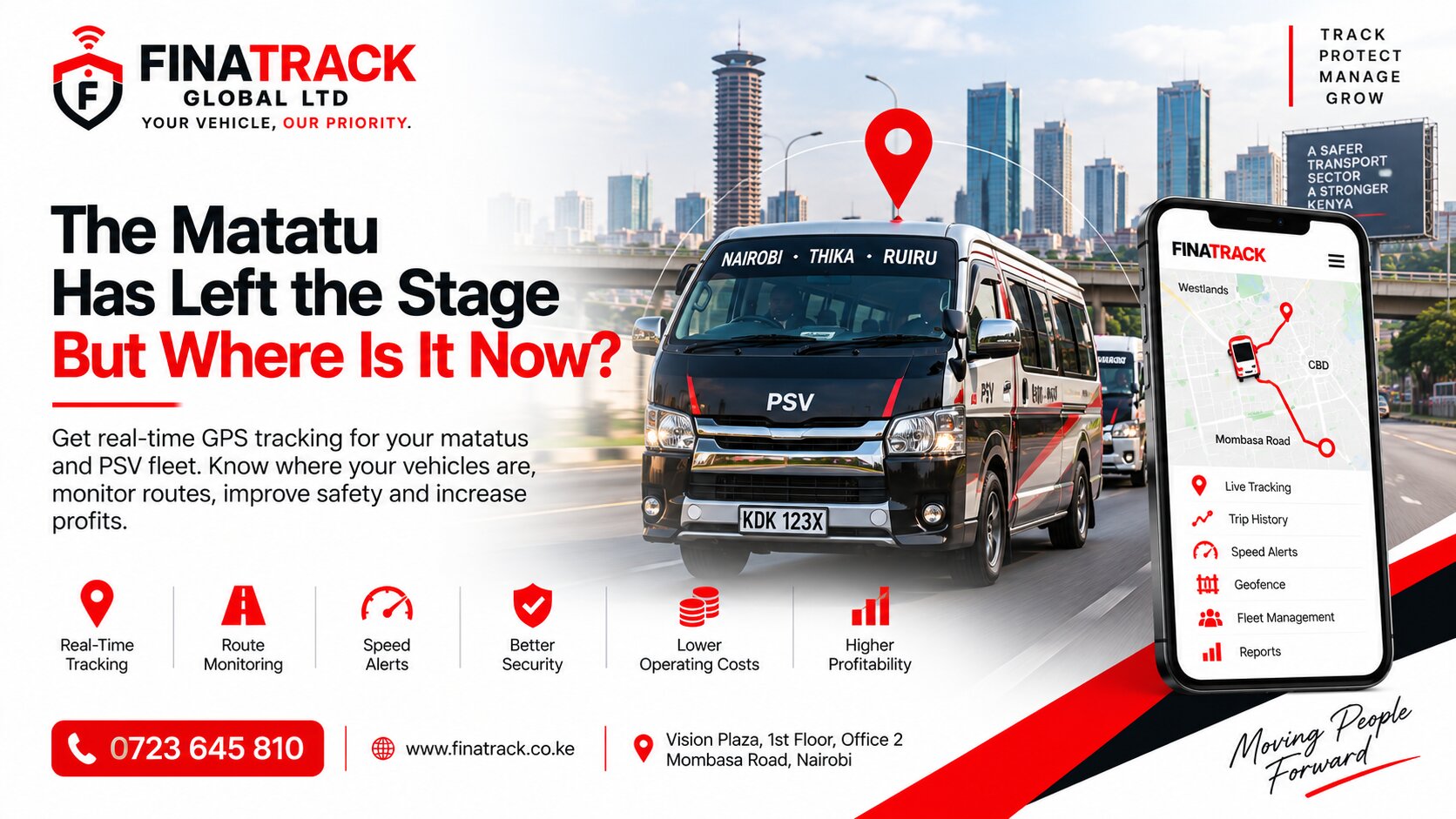
A matatu or other public service vehicle can leave the stage early in the morning and remain on the road for most of the day, sometimes travelling dozens of trips before returning to the owner. During those hours, the vehicle is generating revenue, consuming fuel, accumulating mileage and carrying passengers, yet the owner may have very little independent information about how it is actually being operated. For many Kenyan PSV operators, this gap between vehicle ownership and daily vehicle visibility creates unnecessary financial and security risk.
GPS tracking can help close that gap by giving authorised owners and managers access to vehicle location, trip history, mileage, selected speed information, geofencing and other operational records depending on the system installed. The objective is not simply to place a moving dot on a map. The greater value comes from understanding how the vehicle is being used throughout the working day and using that information to make better operating decisions.
A matatu owner may receive a call saying the vehicle is stuck in traffic, delayed at a stage or completing an additional trip before returning. Without independent information, management has little choice but to accept the explanation or begin calling other people for confirmation. GPS tracking gives the owner another source of information before deciding whether anything requires attention.
The first benefit is straightforward vehicle visibility. An authorised user can open the tracking platform and check the vehicle’s current or most recently reported location instead of calling the driver every time they need an update. This can be especially useful for owners managing several vehicles operating on different routes.
The last update time should always be considered together with the map position. A vehicle may appear at a particular location even though the tracker has not communicated for some time. Looking at the timestamp helps the owner distinguish a recent position from historical information.
For PSV operators, this becomes particularly useful when a vehicle is expected to have completed a route but has not returned. The owner can see whether the matatu is still moving along the expected corridor, parked for an unusually long period or operating somewhere entirely different. The information creates a starting point for investigation rather than leaving management dependent entirely on verbal explanations.
Trip history can provide even more value because owners do not need to watch the vehicle continuously. At the end of the day or week, the operator can review where the vehicle travelled and approximately how its movement compared with the expected route. Repeated patterns become much easier to recognise when several days of journeys can be viewed together.
This can help answer one of the most important questions in PSV management: Is the vehicle actually operating where it is supposed to operate? A route deviation may have a perfectly reasonable explanation, including traffic, road closures, police diversions or operational instructions. Repeated unexplained deviations, however, deserve closer attention.
A vehicle that consistently leaves its expected route may be accumulating additional mileage without generating corresponding value for the owner. The extra distance contributes to fuel consumption, tyre wear, servicing and depreciation. What appears to be a small daily detour can become a significant annual operating cost when repeated hundreds of times.
GPS information can therefore support route discipline without forcing drivers to follow one rigid road regardless of conditions. The purpose is understanding patterns and exceptions. Management should always consider traffic and operational context before treating a deviation as misuse.
Mileage is another important issue for matatu and PSV operators. Commercial passenger vehicles can cover substantial distance over relatively short periods because they operate many hours per day. Accurate mileage information therefore becomes important for maintenance, tyre planning and understanding how heavily each vehicle is being used.
Two similar matatus purchased around the same time can accumulate mileage at very different rates. One may operate longer shifts or complete more trips, while the other spends more time parked or undergoing repairs. GPS records can help management understand why one vehicle reaches maintenance intervals much sooner than another.
The kilometre reading on the dashboard remains important, but GPS history adds context. The odometer tells the owner how far the vehicle has travelled, while tracking information helps explain where those kilometres came from. Combining the two creates a much clearer operational record.
For owners operating several vehicles, mileage differences can reveal workload imbalance. One PSV may be working extremely hard while another similar vehicle is producing far fewer kilometres. Management should investigate whether that difference is commercially justified.
The higher mileage vehicle may simply be the stronger performer or operate on a busier route. Alternatively, one driver may be taking unnecessary journeys while another vehicle is underutilised. GPS tracking helps the owner distinguish productive movement from unexplained movement.
Maintenance planning becomes more important as mileage increases. A vehicle that is constantly on the road can reach its next service requirement much faster than management expects if records are not updated consistently. Relying on memory can result in vehicles remaining in service beyond sensible maintenance intervals.
GPS mileage records can support a more organised maintenance routine. The exact servicing schedule should still follow manufacturer recommendations and professional mechanical advice, but tracking gives management better information about how quickly the vehicle is accumulating distance. This makes it easier to plan workshop visits before breakdowns interrupt operations.
Breakdowns are particularly expensive for PSV operators because a vehicle in the garage is normally not producing revenue. The business may still face financing, insurance, driver and other fixed costs while the vehicle remains unavailable. Preventive maintenance therefore has a direct commercial value.
Vehicle downtime can also affect route operations and passengers. If one matatu repeatedly breaks down, another vehicle may have to carry additional workload or the operator may lose business while repairs are completed. Tracking data cannot diagnose mechanical problems, but it can help identify heavily used vehicles that deserve closer maintenance attention.
Speed is another area where GPS telematics can support PSV management. Depending on the tracking system, owners can review vehicle speed information and selected overspeed events. This creates an independent record that can support driver coaching and safer fleet management.
One overspeed event should not automatically be used to label a driver reckless. Road conditions, overtaking and tracker configuration should be considered, while the most useful information comes from repeated patterns. A vehicle that consistently records unusually high speeds deserves a much closer look than one isolated event.
The commercial pressure surrounding PSV operations can sometimes encourage drivers to rush. More trips may appear to mean more revenue, but excessive speed increases accident exposure, vehicle wear and the potential consequences of a serious collision. A short term attempt to complete another trip can create a much larger financial loss if the vehicle is involved in an accident.
Management should therefore use speed data to improve safety rather than simply punish drivers. A pattern of high speed may reveal an employee problem, but it can also indicate that schedules or revenue expectations are unrealistic. Fleet data works best when management investigates the reason behind the behaviour.
Harsh braking and acceleration information can provide additional context where supported by the installed telematics system. Kenyan PSV drivers operate in environments with heavy traffic, pedestrians, motorcycles and frequent changes in road conditions, so individual harsh events should be interpreted carefully. Patterns over many journeys provide more useful management information.
Passenger comfort also matters. Repeated aggressive acceleration and braking can create an unpleasant experience even where no accident occurs. A smoother driving style can support both safety and customer satisfaction.
AI dashcams can add another layer for operators seeking greater driver and road visibility. Depending on the system, driver monitoring can help identify signs of distraction or fatigue, while road facing video can provide valuable context around incidents. This can be particularly useful for vehicles operating long hours or early morning and late evening shifts.
Video telematics can also assist after an accident. GPS data may show the route and vehicle movement, while video can help management understand the surrounding road situation. The two sources should support an investigation rather than being treated as an automatic determination of fault.
Fuel represents another major operating cost for matatus and other PSVs. Owners may spend substantial amounts every day while depending heavily on drivers or receipts to explain consumption. GPS tracking can provide movement and mileage information that helps place those fuel expenses in context.
A vehicle that consumes more fuel may simply be covering more kilometres. The more useful question is whether the fuel increase matches actual vehicle activity. Comparing mileage, routes and stationary time can help management understand whether consumption appears reasonable.
Idling can also contribute to fuel expenditure. A matatu waiting at a stage, terminus or parking area may remain with the engine running for extended periods. Some idling may be operationally necessary, but repeated unnecessary engine time increases cost without adding mileage or passenger revenue.
Where ignition information is available, management can review periods when the vehicle remained stationary while the ignition was active. The purpose should be identifying patterns rather than treating every parked engine period as wrongdoing. Operational reality needs to be considered.
Dedicated fuel monitoring can provide deeper visibility for operators with larger vehicles or more demanding fuel-control requirements. Depending on the vehicle and installation, fuel level information can be reviewed alongside location and trip activity. This can help identify refilling patterns and unusual changes that require further investigation.
GPS tracking alone should not be presented as direct fuel measurement where no dedicated fuel sensor is installed. Its value lies in explaining how and where the vehicle moved. Fuel monitoring adds another layer where the operator needs more detailed control.
Another important area is unauthorised vehicle use. A PSV may complete its normal operations and then continue moving later than expected. The journey may be legitimate, but the owner should be able to establish whether it was authorised.
After-hours movement contributes to mileage, fuel, maintenance and accident exposure. If the vehicle is being used for private or unrelated journeys without the owner’s permission, the business bears much of the cost. Trip history can reveal these repeated patterns.
Clear rules should therefore exist before tracking data is used for accountability. Drivers and crews should understand where vehicles are expected to operate, where they should be parked after work and what additional journeys require approval. GPS tracking then supports rules that have already been communicated.
Geofencing can make this easier. The operator can create virtual boundaries around a yard, stage, route area or other important location depending on the platform. Entry or exit events can help management identify unusual vehicle movement without constantly watching the map.
A matatu expected to remain in a secure yard overnight should not normally leave at 2 a.m. without an authorised reason. A geofence or ignition event can provide an early reason to check what is happening. The same movement during normal operating hours would obviously have a completely different meaning.
This is why alerts need sensible configuration. If the system generates too many unnecessary notifications, the owner may eventually stop paying attention to all of them. The strongest setup focuses on events that genuinely require action.
Vehicle security itself remains one of the most important reasons for tracking a PSV. A matatu, shuttle or bus represents a significant business asset, and theft can eliminate the owner’s source of income immediately. A wired GPS tracker provides location visibility and selected security functions while operating normally.
For higher value vehicles, relying on one tracker alone may not provide the strongest security strategy. A primary wired tracker can be combined with an independent wireless tracker or tracking tag to provide additional recovery options if the first device loses power or is compromised. The appropriate level of protection depends on the value and risk of the vehicle.
An alarm or immobilisation system can create another layer. The alarm focuses on intrusion, while GPS provides remote visibility and an immobilisation function can make unauthorised vehicle operation more difficult when appropriately installed. Layered security reduces dependence on one device.
Remote immobilisation should always be used responsibly. An authorised operator should not attempt to stop a vehicle in circumstances where doing so could create an accident or endanger passengers and other road users. Security functions should support safe recovery procedures.
Passenger vehicles require even greater caution because people may be on board. Any remote control feature affecting the vehicle should be handled by authorised personnel who understand the system and its safety implications. Technology should never create a new risk while trying to solve another one.
GPS tracking can also help when a PSV breaks down away from the usual route. Drivers sometimes struggle to describe their exact location, particularly on unfamiliar roads or during regional trips. The latest GPS position can help the owner coordinate a mechanic, recovery truck or replacement vehicle more efficiently.
This can reduce downtime because assistance can be sent toward a more precise location. Passengers can also be transferred faster where another vehicle is available. Location visibility becomes an operational tool rather than only a theft-recovery feature.
For SACCOs and companies managing several vehicles, a central tracking platform creates additional value. Management can view multiple PSVs from one account rather than calling every driver individually. Vehicles can be compared according to movement, mileage and operational status.
This makes exceptions easier to identify. If twenty vehicles are operating normally while one remains parked in an unexpected location for several hours, management can focus attention on that unit. Fleet monitoring becomes more practical because the system highlights where questions need to be asked.
The same visibility can help identify underused vehicles. A fleet may contain units that travel considerably less than others while still creating insurance, maintenance and financing costs. Management can investigate whether those assets should be reallocated or whether there is a legitimate operational reason for their low utilisation.
High utilisation can reveal the opposite issue. A particular matatu may be accumulating mileage much faster than comparable units, increasing maintenance and replacement pressure. Redistributing workload where practical can reduce excessive wear.
The goal is not making every PSV perform exactly the same number of kilometres. Different routes naturally create different operating patterns. The objective is ensuring management understands why the differences exist.
GPS tracking can also strengthen communication between owners and drivers. Instead of every discussion becoming one person’s word against another, both sides can refer to trip information. A driver can demonstrate that a delay resulted from a genuine route change just as easily as management can identify unexplained movement.
This can actually improve trust when the technology is used fairly. Tracking should not be treated as a system designed only to catch drivers doing something wrong. It can also protect responsible employees from unfair accusations.
Drivers should therefore understand why the vehicles are tracked. Security, mileage control, maintenance, route management and safety are legitimate business purposes. Clear communication makes GPS tracking easier to integrate into day-to-day operations.
Access to the tracking platform should still be controlled. Not every driver or employee necessarily needs to see the location of every vehicle in the fleet. Vehicle movement data can reveal operating routes, parking locations and other sensitive business information.
Former employees should have access removed promptly when they leave. Shared administrator passwords should also be managed carefully because one set of credentials can provide visibility over valuable assets. Digital security is part of vehicle security.
For larger operators, assigning different access levels can improve control where the platform supports it. A route supervisor may only require visibility over certain vehicles, while senior fleet management can access the entire operation. Permissions should reflect actual responsibilities.
Tracker health itself deserves regular attention. A vehicle can continue operating and earning revenue even when the GPS device has stopped communicating. If nobody checks the last update time, the tracking failure may remain hidden for weeks.
A simple routine can prevent this problem. Management can review the tracking platform regularly and identify vehicles showing unusually old timestamps. Those units can then be checked before a security incident makes the problem urgent.
The tracker should also be inspected after battery replacement, dashboard work or significant electrical repairs. Mechanics may accidentally disturb aftermarket wiring without realising it. A short test drive after workshop work can confirm that the tracker is reporting normally again.
Ignition status should also be checked. If the platform shows ignition ON while the vehicle is parked or OFF while it is moving, wiring or configuration may need attention. Incorrect ignition information can distort other fleet reports.
Businesses relying on tracking for mileage and driver analysis should take data accuracy seriously. Poor information can create wrong management decisions. Professional installation and technical support are therefore as important as the physical tracking device.
A PSV operator should also consider the age of the tracker. Older devices can remain useful for years, but repeated offline events, weak backup batteries or outdated communication technology may eventually justify an upgrade. Replacement should be based on reliability rather than age alone.
Modern 4G tracking hardware can provide a stronger long-term communication platform where older equipment has become unreliable. The upgrade should still be professionally installed and configured because new hardware cannot compensate for poor wiring. Technology and workmanship need to function together.
The tracking platform should also be easy enough for management to use regularly. A complicated system that nobody understands provides limited operational value. Owners should know how to check the latest location, trip history, alerts and vehicle status confidently.
Training therefore matters. When a tracker is installed, the customer should be shown how to log in, identify whether the device is online and review recent journeys. Fleet operators should also know how to recognise unusual events and when technical support is required.
GPS information should not replace ordinary PSV management. Driver recruitment, vehicle maintenance, insurance, passenger service and financial controls remain essential. Tracking simply gives management better visibility over the physical asset around which many of those responsibilities revolve.
The strongest value comes when GPS data is combined with other business records. Mileage can be compared with maintenance, fuel with trips and vehicle utilisation with revenue. Management begins to understand not only where the vehicle went but whether its movement made commercial sense.
For example, one PSV may generate high mileage and high fuel expenditure but also produce consistently strong revenue. Another may use less fuel but spend significant time parked and generate relatively little income. Looking only at fuel cost would not reveal which asset is performing better.
The same idea applies to route decisions. A route requiring more kilometres may still be commercially attractive because passenger demand is stronger. GPS data provides the operating cost context while financial records provide the revenue side.
This is where telematics can move from basic tracking into real fleet management. The vehicle is no longer simply visible on a map. Management can begin using movement information to make decisions about routes, maintenance, drivers and asset utilisation.
Smaller matatu owners can benefit without complicated reports. Even one or two vehicles can be monitored for location, mileage and unusual movement. The owner gains greater visibility over an asset that may spend twelve or more hours away from direct supervision.
For larger SACCOs and PSV fleets, the benefit becomes even greater because the number of phone calls and manual reports required to understand fleet activity can reduce significantly. Managers can identify exceptions through one platform and concentrate their attention where it is genuinely needed.
Finatrack Global Ltd provides professionally installed GPS tracking and fleet telematics solutions for Kenyan PSV operators, matatu owners and organisations managing passenger transport vehicles. Depending on the selected system, operators can access real-time or recently reported location, trip history, mileage, geofencing, ignition information and selected driver behaviour alerts through a central monitoring platform.
Finatrack’s wired GPS tracker is available at KES 15,000, providing a permanent everyday tracking solution with vehicle monitoring functionality. PSV operators requiring additional security can also consider wireless backup tracking, tracking tags, advanced alarm systems and AI dashcams depending on the level of risk and operational visibility required.
Professional installation can be arranged at the customer’s convenient location or through Finatrack Global Ltd at Vision Plaza, 1st Floor, Office 2, Mombasa Road, Nairobi. Matatu owners, SACCOs and passenger transport businesses can contact 0723 645 810 or visit www.finatrack.co.ke for GPS tracking and fleet management solutions.
A PSV earns its money on the road, which means the owner cannot physically remain beside it throughout the working day. GPS tracking helps close that distance by providing independent information about where the vehicle is, how much it travels and whether its operation matches the expectations of the business. For Kenyan matatu and PSV operators, the real value is not simply knowing where the vehicle is today but using that visibility to protect the asset, manage drivers better and keep the vehicle productive for longer.