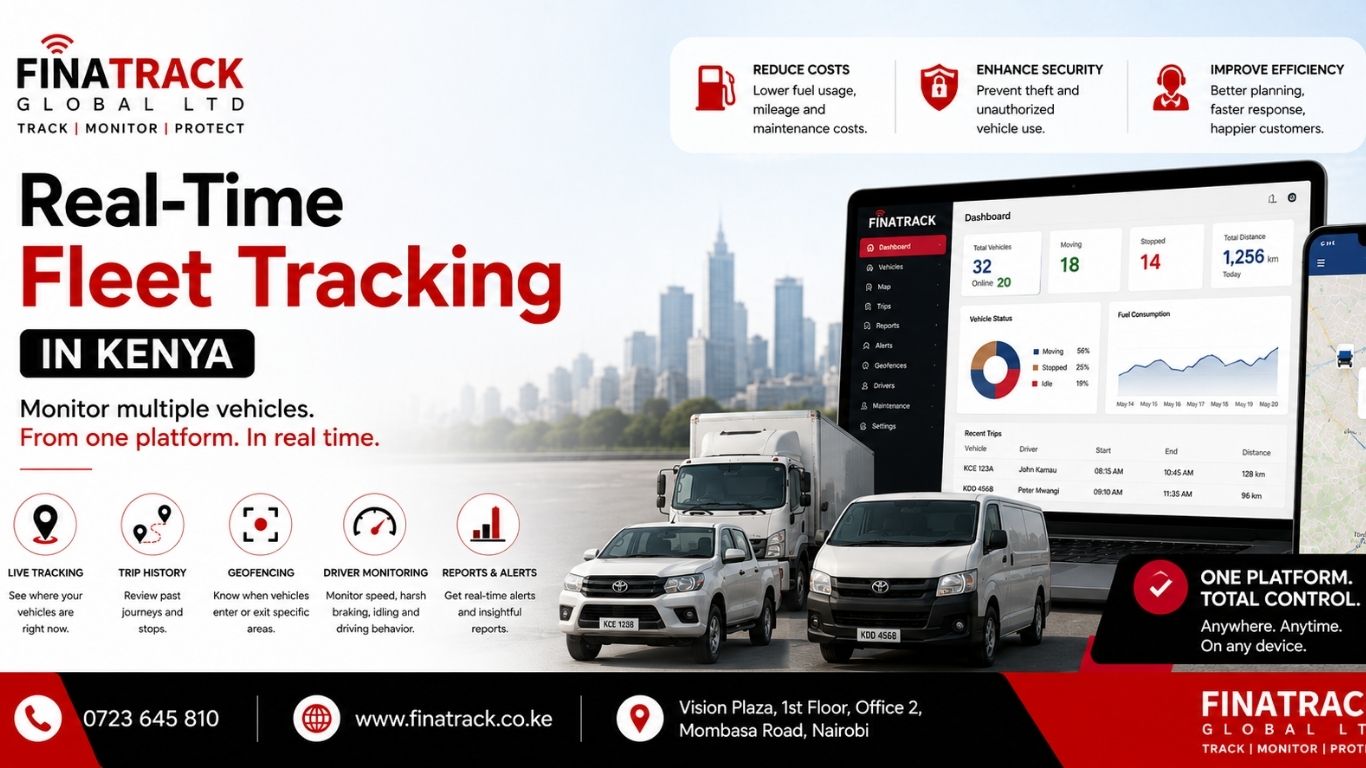
Managing one company vehicle is relatively straightforward because the owner usually knows who is driving it, where it is expected to go and when it should return. The challenge changes when a business operates ten, twenty or even fifty vehicles across different parts of Kenya. At that point, phone calls, WhatsApp messages and handwritten movement records can quickly become inefficient, making it difficult for management to maintain a clear picture of what is happening across the fleet.
Real-time fleet tracking gives businesses a central platform from which authorised managers can monitor multiple vehicles without contacting every driver individually. Instead of asking where each vehicle is, the fleet manager can open a web or mobile tracking platform and view the latest reported positions of vehicles in one place. This creates a much clearer operational picture for businesses whose vehicles spend most of the working day away from the office.
The technology is useful across many industries because fleets perform very different jobs but face similar management challenges. A logistics company may have trucks travelling between Nairobi, Nakuru and Mombasa, while a distributor may have vans delivering products across the city. A construction company may have pickups at several project sites, while another business may operate company cars used by sales representatives and field technicians.
When these vehicles are managed separately through calls and messages, information can become fragmented. One manager may know where three vehicles are while another employee has information about several others, leaving senior management without one reliable source of fleet visibility. A central tracking platform brings those vehicle movements together so that authorised users can see the fleet from one dashboard.
The most obvious benefit is live or recently reported vehicle location. A fleet manager can see which vehicles are moving, which are stationary and where each unit most recently communicated from. This can reduce routine communication with drivers while giving management faster access to information when something unusual happens.
The last update time is particularly important when interpreting this information. A vehicle icon may appear on the map even when the tracker has not communicated recently, which means the displayed position could be historical rather than current. A reliable fleet monitoring process should therefore consider both the location and the timestamp before management assumes that the vehicle is still at the position shown.
This becomes especially useful when customers ask where a delivery is. Without tracking, the dispatcher may need to call the driver, wait for an answer and then relay that information to the customer. With real-time fleet visibility, the dispatcher can check the vehicle’s position directly and provide a more informed update without unnecessarily interrupting the driver.
The same information can improve dispatching. If an urgent customer request comes in, management can identify which suitable vehicle is already closest to the location rather than automatically sending another vehicle from the office. This can reduce response time, unnecessary mileage and fuel expenditure while allowing the business to use vehicles already operating nearby.
Field service companies can benefit significantly from this approach. A technician may already be working a few kilometres from a new customer request, yet without fleet visibility the office may send another technician from much farther away. Real-time tracking helps management make dispatch decisions based on actual vehicle positions rather than assumptions.
Sales organisations can use the same principle. A customer requiring an urgent visit may be located near one of several representatives already working in the field. The sales manager can identify the nearest suitable vehicle and coordinate the next visit more efficiently, helping the business respond faster without adding unnecessary travel.
A central platform also makes it easier to monitor vehicles operating in different counties. A fleet manager based in Nairobi does not need separate tracking systems for vehicles in Nakuru, Kisumu or Mombasa if the platform has been structured correctly. Authorised users can view selected vehicles together even though those vehicles may be hundreds of kilometres apart.
Vehicle grouping becomes particularly important as a fleet grows. Businesses may want to organise vehicles according to branch, department, project, vehicle type or operational role so that managers are not forced to search through one long list every time they need information. A properly organised platform can make a large fleet easier to understand at a glance.
A company with sixty vehicles, for example, may have twenty assigned to logistics, fifteen to sales, ten to technical support and the remainder to management or field operations. Giving every manager unrestricted visibility over every vehicle can create unnecessary complexity. The fleet platform should therefore support an organised structure that reflects how the business actually operates.
Multi-user access can help achieve this. A fleet manager may require visibility over the entire fleet, while a branch manager may only need access to vehicles assigned to one region. Senior management may primarily need reports and summaries rather than constant access to every individual vehicle movement.
Controlling access also supports better information security. Fleet location data can reveal where valuable company assets are and how employees are operating them, so it should not be available to everyone without a legitimate business reason. Authorised access should reflect each employee’s operational responsibilities.
Trip history extends the value of the platform beyond live monitoring. Management can review where a vehicle travelled earlier in the day, where it stopped and how the journey developed over time. This becomes useful when investigating delays, customer complaints or unexplained vehicle movements.
Suppose a delivery was expected at a customer’s premises at 11 a.m., but the customer reports that the vehicle never arrived. The fleet manager can review the vehicle’s journey and determine whether it reached the area, what time it arrived and how long it remained there. GPS information does not prove that goods were handed over, but it gives management a factual starting point for investigating what happened.
Route monitoring can also reveal inefficiencies that are difficult to see through phone calls. A vehicle may repeatedly travel unnecessary distances because jobs are being assigned without considering geography. Reviewing journey patterns over time can help management reorganise schedules and reduce wasteful movement.
This is particularly relevant in Nairobi, where traffic conditions can significantly affect travel time. The shortest route on a map may not always be the fastest route during a particular period, so businesses should use tracking information alongside practical knowledge of road conditions. Historical journeys can help management understand which routes consistently create delays and which alternatives perform better.
Geofencing can provide another layer of fleet visibility. Virtual boundaries can be created around offices, warehouses, project sites, customer locations or other important areas, allowing management to monitor vehicle entry and exit activity depending on the system configuration. This reduces the need for someone to continuously watch every vehicle on the map.
A distribution company may create geofences around its warehouse and major customer locations. Management can then review when vehicles leave the depot and approximately when they reach important destinations. The information can support operational monitoring while giving dispatchers a clearer picture of how the day’s deliveries are progressing.
Construction companies can use geofences differently. A pickup or truck assigned to one project may be expected to remain around a defined operating area for most of the week. Repeated movement far outside that area can then be identified and reviewed before unnecessary mileage becomes part of normal operations.
Real-time fleet tracking can also improve vehicle security. A company vehicle that unexpectedly starts moving outside normal working hours can quickly be identified when the tracking platform is actively monitored or configured with appropriate alerts. Management can then verify whether the movement is authorised before deciding what action is required.
Ignition information can provide useful additional context. A vehicle expected to remain parked overnight should not normally show unexpected ignition activity unless there is a legitimate assignment, workshop activity or other approved reason. Combining ignition status with location and time gives management a clearer picture than relying on one event alone.
Power-disconnection alerts can provide another security signal where supported and configured. If a tracker’s external power suddenly disappears while the vehicle is parked, management may need to determine whether someone is carrying out legitimate electrical work or whether the security installation is being interfered with. The event itself provides information, while the surrounding circumstances determine its meaning.
Businesses should still avoid assuming every unusual tracker event represents theft or misuse. A vehicle may be moved by authorised staff, taken to a workshop or diverted because of an emergency. Real-time tracking provides evidence that something changed, but good fleet management still requires verification before conclusions are reached.
Driver monitoring can also be incorporated into the same platform depending on the telematics solution. Fleet managers may be able to review repeated overspeeding, harsh braking or acceleration across multiple vehicles. This makes it easier to identify patterns that would be difficult to recognise if every driver were managed separately.
The purpose of this information should be to improve road safety and operating discipline rather than create unnecessary conflict with drivers. One harsh-braking event may occur because another road user suddenly entered the vehicle’s path, particularly in busy Kenyan traffic. Repeated patterns across many journeys provide stronger evidence that driving behaviour may require coaching.
Fleet tracking can therefore support more consistent driver management. Instead of one supervisor applying strict standards while another ignores similar behaviour, businesses can establish fleet-wide expectations and use the same information across departments. This can create a more structured approach to speed management and vehicle safety.
AI dashcams can add further context where businesses require more advanced monitoring. GPS data can show where a vehicle was and how it was moving, while video can help explain what occurred during an accident or disputed road incident. Combining these systems can be particularly useful for logistics, staff transport and other fleets where road exposure is high.
Fuel management can also benefit from central fleet visibility. Even when a tracking system is not directly measuring fuel level, trip history and mileage provide useful information for comparing fuel expenditure with vehicle activity. A vehicle using significantly more fuel without a corresponding increase in mileage deserves investigation.
The explanation may involve congestion, mechanical condition, driver behaviour, unnecessary trips or excessive idling. Tracking does not automatically determine the cause, but it gives management enough operational context to begin a more focused investigation. For businesses requiring more detailed control, compatible fuel-monitoring equipment can provide additional information about refilling and fuel-level changes.
Idling can become easier to identify when several vehicles are viewed together. One driver may routinely leave the engine running for long periods, while similar vehicles on the same type of work spend much less time stationary with ignition active. Comparing vehicles helps management recognise which behaviour is normal for the operation and which deserves attention.
The same comparative approach can be applied to mileage. A company may discover that one vehicle consistently travels substantially farther than similar units assigned to the same department. The difference may result from workload, poor route allocation or unauthorised use, but the tracking platform gives managers the information needed to investigate.
Vehicle utilisation becomes increasingly important as fleets grow because underused assets still cost money. Insurance, depreciation and other ownership costs continue even when a vehicle spends most of the week parked. Real-time and historical tracking can help management understand which vehicles are heavily utilised and which are providing relatively little operational value.
This information can influence purchasing decisions. Before adding another vehicle to the fleet, management can review whether the existing fleet is genuinely operating near capacity. If some vehicles remain underused, better allocation may be more economical than purchasing additional assets.
The opposite finding can also justify investment. When trip records show that every vehicle is heavily utilised and operating schedules remain difficult to meet, management has stronger evidence that additional capacity is genuinely needed. Fleet tracking therefore supports both cost control and capital planning.
Maintenance planning can also benefit from central monitoring. Vehicles accumulate mileage at different rates, meaning two units purchased on the same day may reach their service intervals months apart. Tracking data can help fleet managers identify which vehicles are accumulating kilometres fastest and schedule maintenance accordingly.
Preventive maintenance becomes particularly important for companies whose vehicles operate continuously. A breakdown can interrupt deliveries, customer visits or field work while creating recovery and repair costs. Knowing the vehicle’s actual workload helps management reduce the risk of servicing based only on assumptions.
If a breakdown still occurs, real-time location can make the response more efficient. A driver may be unfamiliar with the exact road or location where the vehicle stopped, but the fleet manager can check the latest tracker position and direct a mechanic or recovery service accordingly. For larger fleets, management may also identify another nearby vehicle that can assist with the disrupted assignment.
The ability to see several vehicles together is particularly valuable during operational disruptions. A dispatcher can understand which resources are available, which vehicles are already committed and which units are closest to the problem. This makes the tracking platform part of daily decision-making rather than simply a theft-recovery tool.
Network coverage should nevertheless be understood when businesses depend on real-time information. A vehicle tracker usually determines its position through satellite signals but uses mobile connectivity to send that information to the tracking server. When mobile coverage becomes weak, the platform may temporarily stop receiving fresh updates even though the vehicle continues moving.
Depending on the tracker and configuration, journey records may be stored and transmitted when communication returns. Fleet managers should therefore understand the difference between a temporary communication gap and a tracker that has genuinely failed. A vehicle that repeatedly disappears along the same remote route and reconnects later presents a different situation from one that remains offline for several days in a normally well-covered area.
The tracking platform should make these differences easier to identify through last-update times and historical records. Managers should avoid treating every offline vehicle as a security emergency while also avoiding complacency when a tracker remains offline unexpectedly. Familiarity with normal fleet behaviour helps distinguish the two situations.
Businesses should periodically review tracker health across the fleet. A device can remain physically installed while no longer communicating, creating a false sense of security if nobody checks its status. Reviewing last-update times and recent journeys helps identify devices that require technical inspection.
This becomes particularly important after vehicle repairs. Battery replacement, dashboard work, alarm installation or other electrical procedures can unintentionally disturb tracker wiring. A vehicle may leave the workshop functioning perfectly while its tracking device remains disconnected.
A simple post-workshop check can prevent this problem from going unnoticed. Management should confirm that the tracker has returned online, that a fresh location is visible and that ignition information behaves normally where configured. A short test journey can provide further confirmation when necessary.
Professional installation is therefore a fundamental part of a reliable fleet tracking system. Secure wiring, suitable device placement and correct configuration help reduce intermittent faults that can undermine confidence in the platform. Fleet visibility is only as reliable as the hardware providing the information.
Technical support matters for the same reason. Businesses need a tracking provider that can help investigate devices that stop communicating, add new vehicles and support changes as the fleet develops. A fleet tracking system is an ongoing operational service rather than simply a one-time hardware purchase.
Ease of use should also influence the decision. A sophisticated platform becomes ineffective if fleet managers find it too complicated to use consistently. Routine tasks such as finding a vehicle, checking the last update and reviewing a journey should be straightforward.
Training helps ensure the platform becomes part of normal business operations. Managers should understand the meaning of online and offline status, ignition information, trip history and relevant alerts. They should also know which employees are responsible for responding when unusual activity occurs.
For a business operating five vehicles, real-time fleet tracking may primarily reduce phone calls and improve basic security. For an organisation managing fifty or more units, the same platform can become a central source of information for dispatch, driver supervision, maintenance planning, vehicle utilisation and operating-cost control.
The value therefore grows as businesses move beyond simply asking, “Where is the vehicle?” A well-managed platform can help answer broader questions about whether vehicles are being used efficiently, which units are closest to the next assignment, where delays are occurring and which parts of the fleet require management attention.
Finatrack Global Ltd provides professionally installed GPS tracking and fleet telematics solutions for Kenyan businesses operating multiple vehicles. Depending on the organisation’s requirements, solutions can include real-time vehicle tracking, trip history, geofencing, driver monitoring, fuel monitoring, AI dashcams and additional vehicle-security features.
Professional installation can be arranged at the customer’s convenient location or at Vision Plaza, 1st Floor, Office 2, Mombasa Road, Nairobi. Businesses seeking greater visibility over multiple vehicles can contact Finatrack Global Ltd on 0723 645 810 or visit www.finatrack.co.ke to discuss a fleet tracking solution suited to their operations.
Managing several vehicles should not require spending the entire day calling drivers to ask where they are. A well-implemented real-time fleet tracking system gives management one central view of vehicle activity, helping the business coordinate resources more efficiently, respond faster to customers and maintain stronger control as the fleet grows.