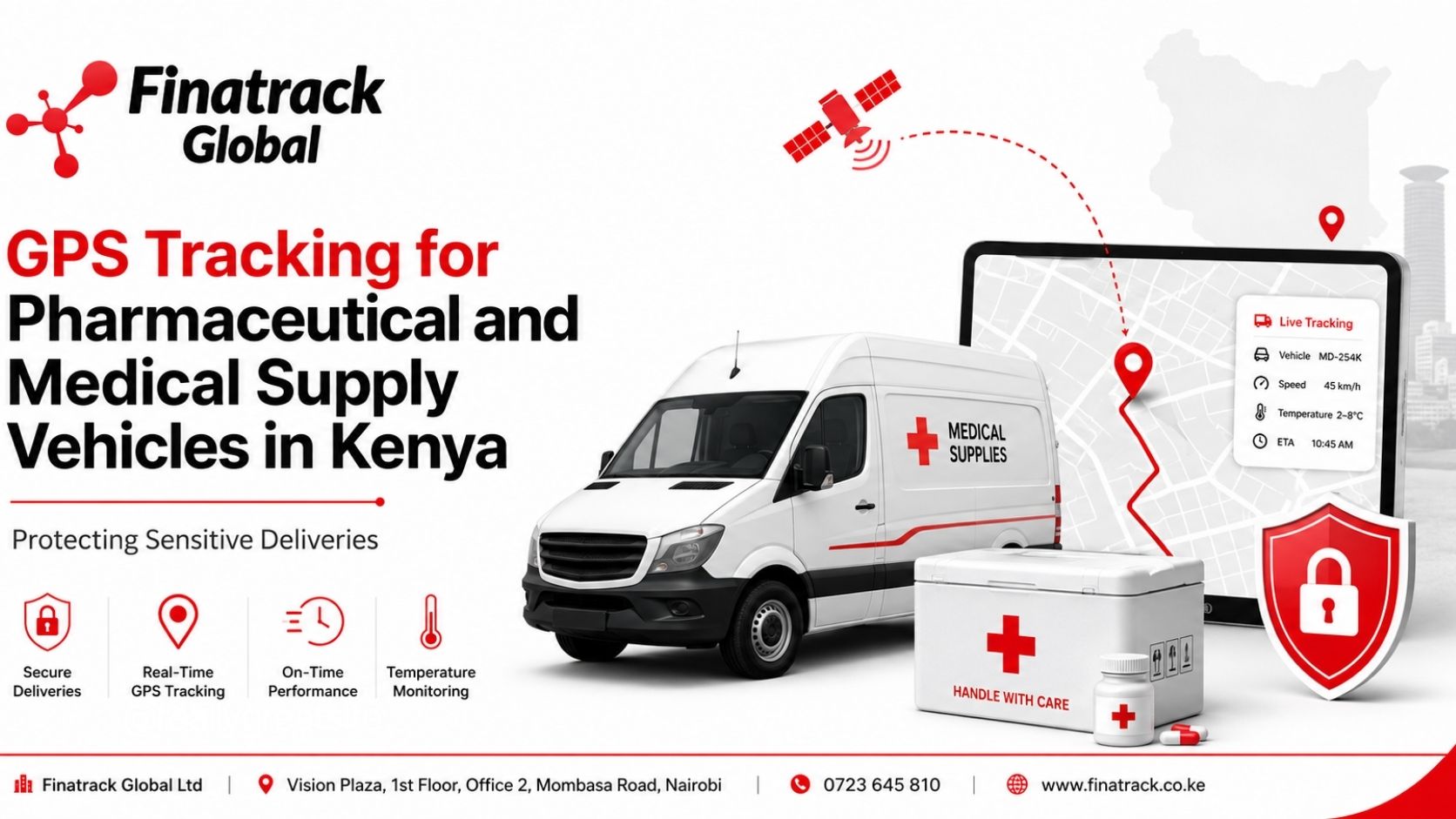
Transporting medicines, vaccines, laboratory supplies and other medical products is very different from moving ordinary cargo. A delayed delivery can affect hospital operations, a vehicle breakdown can interrupt an urgent supply route and an unexplained detour can create concern when the cargo is valuable or time-sensitive. For pharmaceutical distributors, hospitals, laboratories and medical suppliers, visibility over delivery vehicles is therefore becoming an important part of transport management.
GPS tracking gives authorised managers a clearer view of where medical supply vehicles are, where they have travelled and whether deliveries are progressing as expected. Instead of depending entirely on calls from drivers, a company can monitor vehicle movement through a tracking platform and respond more quickly when something unusual occurs.
This can be particularly useful for businesses supplying hospitals and pharmacies across Nairobi and other counties. A van may begin the morning with deliveries to several facilities, then continue to another town before returning to the warehouse. Once the vehicle leaves the distribution centre, management needs a practical way to understand whether it is following the planned route and whether delays are beginning to affect the day’s schedule.
Live location provides the first layer of visibility. A dispatcher can see whether the vehicle has left the warehouse, which part of the route it has reached and whether it appears to be approaching the next delivery location. This reduces the need to repeatedly call the driver for routine updates.
The value becomes greater when several vehicles are operating at the same time. A medical distributor may have one van serving hospitals along Mombasa Road, another covering Westlands and surrounding areas and another making deliveries outside Nairobi. A central tracking platform allows management to view those vehicles together rather than coordinating every journey through individual phone calls.
Route planning can also improve when businesses have accurate trip history. A vehicle that consistently takes longer than expected to complete a particular delivery area may be facing congestion, inefficient sequencing or too many stops. Management can review the actual journey rather than assuming the driver is simply slow.
This information can help businesses redesign routes over time. Deliveries to facilities located close together may be grouped more efficiently, while routes that regularly experience heavy congestion can be scheduled earlier or reorganised. The objective is not only to shorten journeys but also to make arrival times more predictable.
For healthcare supply chains, predictability matters. A hospital expecting essential supplies needs to know whether a delay is likely to be ten minutes or several hours. The supplier may not always provide customers with direct access to vehicle tracking, but the dispatch team can use location information to give more accurate delivery updates.
Trip history can also help when a customer disputes whether a delivery vehicle reached a particular facility. GPS records can show whether the vehicle travelled to the location and approximately when it arrived. This can provide useful operational evidence while the company checks delivery notes, signatures and other records.
GPS location should not be treated as proof that the goods were handed over correctly. A vehicle can arrive outside a hospital without completing the delivery. The strongest delivery process combines tracking information with signed documentation, electronic proof of delivery or other appropriate confirmation.
This distinction is particularly important for pharmaceutical and medical businesses because product accountability can be sensitive. Tracking tells management where the vehicle was. Inventory and delivery records confirm what was actually handed over.
Security is another major reason to monitor medical supply vehicles. Some pharmaceutical products and medical equipment can be valuable, making delivery vehicles attractive targets for theft. Even where the individual items are not extremely expensive, losing a full consignment can create significant financial and operational disruption.
GPS tracking allows the business to maintain visibility if a vehicle moves unexpectedly or deviates substantially from the planned route. The last reported position can also become useful if communication with the driver suddenly stops.
An unexpected deviation does not automatically mean theft or misuse. A driver may be avoiding traffic, following police directions, looking for a customer entrance or responding to roadworks. Tracking allows management to identify the deviation and ask for an explanation rather than discovering it much later.
Repeated unexplained route changes deserve more attention. If the same vehicle regularly leaves the approved delivery area or makes long stops at unrelated locations, management has information that can support further investigation.
Geofencing can help automate some of this oversight. A virtual boundary can be created around a warehouse, hospital, distribution point or other important location. Depending on the tracking system, management can identify when a vehicle enters or leaves those areas.
This can help a dispatcher understand when vehicles depart from the warehouse in the morning and when they return at the end of the day. It can also provide a useful record of visits to frequently served medical facilities.
For businesses making deliveries to remote hospitals or health centres, network coverage becomes an important consideration. The tracker may temporarily stop updating live when mobile communication becomes weak, even though the device can still be operating. Depending on the equipment and configuration, journey records may be stored and uploaded when connectivity returns.
This means dispatch teams should understand the difference between a predictable communication gap and an unusual tracker outage. If several vehicles consistently lose connectivity along the same rural route and later return online, the issue may simply be network coverage.
A vehicle that unexpectedly goes offline in an area where it normally reports reliably deserves a different response. Management may need to check the vehicle’s power supply, tracker status, SIM connectivity or installation.
Cold-chain transport creates an additional challenge for some pharmaceutical and medical suppliers. Vaccines and certain medicines may require controlled temperatures throughout transportation. GPS tracking by itself does not measure cargo temperature unless the solution has been integrated with suitable sensors.
Where temperature monitoring is required, businesses should use the appropriate cold-chain equipment rather than assuming a location tracker alone can verify product conditions. The GPS system can show where the vehicle travelled while compatible temperature-monitoring equipment can provide information about the conditions inside the cargo area.
Combining those systems can provide a more complete picture. Management can see where the vehicle was when a temperature event occurred and investigate whether the problem coincided with a long stop, equipment failure or another operational issue.
The same principle applies to refrigerated medical deliveries. Knowing that the van reached its destination is useful, but knowing whether the refrigeration system maintained the required conditions throughout the journey may be equally important.
Vehicle breakdowns can create serious disruption in this environment. A van carrying ordinary consumer goods may be delayed with limited consequences beyond customer inconvenience. A medical supply vehicle may be carrying products needed for scheduled procedures, laboratory work or urgent patient care.
GPS tracking can help the company identify exactly where the vehicle has stopped. A mechanic, recovery vehicle or replacement delivery van can then be sent to the reported location without relying entirely on verbal directions from the driver.
For a business with several delivery vehicles, the dispatcher may also be able to identify the nearest available unit. Depending on cargo compatibility, capacity and operational requirements, another vehicle could potentially assist with the delivery.
Faster response can reduce the amount of time products remain stranded on the roadside. This becomes particularly important where temperature-sensitive goods are involved.
Maintenance planning can therefore become part of delivery reliability. Medical supply vehicles may cover substantial daily mileage, especially where distributors serve customers across several counties. Servicing vehicles according to assumptions rather than actual usage can increase the risk of breakdowns.
GPS mileage and trip records can help fleet managers understand which vehicles are travelling the greatest distances. A van covering long regional routes will reach maintenance intervals much faster than another used mainly for shorter urban deliveries.
Preventive maintenance protects both the vehicle and the delivery schedule. A well-maintained van is less likely to interrupt a route carrying products that customers are expecting at a specific time.
Driver behaviour also matters. Medical supply drivers may work under pressure when delays accumulate or several deliveries remain outstanding. That pressure should not translate into unsafe speeding or aggressive driving.
GPS telematics can help management identify repeated overspeeding, harsh acceleration or braking depending on the tracking solution installed. The objective should be to identify patterns and improve driver behaviour rather than punish employees automatically for isolated events.
Traffic conditions must always be considered. A driver may brake suddenly because a pedestrian crosses the road or another vehicle cuts into the lane. Repeated aggressive events across many journeys provide stronger information than one exceptional incident.
Safer driving can also protect the cargo. Sudden braking and harsh manoeuvres can cause packages to shift inside the vehicle, especially where medical equipment or fragile laboratory supplies are being transported.
Fleet managers can therefore use driver information as part of both road-safety and cargo-protection programmes. A smooth, professionally driven vehicle creates less risk for employees, other road users and the goods being carried.
AI dashcams can provide additional context where businesses require advanced monitoring. Video telematics can help investigate accidents or disputed road incidents and can support driver-safety programmes when properly implemented.
The combination of GPS and video can be particularly useful after an incident. Location and speed data may show where the event occurred, while video can provide additional context about what happened on the road.
Businesses should nevertheless use tracking and video responsibly. Drivers should understand the legitimate operational reasons for monitoring, including safety, vehicle security, route management and protection of valuable cargo. Access to tracking information should remain limited to authorised staff.
After-hours vehicle use also deserves attention. A medical delivery van may be expected to return to a warehouse or approved parking area after completing its route. If it begins travelling again late at night without authorisation, the business should be able to identify that activity.
Trip history can show whether additional journeys occurred after working hours. Ignition alerts and geofences can provide additional information depending on how the system is configured.
Again, unusual activity should be verified before conclusions are drawn. Emergency deliveries, hospital requests or authorised maintenance may explain late-night movements. Tracking provides the information needed to begin that verification.
For companies carrying high-value medical equipment or pharmaceutical stock, layered vehicle security may be appropriate. A wired GPS tracker can provide primary location and vehicle information while a backup wireless tracker or tracking tag provides an additional location source if the main device is interfered with.
Vehicle alarms and immobilisation systems can provide further layers depending on the type of vehicle and operating environment. The objective is to make it more difficult for one act of tampering to remove every security measure at once.
Remote immobilisation, where installed, should always be used according to safe operating procedures. A company should never create additional road danger by attempting to stop a vehicle in an unsafe manner.
If theft is suspected, tracking information should support appropriate security and law-enforcement response procedures. Employees should not be instructed to personally confront suspected criminals simply because the vehicle’s location is visible on a screen.
Fuel management is another important cost for medical distribution fleets. Delivery vehicles often spend much of the day moving between customers, and small inefficiencies can become expensive when repeated across several vans.
Trip records can help businesses compare fuel expenditure with actual distance travelled. If fuel costs rise substantially while mileage remains relatively unchanged, management has a reason to investigate.
The cause may involve traffic, mechanical problems, excessive idling, route inefficiency or driver behaviour. Tracking data provides context before management decides what is responsible.
For suitable commercial vehicles, dedicated fuel monitoring can provide further visibility. The business may be able to compare refilling activity and fuel-level changes with actual vehicle movement depending on the system installed.
This can be useful for larger distributors running trucks or vans over long regional routes. Fuel receipts remain necessary for accounting, but vehicle data can help show whether consumption patterns match the work being performed.
Idling deserves particular attention in urban delivery fleets. A vehicle may remain running outside a hospital while staff wait for documents, loading or access clearance. Some waiting is unavoidable, but excessive engine idling consumes fuel without moving the vehicle closer to the next customer.
Tracking data can help identify where long stationary periods occur. Management can then determine whether those stops are part of normal delivery procedures or whether operational changes could reduce them.
Vehicle utilisation can also be reviewed. One medical delivery van may be completing significantly more trips than another vehicle in the same fleet. The difference may come from customer locations, capacity, route allocation or vehicle downtime.
GPS records can show how much each vehicle is actually being used. This can support decisions about fleet allocation and whether the business genuinely requires additional vehicles as its distribution network grows.
A company considering buying another van may discover that one existing vehicle is underutilised because routes are poorly allocated. Another business may find that every vehicle is operating intensively, providing stronger evidence that fleet expansion is justified.
Tracking data does not replace commercial judgment, but it gives management more reliable information on which to base that judgment.
For pharmaceutical companies working with third-party transporters, GPS visibility can also be valuable where appropriate arrangements exist. The supplier may need confirmation that goods are moving towards the intended destination rather than relying entirely on estimated arrival times.
Where third-party tracking data is shared, responsibilities and access should be clearly agreed. Businesses should avoid creating unclear monitoring arrangements in which several organisations access vehicle information without defined operational reasons.
Internal procedures matter just as much as the technology. A fleet manager receiving an unusual route or security alert should know who to contact and what steps to follow. The driver, dispatch supervisor and security team should each understand their responsibilities.
This is particularly important in healthcare supply chains where unnecessary delays can have consequences beyond the transport department. Escalation procedures should therefore be clear before an incident occurs.
The tracking platform itself should be checked regularly. A tracker that has remained offline for weeks provides little value even if nobody has physically removed it from the vehicle.
Fleet managers can periodically review the last update times of delivery vehicles and identify units that have stopped communicating. Technical problems can then be corrected before the vehicle is urgently needed.
Trackers should also be checked after battery replacement, dashboard work or other significant electrical repairs. A mechanic can unintentionally interfere with tracking wiring while carrying out unrelated work.
Before the vehicle returns to delivery duties, management should confirm that its location and ignition status are reporting normally. A brief check can prevent a serious information gap later.
Professional installation is therefore essential. Medical distribution vehicles may operate every working day, and intermittent tracking faults quickly undermine confidence in the system.
The device should be securely powered, discreetly installed and tested before the vehicle returns to service. Managers should also understand how to use the platform rather than depending entirely on the installer.
A good handover should show users how to check current location, trip history, ignition status and important alerts. The company should also know who to contact when a device behaves unusually.
For a small pharmacy distributor operating two vans, GPS tracking may mainly provide security and delivery visibility. For a large pharmaceutical business operating a national distribution fleet, it can become part of a much wider transport-management system.
The underlying objective remains the same. Management needs to know where valuable and sometimes time-sensitive products are while they are on the road.
GPS tracking cannot guarantee that a medicine arrives in perfect condition, that every delivery is completed correctly or that every route will avoid delays. It provides reliable vehicle information that helps the organisation manage those risks more effectively.
When combined with proper cold-chain controls, delivery documentation, maintenance, driver management and security procedures, that visibility can strengthen the entire distribution operation.
Finatrack Global Ltd provides professionally installed GPS tracking, fleet telematics, fuel monitoring, AI dashcam and vehicle-security solutions for pharmaceutical distributors, hospitals, laboratories, medical suppliers and other businesses operating delivery fleets in Kenya.
Professional installation can be arranged at the customer’s convenient location or at Vision Plaza, 1st Floor, Office 2, Mombasa Road, Nairobi. Businesses seeking better visibility over pharmaceutical and medical supply vehicles can contact Finatrack Global Ltd on 0723 645 810 or visit www.finatrack.co.ke.
When a medical delivery vehicle leaves the warehouse, management should not have to lose sight of the journey.
GPS tracking helps keep that journey visible until the vehicle reaches its destination and returns.