Choosing a GPS tracker is not only about price. Vehicle owners also need to think about how the device is powered, how it will be installed, whether it needs to be moved between vehicles and what level of security or convenience they want. Two of the most common options are wired GPS trackers and wireless GPS trackers, and while both can help you monitor a vehicle’s location, they are designed for different use cases.
For many motorists in Kenya, the decision usually comes down to permanence versus flexibility. A wired tracker is installed directly into the vehicle and is suitable for long-term monitoring, while a wireless tracker can be moved more easily and does not require permanent wiring into the vehicle. Neither option is automatically better in every situation. The right choice depends on how the vehicle is used, how often you want to move the tracking device and what kind of security setup you prefer.
What Is a Wired GPS Tracker?
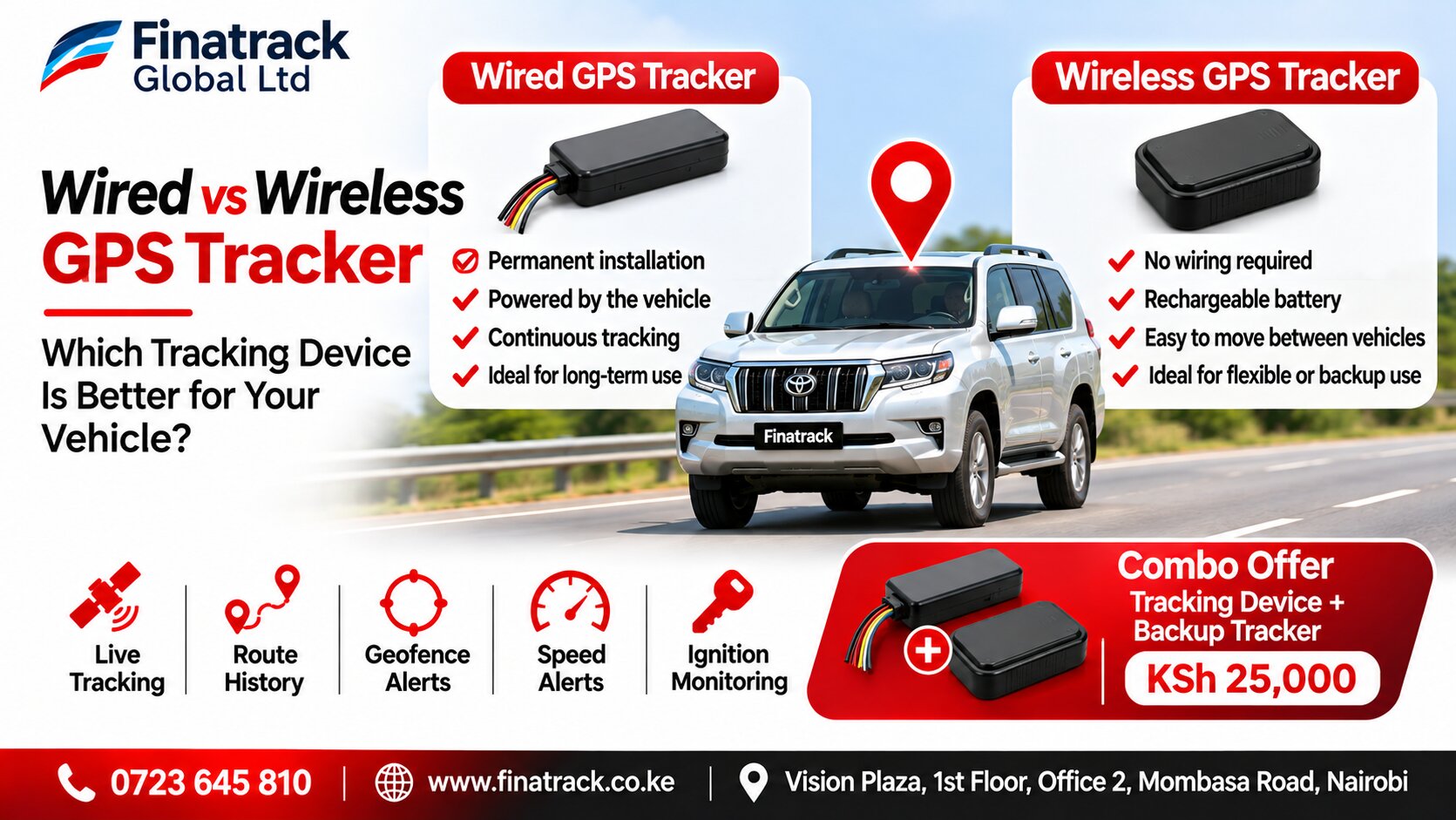
A wired GPS tracker is installed directly into the vehicle and connected to its electrical system. Because it draws power from the vehicle, the user does not need to keep removing it for regular charging in the same way they would with a battery-powered tracker. Once professionally installed, the device can remain hidden inside the vehicle and provide continuous monitoring as long as the vehicle and tracking system are functioning normally.
This type of tracker is well suited to private motorists who want a permanent security solution, as well as businesses that manage company vehicles over long periods. Depending on the system, features may include live location tracking, route history, geofence alerts, speed alerts, ignition status and other vehicle monitoring functions. Because the device is fixed to one vehicle, it is also easier to build consistent tracking records around that particular car, van, truck or motorcycle.
What Is a Wireless GPS Tracker?
A wireless GPS tracker is designed to operate without permanent wiring into the vehicle. In many cases, it uses an internal rechargeable battery and can be placed discreetly in the vehicle or moved from one vehicle to another. This makes it attractive to users who want flexibility or who do not want to modify the vehicle’s wiring.
The main advantage of a wireless tracker is portability. If you operate several vehicles but only need to monitor one of them at a time, a wireless unit can be transferred more easily. It can also be useful as a secondary or backup tracker because it can operate independently from the vehicle’s main electrical system. However, because it depends on its own battery, it needs regular charging and monitoring to ensure it remains active.
Which One Is Better for Long-Term Vehicle Security?
For long-term security, a wired tracker is often the more practical primary option because it is permanently installed and continuously powered by the vehicle. This makes it suitable for drivers who want a device to remain in one car without having to think about frequent charging. A discreet professional installation can also make the tracker harder to identify than a device that is simply placed somewhere inside the vehicle.
That said, the strongest setup may not always be one device or the other. Some vehicle owners combine a wired tracker with a wireless backup tracker so that they have two independent tracking layers. The wired tracker handles normal day-to-day tracking, while the wireless device can provide redundancy if the primary tracker is disconnected or discovered.
For high-value vehicles or motorists particularly concerned about theft, this layered approach can be more effective than choosing only one tracker.
Which One Is Better for Flexibility?
A wireless tracker is usually better when flexibility matters most. Because it is not permanently wired into one vehicle, it can be moved between cars, used temporarily or placed in a vehicle only when needed. This can be useful for businesses with changing vehicle assignments, car rental operations, contractors or anyone who does not want a permanent installation.
The trade-off is battery management. A wireless tracker can only work effectively if it has enough charge. If the battery runs flat, the tracker may stop reporting its location, which defeats the purpose of having it. Users therefore need to build charging into their routine and understand the expected battery life of the specific device.
A wired tracker, by contrast, requires less day-to-day attention because its power comes from the vehicle. Once installed, it is generally more convenient for continuous use.
Which One Is Better for Monitoring Company Vehicles?
For most businesses with vehicles assigned permanently to staff, a wired tracker is usually the more practical choice. It gives management a stable tracking record for each vehicle and can support features such as route history, geofencing, speed monitoring and ignition status. These features are useful for logistics companies, sales teams, contractors, staff transport operations and other businesses that need to understand how company vehicles are being used.
A wireless tracker can still be useful in a commercial environment, especially where vehicles change frequently or where the company wants a secondary tracking device. It may also be useful for temporary projects where a business only needs tracking for a limited period.
The important question is whether the company needs a permanent vehicle management system or a flexible tracking device that can be moved around. That distinction often makes the decision much easier.
Which One Is Better as a Backup Tracker?
A wireless tracker is often well suited to the backup role because it operates independently from the main vehicle wiring. If the primary wired tracker is disconnected, the backup device may continue reporting as long as it has power and network connectivity.
This separation is valuable because a backup tracker should not depend on exactly the same systems as the main tracker. If both devices rely on the same power source and are installed in the same location, the benefit of redundancy is reduced.
For motorists who want stronger layered security, a wired primary tracker combined with a discreet wireless backup device can provide a more resilient setup.
Installation Makes a Big Difference
The effectiveness of a GPS tracker is influenced by more than just whether it is wired or wireless. Installation quality also matters. A poorly installed wired tracker may be easier to discover or may develop electrical problems, while a wireless tracker placed carelessly may have poor signal or be found quickly.
Professional installation helps ensure that the device is positioned discreetly, receives good GPS reception and is set up correctly. For wired units, proper installation also reduces the risk of electrical faults. For wireless units, users should be advised where the device can be placed without blocking its signal or exposing it unnecessarily.
The tracker should be easy enough to maintain but not so obvious that anyone accessing the vehicle can immediately find it.
What About Network Coverage?
Both wired and wireless GPS trackers generally rely on GPS signals for location and mobile network connectivity for transmitting that data to the tracking platform. This means that either type can experience delays in reporting when the vehicle enters an area with poor network coverage.
The difference between the two is mainly how they are powered and installed, not how GPS itself works. Some trackers can store location information and upload it later when the network becomes available again, but exact behaviour depends on the device and platform.
Vehicle owners should therefore ask how the tracker performs in areas with weak connectivity and what happens to location records during temporary network loss.
Which Tracker Is Better for Private Cars?
For most private car owners who want permanent, everyday security, a wired tracker is usually the simpler long-term solution. It can remain installed in the vehicle without regular charging and provides a consistent tracking record. It is particularly useful for motorists who want to monitor the car continuously and access features such as route history and geofence alerts.
A wireless tracker may be more attractive to someone who wants portability, temporary use or an additional backup device. It can also appeal to vehicle owners who do not want permanent wiring modifications.
The best option therefore depends on whether you value convenience and permanence more than portability and flexibility.
Finatrack Wired and Wireless GPS Tracking Solutions
Finatrack Global Ltd provides both wired and wireless GPS tracking solutions for vehicle owners and businesses in Kenya. Our wired tracker is designed for long-term vehicle monitoring, while our wireless or magnetic tracker offers greater flexibility and can also be used as an additional tracking layer.
The Finatrack Wired GPS Tracker is available at KSh 15,000 one-off with no annual subscription, or customers can choose KSh 10,000 installation plus KSh 3,000 annual subscription. The Wireless/Magnetic Tracker is available at KSh 15,000.
For customers who want stronger layered security, Finatrack also offers a Tracking Device + Backup Tracker Combo at KSh 25,000.
So, Which One Should You Choose?
If you want a permanent tracker for one vehicle and prefer not to worry about charging, a wired GPS tracker is usually the better choice. If you want flexibility, portability or a secondary tracking device, a wireless tracker may suit you better.
For many vehicle owners, the most effective answer is not choosing one and rejecting the other. A wired tracker can serve as the main monitoring system, while a wireless unit can provide additional backup security.
For installation or enquiries, contact Finatrack Global Ltd on 0723 645 810, visit www.finatrack.co.ke, or visit our office at Vision Plaza, 1st Floor, Office 2, Mombasa Road, Nairobi.
The right tracker is the one that fits how you use your vehicle, how much flexibility you need and how much security redundancy you want.