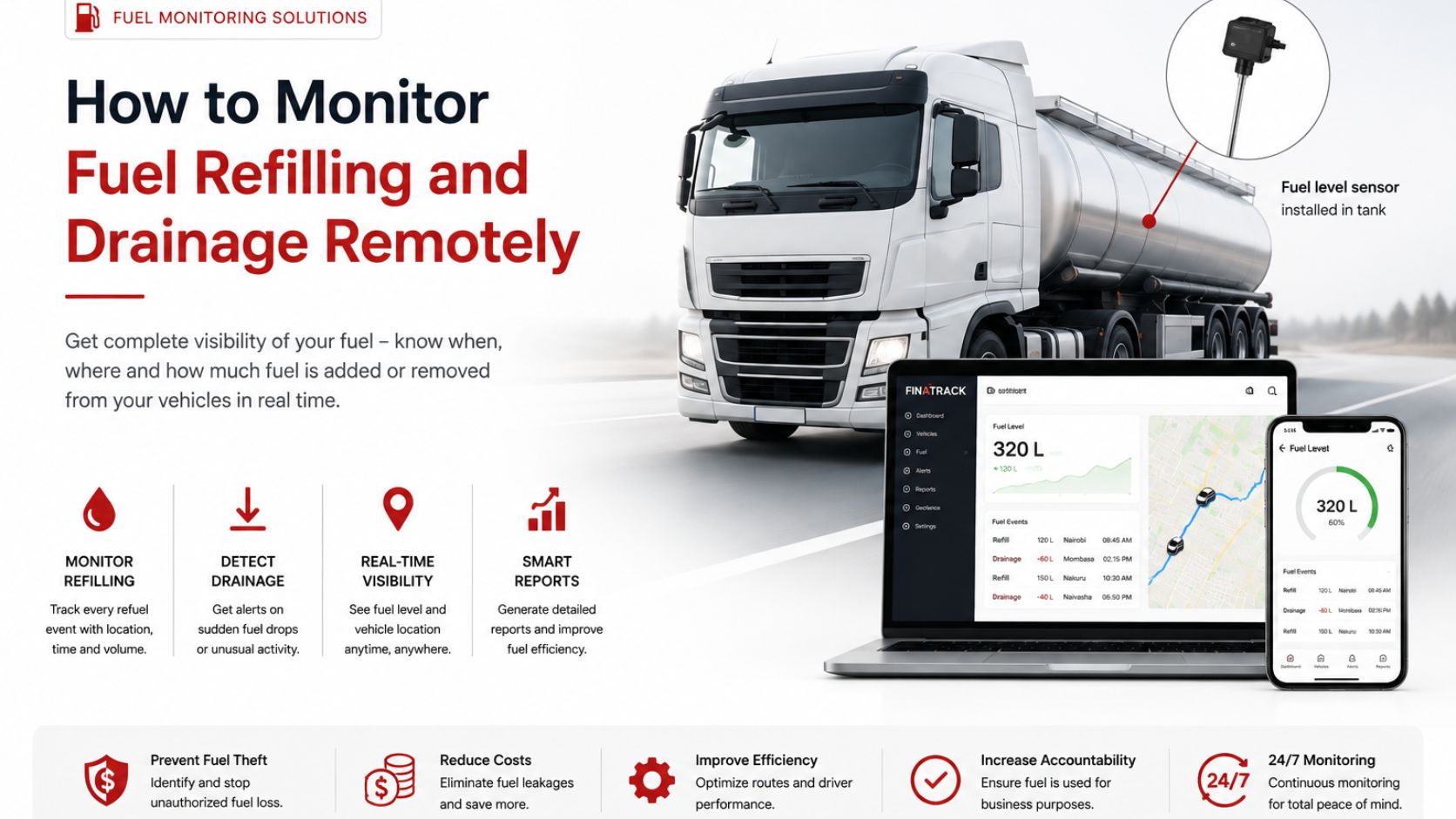
Fuel is one of the largest operating costs for many transport and logistics businesses, yet it is also one of the expenses that can be hardest to control. A company may know how much fuel was purchased, how much money was issued to a driver and how many kilometres a vehicle covered, but that does not always explain what actually happened inside the fuel tank. Remote fuel monitoring helps close that gap by giving fleet managers a clearer view of refilling, consumption and unusual fuel loss.
A modern fuel monitoring system typically combines a fuel level sensor with GPS tracking and an online fleet management platform. The sensor measures changes in the level of fuel inside the tank, while the GPS system records where the vehicle is and when the change occurred. This allows management to review fuel activity without physically inspecting the vehicle every time it is refuelled.
The ability to monitor refilling remotely can improve accountability considerably. When fuel is added to a vehicle, the level inside the tank should rise. A properly calibrated system can record that increase and associate it with the location and time of the event, giving management another source of information alongside fuel receipts and driver records.
This can be particularly useful for transport businesses whose vehicles refuel at different stations across Kenya. A fleet manager does not need to accompany every truck or delivery vehicle to the fuel station. Instead, the tracking platform can be used to review whether a significant increase in fuel level occurred around the time and location reported by the driver.
The system should not be treated as a replacement for receipts, fuel cards or normal accounting controls. It works best as an additional source of evidence. A receipt shows what was paid for, while the fuel monitoring system helps show what happened to the level inside the tank.
Remote monitoring becomes even more valuable when fuel drainage is suspected. A sudden drop in fuel level while the vehicle is parked or operating under unusual circumstances may indicate that fuel has been removed. The system can flag such an event for investigation, allowing management to review where the vehicle was and what was happening at the time.
Not every reduction in fuel level should automatically be treated as theft. Fuel naturally decreases as a vehicle is driven, and readings can also be affected by tank shape, road gradient, vehicle movement and sensor calibration. The value of the system comes from identifying unusual patterns rather than assuming every change represents wrongdoing.
This is why proper calibration is critical. Commercial vehicle fuel tanks are not always simple rectangular containers. Some have irregular shapes, internal sections or dimensions that affect the relationship between fuel height and actual volume. A sensor reading therefore needs to be calibrated against known fuel quantities if the business expects reliable volume estimates.
Poor calibration can create misleading information. A system may appear to show fuel losses that did not actually occur or may underestimate genuine drainage. This can lead to unnecessary disputes between management and drivers, which is why professional installation and calibration should be treated as part of the solution rather than an optional extra.
Once the system is calibrated, fleet managers can begin comparing fuel events with vehicle movement. If a large drop in fuel level occurs while a truck is stationary for an extended period, management may want to investigate. If the same change occurs gradually during a long journey, normal fuel consumption may be the more likely explanation.
Location data provides important context. A drainage event recorded at an authorised depot may require a different interpretation from one occurring at an unexpected roadside stop. GPS tracking helps management understand where the vehicle was when the fuel level changed, making investigations more focused.
Trip history can add even more information. If unusual fuel activity occurs during a particular journey, managers can review the route followed, stops made and time spent at each location. This can help determine whether the event corresponds with an authorised refuelling stop, a delivery point or an unexplained deviation.
For logistics and transport businesses, remote fuel monitoring can also improve the way trip costs are analysed. Instead of estimating fuel consumption using receipts alone, the company can compare fuel level changes with the distance travelled. Over time, this can help management understand how much fuel different vehicles consume on particular routes.
This information can support better pricing decisions. A transport business that knows its actual fuel consumption between Nairobi and Mombasa, Nairobi and Kisumu or other regular routes can calculate operating costs more accurately. Without reliable fuel data, the company may quote customers using assumptions that do not reflect the true cost of each journey.
Fuel monitoring can also reveal differences between vehicles. Two trucks of similar size may perform similar work but show significantly different fuel consumption. The reason could be driving style, maintenance condition, load, route, idling or possible fuel loss. Remote monitoring gives management the information needed to investigate rather than simply accepting the difference.
Driver behaviour is another important factor. Excessive speeding, harsh acceleration and long periods of idling can increase fuel consumption. When fuel data is combined with telematics information, fleet managers can see whether a vehicle is using more fuel because of operational behaviour rather than theft.
This helps create a fairer management process. A driver should not be accused of fuel theft simply because a vehicle is consuming more fuel than expected. The business should review the wider data, including distance, load, speed, idling, route and mechanical condition, before reaching conclusions.
Mechanical problems can also increase consumption. Poor tyre pressure, engine faults, fuel system issues and other maintenance problems can reduce efficiency. A sudden change in fuel performance may therefore be an early sign that the vehicle needs inspection.
For construction companies, remote fuel monitoring can be useful beyond road vehicles. Trucks, generators and some types of heavy equipment may consume large quantities of diesel at project sites where supervision is limited. Monitoring fuel activity remotely can help management improve accountability across several locations.
The same principle applies to buses, school transport fleets and distribution vehicles. Where fuel represents a substantial operating expense, the ability to see refilling and unusual losses remotely can make budgeting and cost control more reliable.
Businesses should also consider how alerts are configured. A good fuel monitoring system should help identify important events without overwhelming managers with unnecessary notifications. Excessive false alerts can cause users to stop paying attention to the system altogether.
The purpose of alerts should therefore be to draw attention to events that genuinely deserve investigation. A sudden fuel drop outside normal consumption patterns may be more useful than constant minor fluctuations in tank level.
Reporting is equally important. Fleet managers should be able to review fuel events over time rather than examining each alert in isolation. Monthly or weekly reports can help identify vehicles with repeated unusual losses, frequent refuelling discrepancies or consistently poor fuel efficiency.
This makes the system useful for both daily operations and longer-term management. A single fuel event may explain one incident, while several months of data can reveal broader patterns across the fleet.
Remote monitoring also improves supervision for businesses operating vehicles far from head office. A truck may be hundreds of kilometres away, but management can still review fuel activity through the online platform. This reduces dependence on physical supervision and manual reporting.
The system should, however, be supported by clear internal procedures. Businesses should define who reviews fuel alerts, who investigates discrepancies and how drivers are given an opportunity to explain unusual events. Technology should support management decisions rather than replace proper investigation.
Data access should also be controlled. Fuel and location information can reveal sensitive details about business operations, including routes, customers and vehicle activity. Only authorised employees should have access to the monitoring platform.
Professional installation remains one of the most important parts of the entire system. A poorly installed sensor can produce unreliable data, while a badly positioned GPS tracker can create communication problems. Businesses should therefore choose a provider based on technical capability, calibration experience and after-sales support rather than price alone.
The system should also be tested after installation. Management should confirm that refuelling events, fuel level changes and vehicle locations appear correctly on the platform before relying on the data for operational decisions.
Finatrack Global Ltd provides GPS-based fuel monitoring solutions for commercial vehicles and fleets in Kenya. The system can combine vehicle tracking with fuel level monitoring to help businesses review refilling, consumption and unusual drainage events remotely.
For fleet owners, the real value lies in visibility. Instead of waiting until the end of the month to discover that fuel expenditure is higher than expected, management can investigate fuel activity much closer to when it happens.
That can improve accountability, reduce unexplained losses and provide a clearer understanding of how fuel is being used across the fleet.
Remote fuel monitoring does not eliminate the need for good management.
It gives management better information.
When every litre has a cost, knowing when fuel entered the tank, where it was used and when it disappeared can make a significant difference to the profitability of a fleet.
For professional GPS fuel monitoring and fleet telematics solutions in Kenya, contact Finatrack Global Ltd on 0723 645 810 or visit www.finatrack.co.ke.