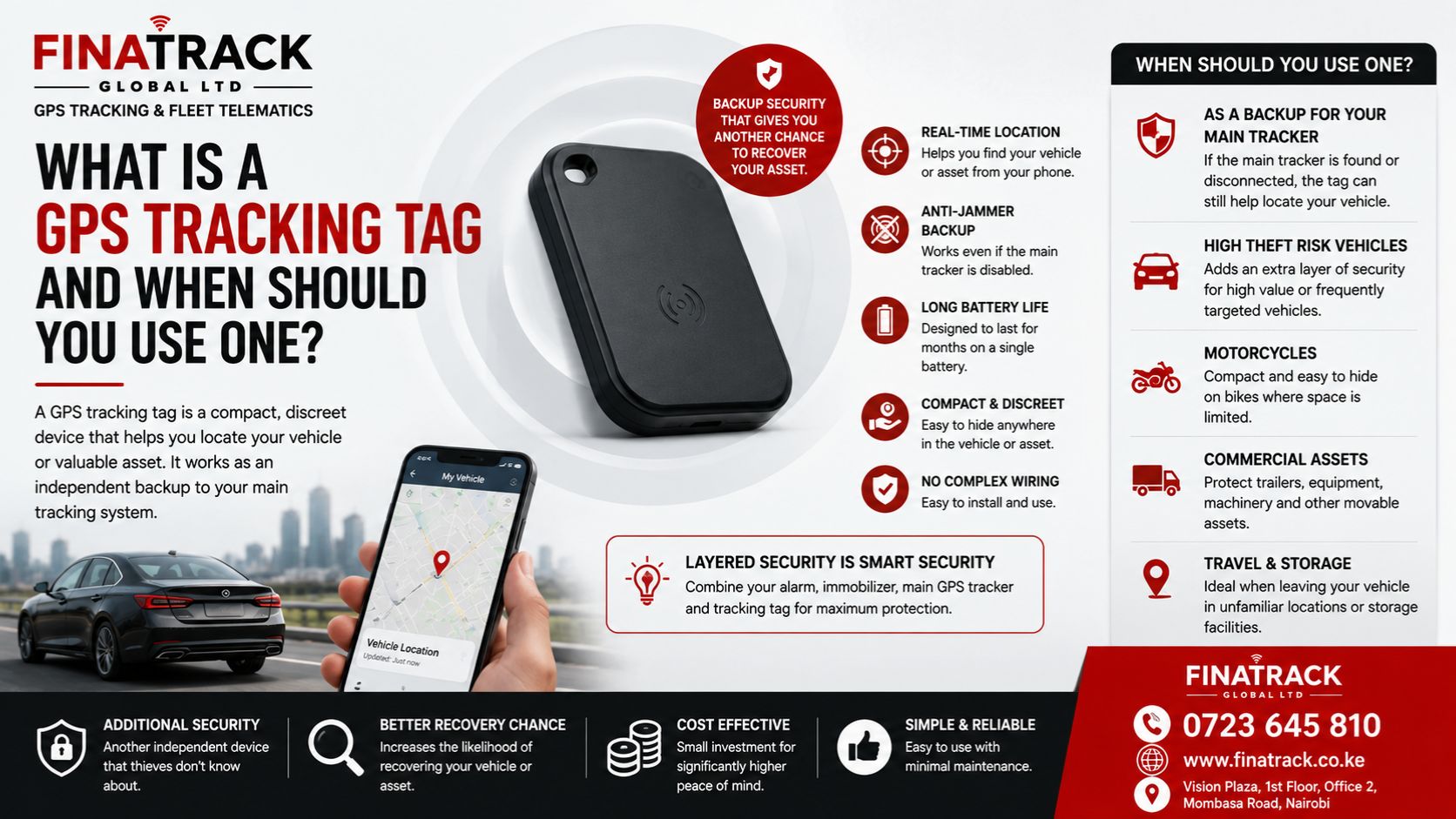
Vehicle tracking technology has expanded beyond the conventional wired GPS tracker installed behind a dashboard. Motorists can now choose from wired trackers, wireless magnetic devices and compact tracking tags designed to provide an additional way of locating a vehicle or valuable asset. Although these products are often grouped together under the term GPS tracking, they do not all work in the same way.
A tracking tag is usually a small, discreet device designed to help an owner locate a vehicle or other asset. Depending on the technology used, the tag may communicate through Bluetooth, nearby smartphones, cellular networks or satellite positioning. Some products marketed as tracking tags contain true GPS technology, while others rely on a network of nearby compatible devices to report their location.
This distinction is important because a tracking tag should not automatically be treated as a replacement for a professionally installed vehicle GPS tracker. A wired GPS tracking system is generally designed for continuous vehicle monitoring and can provide information such as live location, trip history, ignition status, geofencing and speed. A compact tag is usually better suited to providing an additional location reference or acting as a backup when the primary tracking system is unavailable.
The strongest use case for a vehicle tracking tag is therefore backup security. A professionally installed wired tracker may remain the main monitoring system, while a separate tag is concealed elsewhere in the vehicle. If the primary tracker is discovered, disconnected or otherwise compromised, the second device may provide another opportunity to establish the vehicle’s location.
This approach follows the principle of layered vehicle security. No single security device should be expected to defeat every theft method. An alarm may warn of unauthorised entry, an immobiliser can make the vehicle more difficult to start, a wired GPS tracker provides real time visibility, and a separate tracking tag can create another independent layer.
The compact size of a tracking tag is one of its main advantages. Unlike a conventional wired tracking unit, it may not require installation into the vehicle electrical system. This allows it to be positioned discreetly and moved between assets where necessary, depending on the product and intended use.
Battery life is another factor that makes some tracking tags attractive. Certain tags are designed to operate for extended periods before the battery requires replacement or charging. This can make them particularly useful as passive backup devices where the owner does not need constant real time tracking but still wants another potential method of locating the asset.
However, motorists should understand the limitations. Many compact tracking tags do not continuously send their own GPS position through a mobile network. Instead, some rely on nearby compatible smartphones or devices to detect the tag and anonymously relay its approximate location through a wider network. If the tag remains in an area where there are few compatible devices nearby, location updates may become less frequent.
A conventional cellular GPS tracker works differently. It determines its position using satellite signals and normally transmits the information through a SIM card or mobile data connection to a tracking platform. This is why a wired GPS tracker is generally more suitable when the owner needs regular location updates throughout a journey.
The difference becomes particularly important during a theft incident. A primary GPS tracker may allow the owner or tracking provider to follow a moving vehicle through a live tracking platform, subject to network coverage and device configuration. A backup tracking tag may provide intermittent location information rather than the same continuous movement history.
That does not make the tag ineffective. Its value lies in independence. If a thief locates the main tracking installation, they may assume that removing it has eliminated the owner’s ability to locate the vehicle. A separately positioned tag can create an additional challenge because it may operate using a different power source and communication method.
Tracking tags can also be useful on motorcycles. Motorcycles have less space for concealed electronic installations and are easier to move quickly after theft. A compact backup tracking device can therefore complement a professionally installed motorcycle GPS tracker by creating another hidden layer of location technology.
The same concept applies to trailers and other mobile assets. A truck operator may primarily monitor the tractor unit through a wired telematics system while using additional independent tracking technology on a trailer. This can be useful where trailers are regularly detached and moved separately.
Businesses can also use tracking tags for equipment that does not justify a full vehicle telematics installation. Portable machinery, valuable tools and other mobile assets may benefit from a compact location device where the primary concern is loss or unauthorised movement rather than detailed driver behaviour and trip reporting.
For private motorists, tracking tags can provide additional reassurance when travelling or parking in unfamiliar locations. A vehicle owner may already have an alarm and wired GPS tracker but want another independent device because they are concerned that the primary system could be discovered during theft.
The technology can also be useful when transporting vehicles. A car being moved on a transporter, stored at a yard or temporarily handed to another party may benefit from an additional independent location reference. The owner should, however, ensure that any tracking is lawful and that the technology is not being used to secretly monitor another person’s private movements without appropriate justification.
Privacy deserves particular attention because tracking devices can reveal sensitive location information. A device intended to protect a vehicle should not become a tool for unauthorised surveillance. Businesses using tracking technology on company assets should clearly define why the equipment is installed and who is allowed to access location information.
Vehicle owners should also distinguish a backup tag from a wireless magnetic GPS tracker. A magnetic GPS tracker is typically larger and may include its own GPS receiver, SIM card and rechargeable battery. It can therefore provide more direct location tracking than a small Bluetooth-style tag, but it also requires more power and may need regular charging.
A tag is generally smaller and designed for long-term discreet placement. The trade-off is that location updates may depend more heavily on the surrounding communication network rather than on a dedicated cellular connection.
Neither solution is universally better. The correct choice depends on the purpose.
If a motorist wants continuous real time tracking, trip history, ignition alerts and remote vehicle management, a professionally installed wired GPS tracker is usually the stronger primary solution. If the objective is an independent backup layer that is difficult to associate with the main installation, a compact tracking tag may be useful.
For businesses, the same decision should be based on operational requirements. A logistics company managing trucks needs full fleet telematics rather than relying on small tags as the main monitoring system. However, backup tags can still have a place within a wider security strategy for particularly valuable vehicles or assets.
Motorists should also consider battery management. A backup device is only useful if it is functioning when an incident occurs. Where the tag uses a replaceable or rechargeable battery, the owner should know its expected service life and create a routine for checking or replacing it before it expires.
The same principle applies to account access. A tag may be physically hidden inside the vehicle, but weak login credentials can undermine the security of the associated tracking account. Owners should protect passwords and avoid giving unnecessary access to other people.
It is also worth testing the device after installation or placement. The owner should confirm that the tag can be detected and that location information appears as expected. Waiting until a vehicle has disappeared before discovering that the backup device was never configured correctly defeats the purpose of installing it.
Tracking tags should therefore be viewed as part of a wider security strategy rather than a standalone guarantee against theft. Their greatest strength is redundancy. When one system fails, another may still provide information.
A properly designed vehicle security system asks what happens after each layer is defeated. If the alarm is ignored, an immobiliser should still create another obstacle. If the vehicle is moved, the wired GPS tracker should provide visibility. If that tracker is compromised, the backup tag may still offer another path to the vehicle’s location.
This is especially relevant for higher value vehicles, commercial assets and vehicles frequently parked in exposed locations. The cost of adding another security layer can be relatively small compared with the financial consequences of losing the asset.
Finatrack Global Ltd provides vehicle tracking and security solutions for private motorists and businesses in Kenya, including wired GPS tracking, wireless tracking and backup tracking technologies. The most suitable combination depends on the value of the vehicle, how it is used and the level of security required.
So, what is a GPS tracking tag?
It is a compact location device designed to help identify where a vehicle or asset is, often using a different technology and power source from a conventional wired tracker.
And when should you use one?
When you want an additional independent layer of location security rather than depending entirely on one primary tracking device.
For professional GPS tracking and layered vehicle security solutions in Kenya, contact Finatrack Global Ltd on 0723 645 810 or visit www.finatrack.co.ke.