For many businesses in Kenya, employees no longer spend their entire working day inside an office. Sales representatives travel between customer appointments, technicians visit different service locations, and field marketers move across assigned territories looking for business opportunities. Smartphones have become essential tools for coordinating these activities, allowing employees to communicate with customers, navigate unfamiliar locations and submit reports while working remotely. However, as businesses increasingly adopt mobile phone tracking applications to improve field operations, an important question arises: who should be allowed to access employees’ location records?
Knowing where a company phone is located can help a business coordinate assignments, investigate unexpected delays and improve accountability. However, the same technology can reveal detailed information about an employee’s movements, including places visited and the time spent at particular locations. If location records are accessible to too many people or collected without clear boundaries, a useful business management tool can become an unnecessary invasion of privacy. For Kenyan organisations considering mobile phone tracking, establishing appropriate access permissions is therefore just as important as choosing the tracking application itself.
Why Businesses Are Using Mobile Phone Tracking for Field Operations
Businesses that depend on field employees often face challenges that do not arise in traditional office environments. A manager supervising ten sales representatives across Nairobi may find it difficult to coordinate customer visits without repeatedly calling employees for updates. Similarly, a company providing maintenance services may need to determine which technician is closest to a customer requiring urgent assistance.
Mobile phone tracking applications can support these activities by providing location information from compatible devices that have been properly configured and authorised for monitoring. Depending on the application, businesses may be able to review current reported locations, historical movements and notifications associated with designated geographical areas.
Consider a company with sales representatives working in Westlands, Industrial Area, Thika and Kitengela. Rather than contacting each employee whenever an appointment changes, an authorised coordinator may use available location information to identify which field representative is reasonably positioned to attend a nearby customer visit. This can improve operational flexibility and reduce unnecessary travel.
However, the usefulness of mobile phone tracking depends on how responsibly the information is handled. A business may have a legitimate need to coordinate field employees during working hours without needing detailed information about their personal activities after work. Establishing this distinction helps organisations obtain operational value from tracking technology while respecting individual privacy.
Should Every Manager Have Access to Employee Location Records?
One of the most important decisions a business must make when implementing phone tracking is determining which employees genuinely need access to monitoring information. Although it may appear convenient to provide every supervisor with access to the tracking dashboard, unrestricted viewing permissions can expose personal information unnecessarily.
For example, a company operating several regional sales teams may have supervisors responsible for different territories. A Nairobi regional manager may need location information relating to employees assigned to Nairobi, while a manager handling operations in Nakuru may have no operational reason to review the movements of employees working in Mombasa.
An appropriate access structure should reflect these responsibilities. A field operations coordinator may require access to current work-related locations for dispatch purposes, while a senior manager may only need summarised information about territory coverage and completed assignments. An administrator responsible for maintaining the tracking platform may require technical access without necessarily needing to review every employee’s historical movements.
This approach is commonly known as role-based access control. Instead of providing identical permissions to everyone, access is allocated according to an individual’s responsibilities. Where the tracking platform supports separate user roles or restricted accounts, businesses can configure permissions to match their operational structure.
However, not every mobile tracking application provides detailed permission controls. Before adopting a system, organisations should confirm whether the platform supports the access restrictions they require. Where technical controls are limited, businesses should consider whether the system is suitable for their privacy and operational needs.
Why Location History Requires Greater Protection Than Live Location
There is an important difference between viewing a phone’s latest reported position and reviewing a detailed record of its movements over several days or weeks. Live location information may help a dispatcher coordinate a particular assignment, while historical location records can reveal recurring movement patterns, places visited and periods when a device remained stationary.
Consider a sales representative whose work involves visiting customers across Nairobi. During business hours, a supervisor may need to know whether the employee is near a scheduled appointment. However, giving the same supervisor unrestricted access to months of detailed location history may provide information beyond what is necessary for that immediate purpose.
Historical tracking records can also create misunderstandings when interpreted without sufficient context. A phone appearing at a particular location does not prove that a customer meeting took place, nor does it establish exactly what the employee was doing. The device may have been left in a vehicle, carried by another authorised person or affected by positioning inaccuracies.
For these reasons, businesses should distinguish between access needed for daily coordination and access required for legitimate investigations. Routine monitoring may only require current work-related location information, while historical records may be reserved for specific authorised purposes, such as investigating a disputed assignment or reviewing operational routes.
Limiting access to historical information can reduce unnecessary exposure of employee data while preserving its usefulness for legitimate business needs.
Should Employee Phones Be Tracked After Working Hours?
One of the most sensitive questions surrounding mobile phone tracking concerns what happens when an employee finishes work. A company may provide a phone for business communication and field coordination, but this does not automatically mean that continuous location monitoring is necessary or justified.
Imagine a technician who uses a company-issued smartphone during customer visits and takes the device home after completing the day’s assignments. If the tracking application continues reporting location information throughout the evening and weekend, the employer may collect details about personal movements unrelated to the employee’s duties.
Such monitoring can create privacy concerns, even when the device belongs to the business. Ownership of the phone and the lawful handling of personal location data are separate considerations.
Where practical and appropriate, businesses should consider limiting routine monitoring to working hours or clearly defined assignments. Some applications may offer scheduling controls or settings that help manage location reporting. Where such features are unavailable, employers should establish suitable policies and assess whether continuous collection is genuinely necessary.
Certain jobs may involve standby duties, emergency response or overnight assignments where location information is needed outside ordinary office hours. In such circumstances, businesses should explain the monitoring arrangements clearly and ensure that the information collected remains proportionate to the legitimate operational purpose.
The goal should be to monitor relevant business activities rather than create a permanent record of employees’ private lives.
What Does Kenyan Data Protection Law Say About Employee Tracking?
Employee location information is personal data when it can be associated with an identifiable individual. In Kenya, the collection and processing of such information are governed by the Data Protection Act, 2019, and applicable regulations. Organisations using phone tracking systems must therefore consider the principles of lawful processing, transparency, purpose limitation, data minimisation and security.
Before introducing location monitoring, an employer should identify a valid legal basis for processing the information and explain why the tracking arrangement is necessary. Consent may be appropriate in certain circumstances, but it is not the only lawful basis. In employment relationships, employers should also consider whether consent can genuinely be freely given, particularly where employees may feel unable to refuse.
Businesses should communicate what information the application collects, when monitoring occurs, who can access the records and how long the information will be retained. These details help employees understand the monitoring arrangement and allow the organisation to establish clear internal responsibilities.
The Office of the Data Protection Commissioner provides guidance on privacy policies, lawful processing and organisational data protection responsibilities. Its guidance also emphasises the importance of limiting information collection to legitimate purposes and applying appropriate safeguards against unauthorised access.
For businesses implementing employee tracking, compliance should be considered before monitoring begins rather than after a complaint arises. Depending on the nature and scale of processing, additional obligations such as registration requirements or a data protection impact assessment may also need to be evaluated.
How Long Should Businesses Keep Employee Location Records?
Location history can be useful when investigating delayed assignments, reviewing customer visits or resolving disagreements about work-related movements. However, retaining detailed records indefinitely may create unnecessary privacy and information security risks.
A business should establish how long it genuinely needs location information for its stated operational purposes. Some records may only be useful for short-term dispatch coordination, while others may be needed for legitimate accounting, contractual or dispute-resolution purposes.
For example, a company that uses phone tracking primarily to coordinate daily customer visits may not require detailed movement records covering several years. Keeping unnecessary information increases the amount of personal data exposed if a tracking account is compromised or accessed improperly.
A suitable retention policy should explain when records are reviewed, how long they are retained and when they are securely deleted or anonymised, subject to applicable legal and operational requirements. The policy should also account for circumstances where specific information must be preserved because of an ongoing dispute or lawful investigation.
Businesses should review their arrangements periodically as operational needs change. A retention period that was appropriate when a company managed two field employees may require reassessment when the organisation expands to several branches and dozens of users.
How Businesses Can Prevent Misuse of Tracking Information
The security of employee location records depends on both the tracking platform and the behaviour of the people authorised to use it. Even a well-designed application may expose information unnecessarily if multiple employees share one administrator account or if access credentials are provided to people who no longer require them.
Businesses should allocate access according to responsibility and remove permissions promptly when employees change roles or leave the organisation. Strong passwords and multifactor authentication, where supported, can help protect monitoring accounts from unauthorised access.
Organisations should also establish clear rules against using location information for personal curiosity, harassment or other purposes unrelated to legitimate business operations. A supervisor who needs location information to coordinate deliveries should not automatically be permitted to use the same records to investigate an employee’s private activities.
Where supported, access logs can help organisations review who has viewed or exported location information. Internal procedures should also govern how records are shared with other parties, including customers, contractors or investigators.
These measures improve accountability and help employees understand that location monitoring is being used for a defined business purpose rather than unrestricted observation.
Choosing a Mobile Phone Tracking Solution for Your Business
Before purchasing a mobile phone tracking application, businesses should identify the operational problems they want to solve. A company primarily interested in dispatch coordination may have different requirements from one seeking historical movement records or location-based notifications.
The application should support the necessary location functions while allowing users to manage permissions appropriately. Businesses should also confirm device compatibility, location accuracy limitations, reporting requirements and how the system behaves when internet connectivity is unavailable.
At Finatrack Global Ltd, our Mobile Phone Tracker App provides supported features such as real-time location monitoring, historical playback, geofencing, speed alerts and SOS functionality for compatible Android and iPhone devices. These features can support authorised field operations, depending on the device’s configuration and operating conditions.
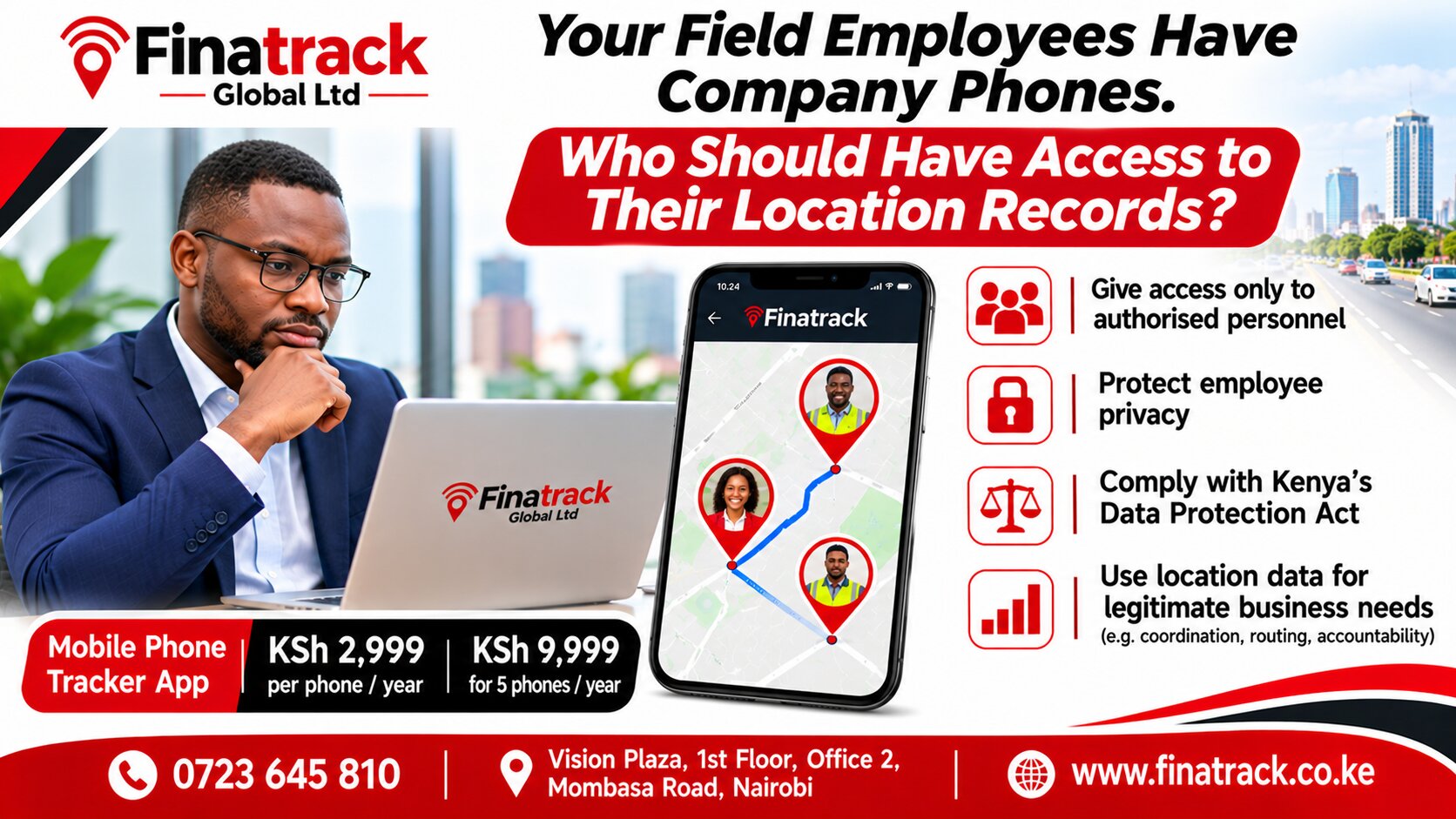
Our Mobile Phone Tracker App costs KSh 2,999 per year for one phone, while our five-phone package is available at KSh 9,999 per year. The five-phone arrangement may be suitable for small businesses seeking a practical starting point for coordinating field employees.
Before installation, organisations should confirm the available account-management and access-control features, establish appropriate privacy procedures and ensure that the intended monitoring activities have a valid legal basis.
Improve Field Operations Without Compromising Employee Privacy
Mobile phone tracking can help businesses coordinate field activities, reduce unnecessary calls and improve visibility over authorised work-related movements. However, collecting location information creates responsibilities that extend beyond installing an application and opening a monitoring dashboard.
A responsible tracking arrangement identifies who genuinely needs access to location information, limits monitoring to legitimate purposes and protects records against unnecessary disclosure. It also recognises that knowing where a phone is located does not automatically establish what an employee is doing or whether an assignment has been completed successfully.
For Kenyan businesses, the most effective approach is to combine suitable tracking technology with clear employee communication, practical operational procedures and appropriate data protection safeguards. When these elements work together, businesses can improve field coordination while maintaining professional boundaries and respect for employee privacy.
Finatrack Global Ltd provides mobile phone tracking solutions for businesses and individuals seeking convenient access to authorised location-monitoring features. Our single-phone subscription costs KSh 2,999 annually, while the five-phone package costs KSh 9,999 annually.
For product enquiries and installation assistance, contact Finatrack Global Ltd on 0723 645 810, visit our office at Vision Plaza, 1st Floor, Office 2, Mombasa Road, Nairobi, or explore our solutions at www.finatrack.co.ke.
Employee tracking should help your business work better, not create unnecessary surveillance. Give the right people access to the right information, for the right reasons.