Water bowser businesses play an important role in Kenya, supplying water to construction sites, residential developments, commercial premises, farms and areas where reliable piped water is unavailable. In towns such as Nairobi, Kitengela, Athi River and Thika, contractors and property developers often depend on water delivery trucks to keep construction activities moving. For bowser owners, every successful delivery generates revenue, but every journey also involves fuel, driver expenses, maintenance and vehicle wear. Without proper monitoring, these operating costs can gradually reduce the profitability of the business.
Managing a water bowser can become particularly challenging when the owner is not directly involved in daily deliveries. A driver may receive several assignments, travel between different filling points and customer locations, and return with records showing the deliveries completed. However, the owner may have limited independent information about the actual routes travelled, the time spent at each destination or whether the vehicle was used for additional assignments. GPS tracking and fuel monitoring technology can provide greater visibility into these activities, helping bowser operators improve accountability and identify unnecessary expenses without relying entirely on manual reports.
Why Water Bowser Businesses Need Better Vehicle Monitoring
Unlike ordinary transport businesses that move goods between established collection and delivery points, water bowser operators may visit several locations within a relatively small geographical area. A truck can collect water from an approved filling point, deliver it to a construction site and return for another load several times during the day. These repeated journeys can create substantial operating expenses, particularly when the filling point is far from the customer.
Consider a water bowser serving construction projects around Athi River and Kitengela. The driver may begin the morning with a delivery to one site, receive another request from a nearby customer and then travel to a different filling station before completing the next assignment. As the day progresses, unexpected traffic, waiting periods and route changes can make it difficult for management to reconstruct the vehicle’s activities accurately.
Many small bowser businesses rely on driver phone calls, delivery notes and fuel receipts to account for these movements. Although these records remain important, they may not always explain why a truck travelled a particular distance or spent several hours away from its expected operating area. When a business operates multiple bowsers, the difficulty increases because the owner cannot personally supervise every journey.
A GPS tracking system allows authorised users to review the available locations and historical movements of their vehicles. Instead of depending entirely on verbal updates, management can examine recorded journeys and compare them with approved delivery assignments. This additional visibility can help businesses coordinate their operations and investigate unexpected activity.
How GPS Tracking Helps Monitor Water Delivery Routes
Route monitoring is one of the most practical applications of GPS tracking in a water bowser business. A tracking device can record a vehicle’s movements and provide historical journey information through a compatible monitoring platform. The business owner can then review where the vehicle travelled during a selected period and compare those movements with scheduled deliveries.
For example, a bowser assigned to transport water from an approved filling point in Nairobi to a construction site along Mombasa Road may be expected to follow a reasonably direct route. If the recorded journey includes an unusual diversion, the owner can investigate whether the change resulted from traffic, a customer request, a road closure or another explanation.
Over time, these records can also help businesses identify routes that consistently involve unnecessary travel. A company may discover that certain delivery schedules require trucks to travel repeatedly between distant locations even when a more efficient sequence could be arranged. By reviewing historical movements, management can make better decisions about vehicle allocation and delivery planning.
However, GPS records should not automatically be treated as proof that a water delivery was completed. A truck arriving at a construction site does not necessarily mean that the agreed quantity of water was discharged or accepted by the customer. Location tracking should therefore support delivery notes, customer acknowledgements and other operational records rather than replace them.
Can GPS Tracking Help Detect Unauthorised Water Bowser Trips?
One concern for businesses that operate vehicles through hired drivers is the possibility of unauthorised use. A water bowser may be assigned to complete deliveries for the company during working hours, but the owner may not always know whether additional journeys take place outside approved assignments.
Imagine a bowser scheduled to complete four deliveries before returning to the company’s parking yard. If the vehicle makes an additional journey to a location that does not appear in the dispatch records, management may need to establish why the movement occurred. The journey could involve a legitimate instruction that was not documented, or it could indicate that the vehicle was used without proper authorisation.
GPS tracking provides information that can help clarify such situations. Historical route playback allows managers to review recorded movements, while geofencing can provide notifications when a compatible tracker enters or leaves designated areas. A business may establish virtual boundaries around its parking yard, approved filling points or frequently visited construction sites.
If a vehicle leaves the yard outside authorised operating hours, the system may generate an alert, depending on its configuration and connectivity. This gives the owner an opportunity to investigate the movement sooner rather than discovering it when reviewing fuel expenses or driver reports.
Nevertheless, an unexpected trip should not automatically lead to accusations against the driver. Traffic diversions, emergency deliveries and changes to customer instructions may provide legitimate explanations. The purpose of monitoring should be to establish reliable information and encourage accountability.
Why Fuel Consumption Can Reduce Water Bowser Profits
Water bowsers are relatively heavy commercial vehicles, particularly when carrying a full load. Their fuel consumption is influenced by engine condition, vehicle weight, road gradients, driving behaviour and traffic conditions. A truck travelling through congested urban roads or operating repeatedly on rough construction-site access routes may consume more fuel than one travelling at steady speeds on open roads.
For bowser owners, fuel becomes a concern when expenses increase without a corresponding improvement in revenue. A driver may complete the expected number of deliveries but consume more diesel than usual, leaving the owner uncertain whether the increase resulted from road conditions, unnecessary trips, prolonged idling or mechanical problems.
Consider a company operating three water bowsers across Nairobi and Machakos. If each vehicle makes several trips daily, even modest increases in fuel consumption can accumulate over a month. When the business relies entirely on receipts and driver explanations, it may be difficult to establish which part of the operation is responsible for the additional expense.
GPS tracking can help explain some of these differences by showing where vehicles travelled, how long journeys took and where they stopped. When combined with a suitable fuel monitoring system, the business gains additional information about changes in fuel levels and consumption patterns. This makes it easier to investigate irregularities using recorded operational information instead of assumptions.
Fuel monitoring is particularly useful when trucks refuel at different stations or operate far from the company’s main office. A properly configured system can help managers compare recorded fuel-level increases with refuelling transactions and identify unexpected reductions that require investigation. However, fuel readings are estimates affected by sensor calibration, tank configuration and vehicle movement, so discrepancies should be verified before conclusions are drawn.
How Engine Idling Affects Water Bowser Operating Costs
Water bowser operations frequently involve periods when vehicles remain stationary. Drivers may wait at filling stations, queue at construction sites or remain parked while customers prepare to receive water. During some activities, the engine may need to operate to power suitable pumping equipment. In other situations, the engine may remain running unnecessarily.
This distinction matters because fuel continues to be consumed while an engine is idling. A bowser that spends a considerable portion of the day stationary with its engine running may incur significant diesel expenses without covering additional distance. Where pumping equipment is powered by the vehicle’s engine, however, stationary fuel consumption may be part of the legitimate delivery process.
For example, a bowser waiting for access to a construction site may remain parked for an extended period. If the engine continues running throughout the delay, the fuel consumed becomes part of the delivery’s operating cost. Repeated waiting periods across several vehicles can affect the company’s monthly expenses.
A compatible vehicle monitoring arrangement may help managers review engine activity alongside location and journey information. This allows the business to distinguish between vehicle movement and selected stationary operating periods. It may also reveal opportunities to improve scheduling or reduce unnecessary waiting.
The objective should not simply be eliminating all idling. Bowser businesses must consider equipment requirements, worker safety and delivery procedures. Instead, the information can help management understand how much operating time is spent travelling, waiting or performing necessary delivery activities.
Can GPS Tracking Confirm How Much Water Was Delivered?
An important distinction for water bowser owners is the difference between tracking a vehicle and measuring the quantity of water it delivers. A GPS tracker provides location and movement information, but it does not independently establish how many litres of water were loaded or discharged.
Similarly, a fuel monitoring system measures or estimates diesel fuel levels, depending on its installed sensors and configuration. It should not be confused with equipment designed to measure the volume of water transported or delivered.
For example, a bowser may arrive at a construction site carrying water and remain there for thirty minutes. GPS records may show that the vehicle reached the location and how long it stayed, but they cannot confirm that the customer received the full agreed quantity. Determining the actual volume delivered requires suitable water measurement equipment or properly documented delivery procedures.
A business seeking stronger delivery accountability may therefore combine GPS tracking with customer-signed delivery notes and appropriately calibrated water meters where necessary. The tracking system provides movement information, while the delivery documentation and measuring equipment address the quantity supplied.
This distinction is particularly important when customers dispute delivery quantities. Rather than relying on GPS information to prove something it cannot measure, operators should use the appropriate records for each part of the transaction.
How Much Does Water Bowser GPS and Fuel Monitoring Cost in Kenya?
The cost of monitoring a water bowser depends on the equipment required and the type of information the owner wants to access. A business primarily concerned with vehicle movements may begin with a wired GPS tracker, while one experiencing unexplained diesel expenses may also consider a fuel monitoring system.
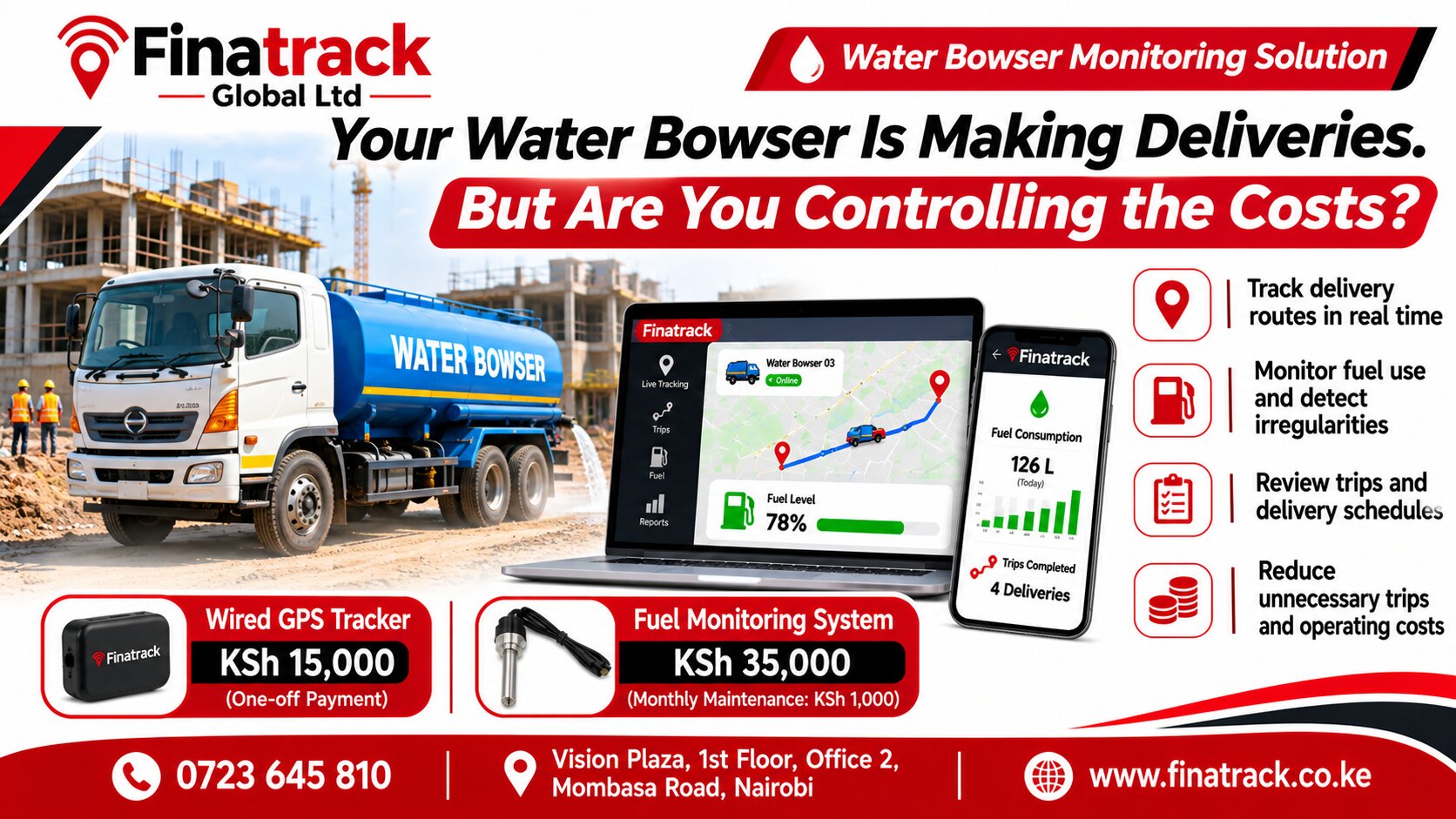
At Finatrack Global Ltd, our Wired GPS Tracker costs KSh 15,000 as a one-off payment without an annual tracking subscription. Customers can alternatively select a package costing KSh 10,000 for installation, followed by an annual subscription of KSh 3,000. The tracking solution supports vehicle location monitoring and relevant movement information, depending on the device’s configuration.
For businesses seeking additional fuel accountability, Finatrack’s Fuel Monitoring System costs KSh 35,000, with a monthly maintenance fee of KSh 1,000. The solution can help operators review fuel-level records and investigate selected consumption discrepancies when installed on compatible vehicles.
Bowser owners should consider their vehicle configurations, operational challenges and monitoring requirements before selecting equipment. A business with several vehicles may also need to establish consistent reporting procedures so that the information collected can support day-to-day management.
Professional installation is important, particularly for fuel-level sensors that require calibration according to the vehicle’s tank arrangement. Customers should confirm the supported functions and applicable service terms before purchasing.
Improve Water Bowser Profitability With Better Vehicle Accountability
Running a profitable water delivery business requires more than securing customers and completing deliveries. Owners must also control fuel expenses, manage routes efficiently, maintain their vehicles and ensure that assigned trucks are used for authorised business activities. When these responsibilities are handled entirely through manual records and telephone calls, important operational details can be overlooked.
GPS tracking provides an additional way to understand where water bowsers travel, review historical movements and investigate unexpected journeys. Fuel monitoring complements this information by helping businesses examine diesel consumption and unusual fuel-level changes. When combined with proper delivery records, vehicle maintenance and responsible driver management, these technologies can support more informed operating decisions.
Finatrack Global Ltd provides GPS tracking and fuel monitoring solutions for water bowser owners, contractors, logistics businesses and commercial fleet operators across Kenya. Our Wired GPS Tracker is available at KSh 15,000 through a one-off payment arrangement, while our Fuel Monitoring System costs KSh 35,000 plus KSh 1,000 monthly maintenance.
For enquiries and professional installation, contact Finatrack Global Ltd on 0723 645 810, visit our office at Vision Plaza, 1st Floor, Office 2, Mombasa Road, Nairobi, or explore our solutions at www.finatrack.co.ke.
Your water bowser may be making deliveries every day, but knowing where it travels and how much fuel it consumes can help you understand whether those deliveries are generating the profits your business expects.