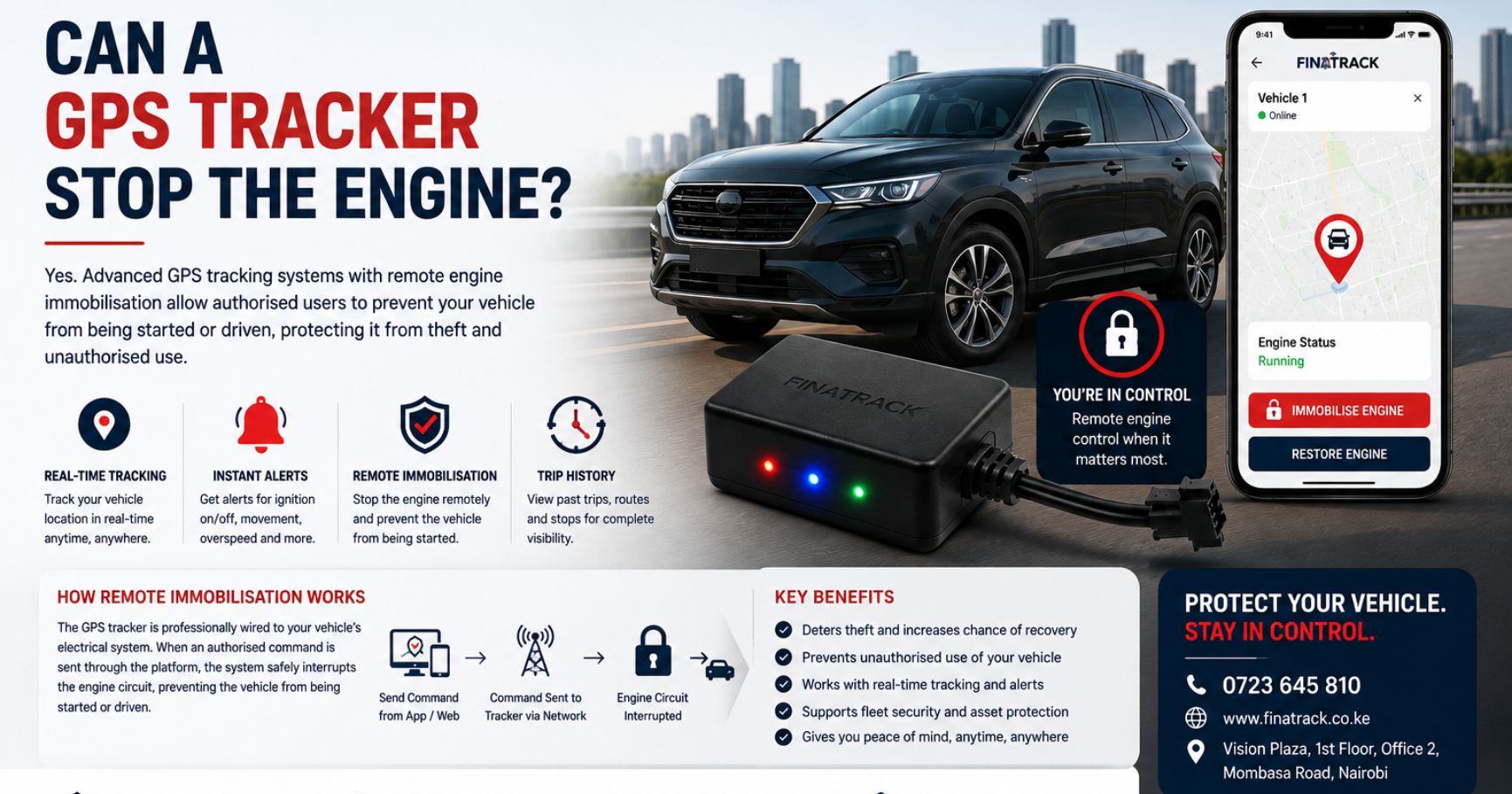
A modern GPS tracker can do much more than show you where your vehicle is. Depending on the type of device installed and how it has been configured, a GPS tracking system can also help prevent a vehicle from being driven away by allowing an authorised user to immobilise the engine remotely.
This feature is commonly known as remote engine immobilisation.
For many vehicle owners in Kenya, it is one of the most attractive security features available in a wired GPS tracking system because it gives the owner an additional level of control when dealing with suspected theft or unauthorised vehicle use.
However, it is important to understand exactly how the technology works.
A GPS tracker does not normally stop the engine by itself simply because it knows where the vehicle is. The tracking device must be professionally connected to the vehicle’s electrical system and configured with an immobilisation relay or similar control mechanism.
When an authorised immobilisation command is sent through the tracking platform, the system can interrupt a selected vehicle circuit according to the installation configuration.
The objective is to prevent the vehicle from being started again or to disable operation under controlled and safe circumstances.
This is very different from suddenly switching off a moving vehicle at high speed.
A professionally configured vehicle tracking system should prioritise safety.
Immediately cutting the engine of a vehicle travelling on a busy highway could create a serious accident risk. For this reason, responsible immobilisation systems are usually configured so that the vehicle is disabled only when it is safe to do so, such as after it has stopped or after the ignition has been switched off.
The exact behaviour depends on the GPS tracking device, the vehicle and how the installation has been configured.
This makes professional installation extremely important.
Remote immobilisation can become particularly useful during a vehicle theft incident.
Imagine discovering that your car has been taken without your permission.
With a standard vehicle alarm, the alarm may have already stopped sounding by the time you realise the vehicle is missing.
A GPS tracking system can provide a different level of visibility.
You may be able to see the location of the vehicle through the tracking platform, follow its movement and provide relevant information to security personnel or law enforcement.
Where remote immobilisation has been installed and the appropriate safety conditions are met, an authorised command may then prevent the vehicle from continuing to operate.
This can make vehicle recovery more manageable.
The feature can also help in situations involving unauthorised vehicle use.
For example, a company may operate several vehicles that are only supposed to be used during certain working hours.
If a vehicle is taken without authorisation, GPS tracking can help management identify its location and movement.
Depending on company procedures and the tracking configuration, immobilisation may provide an additional security option.
For private vehicle owners, the technology can provide reassurance because location monitoring and vehicle control are brought together within the same security system.
However, remote immobilisation should never be treated as a replacement for good vehicle security.
The strongest vehicle protection normally comes from combining several security measures.
A GPS tracker provides location visibility.
A vehicle alarm helps detect unauthorised access.
An immobiliser makes it more difficult to drive the vehicle away.
A hidden cut off system can provide additional protection.
A wireless backup tracker can create another layer of location visibility.
When these technologies work together, it becomes harder for a thief to defeat the entire security system by disabling one device.
This is particularly important because professional vehicle thieves may understand how common security systems work.
If a primary GPS tracker is discovered and disconnected, a secondary tracking device can provide backup location information.
Similarly, if a vehicle is already moving when theft is discovered, the GPS system can help track the vehicle while the owner waits for an appropriate opportunity to immobilise it safely.
Another important point is that not every GPS tracker supports remote engine control.
Basic trackers may only provide location information.
Some inexpensive portable or magnetic trackers are designed primarily for tracking and do not connect directly to the vehicle electrical system.
These devices may provide location updates, trip information and movement alerts, but they usually cannot immobilise the engine because they are not physically connected to the relevant vehicle circuits.
Remote immobilisation is therefore more commonly associated with professionally installed wired GPS trackers.
Before purchasing a tracker, ask the provider whether engine immobilisation is included.
You should also ask how the feature works, who can send the command and what safety controls are built into the system.
Access control is particularly important.
You do not want an unauthorised person gaining access to your tracking account and sending commands to your vehicle.
Your tracking account should therefore be protected using secure login credentials, and access should only be given to people you trust.
Businesses operating fleets should also establish clear procedures regarding who is authorised to immobilise company vehicles.
The decision should not be left to every employee with access to the tracking platform.
The company should determine when immobilisation is permitted, who can approve it and what safety procedures should be followed.
This becomes particularly important for commercial vehicles, delivery vans, trucks and passenger vehicles.
Remote immobilisation should be viewed as a security control, not as a tool for unnecessarily interfering with drivers while they are operating vehicles.
The installation itself also matters.
Poor quality wiring can create electrical problems.
An obvious installation can make the immobilisation system easier to bypass.
A professionally installed GPS tracker should be positioned discreetly and integrated properly into the vehicle.
The installer should also test the immobilisation function after installation to ensure that it works as intended.
For vehicle owners, another useful feature is ignition monitoring.
The GPS tracking system can notify the authorised user when the vehicle’s ignition is switched on.
If you receive an ignition alert while your vehicle should be parked, you can immediately check its location.
This gives you an opportunity to investigate suspicious activity before the situation becomes more serious.
Geofencing provides another layer of protection.
You can create a virtual geographical boundary around a particular location.
If the vehicle leaves that area, the system can generate an alert.
When ignition alerts, geofencing, real time tracking and remote immobilisation are used together, the GPS tracker becomes much more than a location device.
It becomes part of a complete vehicle security system.
Trip history can also help after an incident.
If your vehicle has already moved before you notice it, historical tracking information can help show where it travelled.
This can provide useful context during investigations and recovery efforts.
Businesses can also use the same data for operational management.
Remote immobilisation is particularly relevant for financed vehicles.
Banks, SACCOs, microfinance institutions and asset finance companies may require certain financed vehicles to have approved tracking systems installed.
The primary objective is to protect the financed asset.
Where permitted under the relevant financing agreement and applicable procedures, tracking and immobilisation technology can form part of the lender’s wider asset protection strategy.
For the borrower, the technology also protects a valuable vehicle that they are still paying for.
There is therefore a shared interest in ensuring that the tracking system is reliable and professionally installed.
Vehicle owners should also understand that a GPS tracker does not guarantee that a stolen vehicle will always be recovered.
Criminals may attempt to disable tracking systems, interfere with vehicle electronics or move vehicles into locations where communication is difficult.
This is another reason layered security is important.
No single security device should be considered completely foolproof.
The goal is to make the vehicle harder to steal, easier to monitor and easier to recover if an incident occurs.
A reliable tracking provider should also offer local technical support.
If your system stops communicating or you experience a security incident, you need to know who to contact.
A GPS tracker becomes far more valuable when it is supported by professionals who understand the technology and can assist when necessary.
Finatrack Global Ltd provides GPS tracking, telematics and vehicle security solutions for private vehicle owners, businesses and corporate fleets in Kenya.
Our wired GPS tracking solutions can provide real time vehicle tracking, trip history, geofencing, ignition alerts, speed monitoring and remote engine immobilisation depending on the selected system and installation configuration.
For vehicle owners looking for more than basic location tracking, remote immobilisation can provide an important additional layer of security.
The key is to have it installed correctly and use it responsibly.
So, can a GPS tracker stop the engine?
Yes, certain professionally installed wired GPS tracking systems can support remote engine immobilisation.
But the most important part is not simply whether the vehicle can be disabled.
It is how safely, securely and professionally that feature has been installed and configured.
If you would like to install a GPS tracker with vehicle immobilisation capability, contact Finatrack Global Ltd on 0723 645 810.
You can also visit Finatrack Global Ltd at Vision Plaza, 1st Floor, Office 2, Mombasa Road, Nairobi or visit www.finatrack.co.ke.
Knowing where your vehicle is gives you visibility.
Having the ability to protect it gives you control.