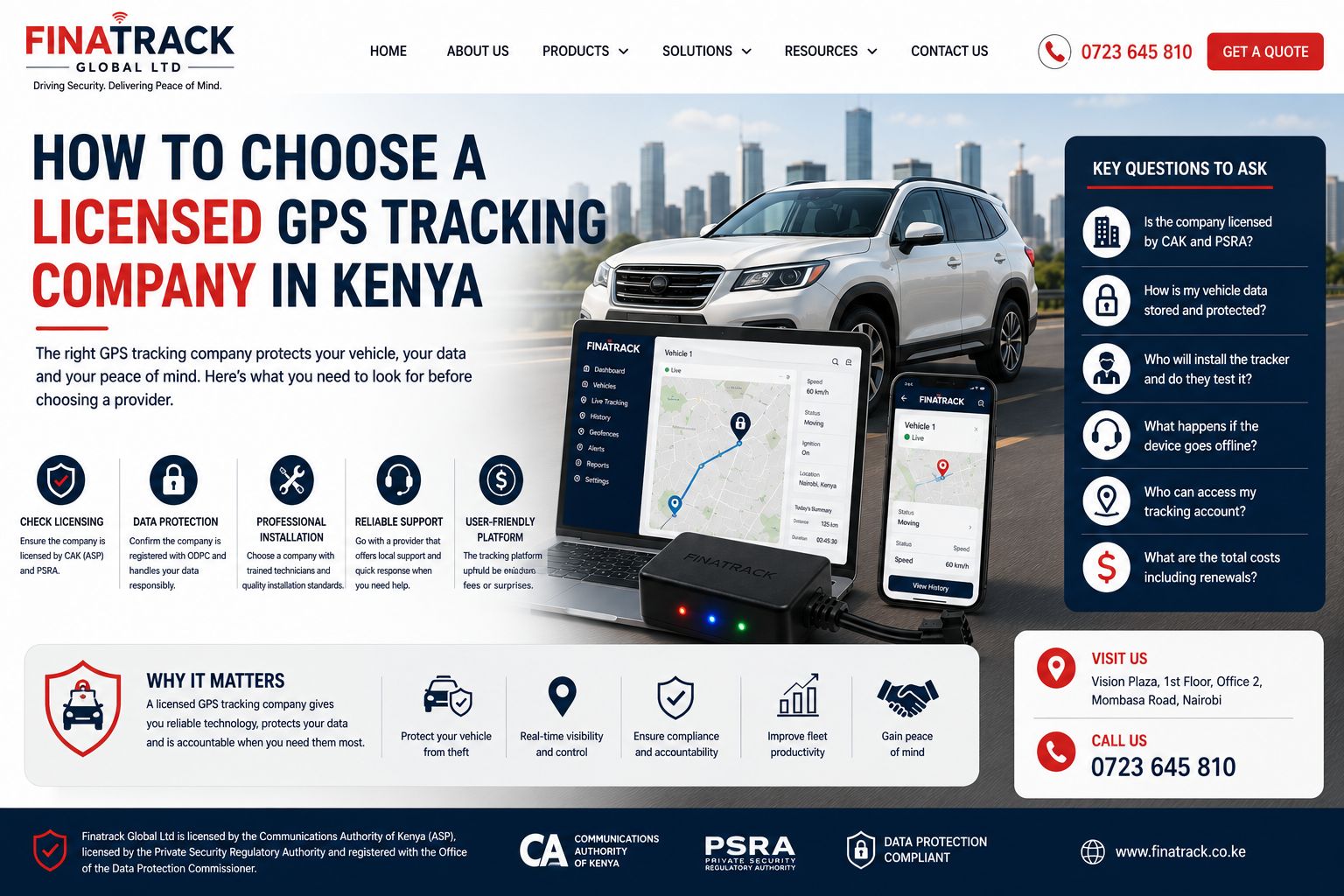
Installing a GPS tracker may take less than an hour, but choosing the wrong company can leave you with problems that last for years.
Your vehicle may be worth hundreds of thousands or even millions of Kenya shillings. The GPS tracking company you choose may have access to information showing where that vehicle is parked, where it travels, when the ignition is switched on and, depending on the system, the ability to remotely immobilise it.
That means choosing a GPS tracking company should involve much more than asking who has the cheapest tracker.
Before allowing anyone to install a tracking device in your vehicle, one of the most important questions you should ask is whether the company is properly licensed to provide the service in Kenya.
GPS vehicle tracking operates at the intersection of telecommunications, private security and personal data management. Kenya has regulatory frameworks covering these areas, making licensing and compliance an important consideration when selecting a tracking provider.
The Communications Authority of Kenya identifies vehicle tracking services among the services that can be provided under an Application Service Provider licence. The Authority also maintains a register of telecommunications licensees that members of the public can use when conducting due diligence.
This is important because a GPS tracker is not simply a box hidden somewhere inside your dashboard.
A modern tracking solution communicates through telecommunications infrastructure to transmit information from the vehicle to a tracking platform. The GPS device identifies the location while mobile connectivity allows that information to reach the platform you access through your smartphone or computer.
When you are dealing with a company providing this type of service commercially, you should be comfortable that it operates within the appropriate regulatory framework.
Private security regulation is equally important.
The Private Security Regulatory Authority specifically identifies car tracking and surveillance among the private security services regulated under the Private Security Regulation Act. PSRA states that persons or companies providing private security services in Kenya are required to be registered and licensed by the Authority.
This is particularly relevant because GPS tracking is frequently purchased as a vehicle security service.
You are installing the device because you want greater protection against theft, unauthorised use or misuse of your vehicle.
If a theft occurs, you may depend on that tracking system during one of the most stressful moments of vehicle ownership.
That is not the time you want to discover that the company you selected has disappeared, cannot access its own platform or does not have the professional capacity to assist you.
Checking licensing before installation therefore gives you another layer of confidence about who you are dealing with.
PSRA advises users of private security services to engage licensed providers and provides a process through which members of the public can verify the registration status of a security company.
The third consideration is data protection.
A GPS tracking system can generate information about the location and movement of a vehicle. Where that information relates to an identifiable person, Kenya’s Data Protection Act becomes relevant. The Act expressly recognises location data as one of the identifiers through which a natural person may be identified directly or indirectly.
Think about the significance of that.
If your vehicle is normally parked at your home every evening, location information may reveal where you live.
If you drive to your office every morning, tracking information can reveal where you work.
If the vehicle follows predictable routes, the tracking history can potentially reveal aspects of your routine.
For a business vehicle, the information could reveal customer locations, delivery routes, operating territories and employee movement.
GPS tracking data should therefore be treated responsibly.
When assessing a GPS tracking company in Kenya, ask how your tracking information is protected.
Find out who can access your account.
Ask whether employees of the tracking company can view your vehicle location.
Find out how login credentials are issued.
Ask what happens when you sell the vehicle.
Understand how long tracking information is retained.
Determine whether another person can access the vehicle without your authorisation.
The Office of the Data Protection Commissioner maintains a register of registered data handlers, while Kenyan data protection law sets obligations relating to lawful, fair and transparent processing and protection of personal data.
A professional GPS tracking company should therefore take both vehicle security and information security seriously.
Licensing, however, should not be the only factor influencing your decision.
A company can have documentation and still provide a poor customer experience.
Once you establish that you are dealing with a legitimate provider, the next question should be whether the company has the technical capability to install and support the system properly.
Professional installation is extremely important.
A wired GPS tracker needs to be integrated into the vehicle’s electrical system. Depending on the selected solution, the installation may include ignition detection and remote vehicle immobilisation.
Poor wiring can create unnecessary electrical problems.
An incorrectly positioned tracker may have communication problems.
A device installed in an obvious location may be easier for a thief to discover.
An immobilisation circuit installed incorrectly may create reliability or safety concerns.
This is why the quality of installation matters just as much as the quality of the GPS device.
Ask who will install your tracker.
A serious GPS tracking company should use trained technicians who understand vehicle electrical systems and tracking technology.
The technician should test the tracker after installation to confirm that the device is communicating properly.
You should be able to log into your tracking account and confirm that your vehicle appears correctly before the installation is considered complete.
If immobilisation is included, the feature should also be tested under safe conditions and its operation explained to you.
You should understand what happens when the immobilisation command is sent and how the vehicle is restored.
A responsible provider should never encourage unsafe immobilisation practices involving a vehicle travelling at speed.
The tracking platform itself also deserves careful attention.
Many customers focus almost entirely on the physical tracker, yet the platform is what you will interact with every day.
Ask to see the tracking system before buying.
The platform should make it easy to identify your vehicle and understand its current status.
You should be able to see the vehicle’s location and access the features included in your package without unnecessary confusion.
Depending on the solution, useful capabilities may include real time tracking, trip history, ignition alerts, geofencing, speed monitoring, movement notifications and remote immobilisation.
For business customers, additional capabilities such as fleet reports, driver behaviour information and vehicle utilisation data may be important.
The cheapest tracker becomes expensive if the platform is unreliable.
Imagine paying for a tracker only to discover several months later that your vehicle frequently appears offline.
Imagine experiencing vehicle theft and finding that the last location update occurred several hours earlier.
Imagine trying to contact the provider and nobody answers the phone.
Those situations demonstrate why price should never be the only selection criterion.
Customer support is one of the most overlooked considerations when purchasing a GPS tracker.
Ask yourself a simple question.
If my vehicle disappears tonight, who do I call?
You should know the answer before installation.
A reliable tracking company should have clear contact channels and provide reasonable technical assistance when customers experience problems.
This becomes even more important for businesses operating commercial fleets.
If one tracker stops communicating in a fleet of fifty vehicles, somebody must be able to investigate the problem.
Fleet operators should therefore consider the provider’s ability to support installations at scale.
A tracking company that works well for one private car may not necessarily have the infrastructure or technical capability required to manage hundreds of commercial vehicles.
Businesses should ask whether the provider can manage bulk installations, maintain accurate vehicle records, troubleshoot devices, provide reports and support fleet administrators.
Banks, SACCOs, insurance companies and asset finance institutions should apply even greater due diligence.
These organisations may depend on GPS tracking to protect vehicles securing substantial financial exposure.
The tracking provider should therefore be able to provide appropriate installation documentation and maintain clear records linking each tracking device to the correct financed vehicle.
If a lender requests an installation certificate, the documentation should correctly identify the vehicle and tracking installation.
Another important consideration is ownership of the tracking account.
When you purchase a tracker for your private vehicle, you should understand who controls access to your account.
Ask whether you will receive your own username and password.
Ask whether the credentials can be changed.
Ask what happens if you change your phone.
A good tracking system should not unnecessarily tie you to one mobile device.
You should also understand whether the company charges recurring fees.
Some GPS tracking companies charge annual tracking platform fees.
Others may have SIM card charges, subscription fees or renewal fees.
A lower installation price may therefore not represent the lowest total cost.
Before purchasing, ask the provider to explain the total cost of ownership.
Find out what you pay today and what you may need to pay after one year, two years or three years.
If a provider advertises lifetime tracking or no annual tracking fees, ask exactly what this covers and whether there are any conditions.
Transparency about pricing is a positive sign.
Be cautious when important costs only appear after installation.
You should also consider the physical presence of the company.
While many GPS tracking services can be sold online, knowing that your provider has an identifiable office can be useful when technical support or physical inspection is necessary.
A professional website, working telephone number, physical office and identifiable company details can all contribute to the due diligence process.
Do not rely solely on social media advertising.
An attractive Facebook or Instagram advert does not prove that the business is licensed, technically capable or established.
Before sending money, search for the company.
Visit its website.
Check its physical location.
Ask for its registered business name.
Request information about relevant licences.
Where possible, verify the information with the relevant regulator rather than relying entirely on screenshots or logos displayed in advertisements.
For Communications Authority licensing, the Authority publishes its telecommunications licensee register and type approved equipment information through its official website.
For private security licensing, PSRA states that customers can request verification of a company’s registration details through the Authority.
The ODPC also provides an online register where the status of registered data controllers and processors can be checked.
Taking a few minutes to perform these checks could save you significant frustration later.
Another useful indicator is whether the company is willing to educate you before selling.
A reputable provider should be able to explain the difference between wired and wireless trackers.
They should explain how the SIM card communicates.
They should tell you what happens when the vehicle is parked.
They should explain the limitations of GPS technology rather than promising that a tracker makes your vehicle impossible to steal.
No tracking system provides absolute protection.
A GPS tracker is one component of a wider vehicle security strategy.
A professional provider should be comfortable explaining that reality.
Depending on your risk profile, you may benefit from combining a wired GPS tracker with a car alarm, immobiliser or independent backup tracking device.
Commercial vehicles may require telematics or fuel monitoring in addition to basic location tracking.
The right provider should recommend a solution based on your actual needs rather than simply selling the most expensive device available.
Finatrack Global Ltd provides GPS tracking, telematics and vehicle security solutions for private motorists, SMEs, corporate fleets, asset finance institutions and other organisations in Kenya.
Finatrack states that it is licensed as an Application Service Provider by the Communications Authority of Kenya, licensed by the Private Security Regulatory Authority and registered with the Office of the Data Protection Commissioner as a Data Controller and Data Processor. The company also provides installations from its Nairobi office and at customer locations depending on requirements.
For a vehicle owner, these credentials should form part of a wider decision that also considers installation quality, platform reliability, functionality and ongoing customer support.
Your GPS tracker may remain inside your vehicle for years.
Choose the company behind it just as carefully as you choose the device itself.
When comparing GPS tracking companies in Kenya, do not begin with the question, “Who is cheapest?”
Start by asking whether the company is licensed.
Ask whether your location data will be handled responsibly.
Ask who will install the tracker.
Ask what happens if the device goes offline.
Ask who you contact during an emergency.
Ask whether you will receive professional support after you have paid.
Then compare the price.
A cheap tracker from the wrong provider can give you a false sense of security.
A professionally installed tracking solution backed by a legitimate, accountable and accessible provider gives you something far more valuable.
Confidence that when you need your tracking system most, there is a real company standing behind it.
For professional GPS tracking, vehicle security, fuel monitoring and fleet telematics solutions in Kenya, contact Finatrack Global Ltd on 0723 645 810.
You can also visit Finatrack Global Ltd at Vision Plaza, 1st Floor, Office 2, Mombasa Road, Nairobi or visit www.finatrack.co.ke.
Your vehicle is valuable.
Your location information is sensitive.
Choose who you trust with both carefully.