For many businesses operating vehicles in Kenya, fuel is not simply another operating expense. It is one of the costs that can determine whether a fleet makes money or quietly eats into the company’s profits.
A truck may be making deliveries every day. A company vehicle may appear busy. Drivers may submit fuel receipts on time. Fuel cards may be reconciled every month. Yet without knowing exactly what is happening inside the fuel tank, a business can still lose thousands of shillings through excessive consumption, unauthorised drainage, inefficient driving, unnecessary idling and inaccurate fuel records.
This is where a fuel monitoring system changes the way a business manages its vehicles.
A fuel monitoring system allows fleet owners and managers to monitor fuel levels, consumption and important fuel events electronically instead of depending entirely on receipts, manual calculations and driver reports.
When integrated with GPS tracking, the system can show not only what happened to the fuel but also where the vehicle was when it happened.
For Kenyan businesses operating trucks, buses, construction vehicles, delivery vans, generators and other fuel intensive assets, this level of visibility can make fuel management significantly more transparent.
Think about a common situation.
A company gives a driver money to purchase 200 litres of diesel. A receipt confirms that 200 litres were purchased. On paper, everything appears correct.
But did all 200 litres actually enter the vehicle’s tank?
Was some fuel removed later?
Did the vehicle consume more fuel than expected because of excessive idling?
Was the vehicle taken on an unauthorised trip?
Did the amount recorded on the receipt match the actual increase in the tank?
Traditional fuel management often struggles to answer these questions.
A GPS fuel monitoring system provides businesses with data that can help them understand what actually happened.
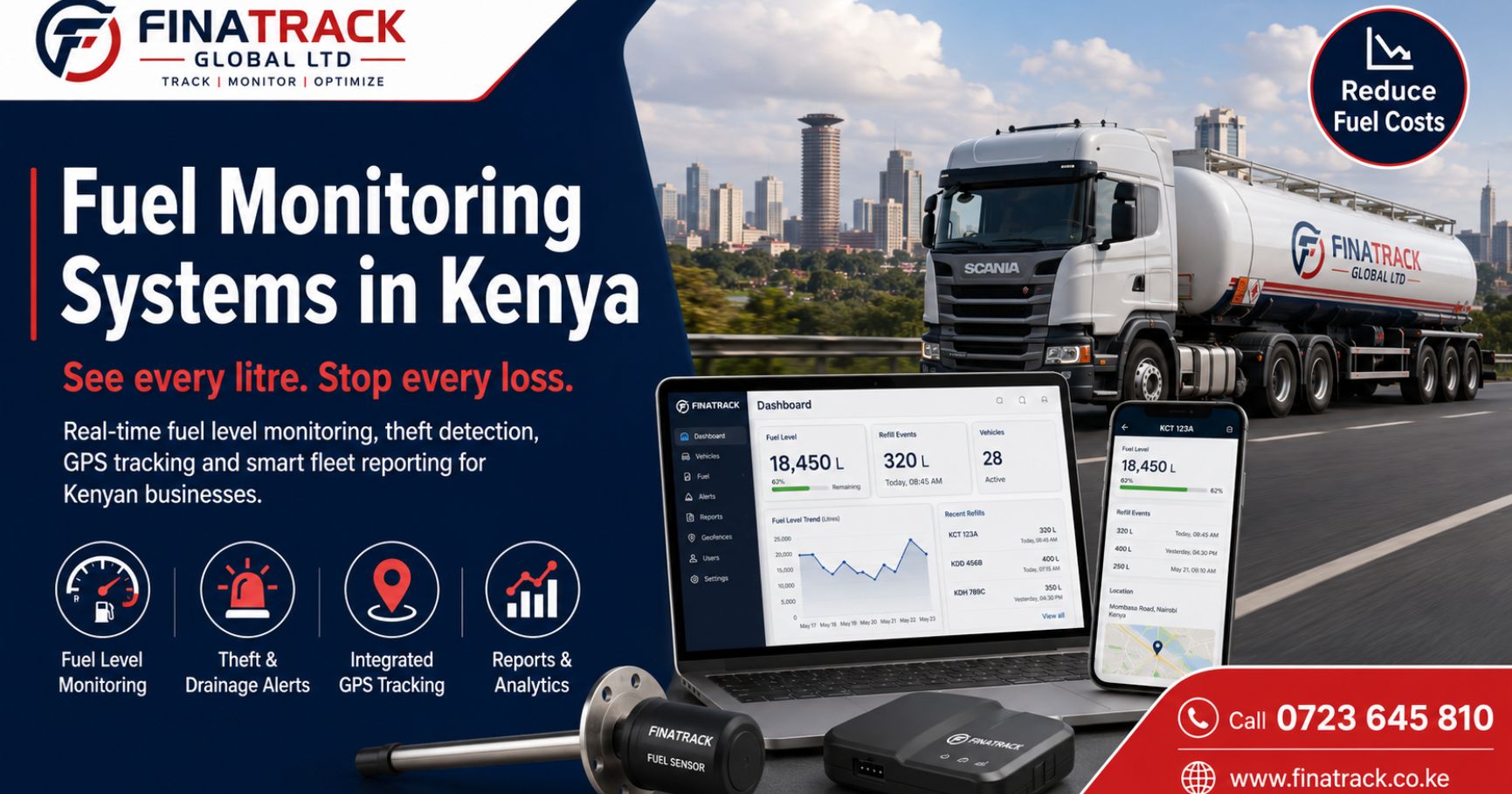
The system typically combines vehicle tracking technology with a fuel level sensor installed in or connected to the vehicle’s fuel tank. The sensor measures changes in fuel level while the GPS tracking platform associates those changes with the location and movement of the vehicle.
Instead of waiting until the end of the week or month to discover that fuel expenses are unusually high, fleet managers can monitor fuel activity much closer to when it occurs.
This creates something extremely valuable in fleet management.
Accountability.
When a vehicle is refuelled, the system can record an increase in the fuel level.
When fuel is consumed during normal driving, the fuel level should generally decline progressively.
If there is an unusual sudden reduction in the tank level, the system may identify the event for investigation.
This does not automatically prove that fuel theft has occurred. Changes in fuel level can sometimes be influenced by vehicle movement, tank shape, sensor configuration and other factors. A properly installed and calibrated fuel monitoring system therefore helps fleet managers distinguish normal consumption patterns from events that deserve attention.
The ability to identify possible fuel drainage is one of the reasons fuel monitoring systems are increasingly valuable to businesses operating commercial vehicles.
Fuel theft does not always involve somebody stealing an entire tank of diesel.
Small quantities removed repeatedly can become a substantial financial loss over time.
Imagine losing only 10 litres from a vehicle several times every month. Multiply that by 10, 20 or 50 vehicles and the cost can quickly become significant.
Without accurate monitoring, these losses can disappear inside normal fuel expenditure.
The business may simply conclude that its fleet consumes a lot of fuel.
The real problem could be something entirely different.
Fuel monitoring provides the visibility required to start asking the right questions.
The system can also improve the way businesses verify refuelling.
A receipt tells you how much fuel was paid for.
A fuel monitoring system can help you understand what happened to the fuel level around the time of that refuelling event.
This additional information becomes particularly valuable for companies where drivers refuel at different petrol stations across Kenya.
Managers do not have to physically accompany every vehicle to every fuel station.
Instead, they can use the monitoring platform to review vehicle location, fuel events and journey information.
This creates a digital trail that can complement fuel receipts, fuel cards and internal fleet records.
The benefits extend beyond theft prevention.
Fuel consumption is heavily influenced by how a vehicle is driven and operated.
Aggressive acceleration, excessive speeding, prolonged idling, unnecessary trips, poor route planning and mechanical problems can all contribute to higher fuel expenditure.
When GPS tracking and fuel monitoring information are viewed together, managers can develop a clearer picture of why a particular vehicle is consuming more fuel than expected.
Consider two trucks of similar capacity performing comparable work.
One regularly consumes significantly more fuel than the other.
Without sufficient data, management might simply accept the difference.
A good fleet management system allows the business to investigate further.
Is one driver speeding more frequently?
Does one vehicle spend longer periods idling?
Is one truck travelling unnecessary kilometres?
Could the vehicle have a mechanical problem?
Are there unexplained reductions in the fuel tank?
These questions turn fuel management from guesswork into a data driven process.
This is especially important for logistics and transport businesses where fuel represents a major part of the cost of completing each trip.
A transport company may negotiate excellent contracts and keep its trucks fully utilised, yet poor fuel control can still reduce the profitability of those contracts.
Knowing how much fuel each vehicle consumes allows management to understand the real cost of operating particular routes.
This information can support better pricing decisions.
If a company knows what it costs to move a truck from Nairobi to Mombasa, Nairobi to Kisumu or Nairobi to another destination, it can evaluate whether the amount charged to the customer adequately covers the trip.
Without reliable fuel information, businesses can sometimes quote transport prices based on assumptions rather than actual operating data.
The same principle applies to distribution companies.
A company delivering products to customers may have several vans leaving its warehouse every morning.
Fuel monitoring combined with GPS tracking can help management understand the journeys completed, kilometres travelled and fuel behaviour associated with those journeys.
For construction companies, fuel monitoring can be useful for trucks, excavators, generators and other equipment that consumes substantial quantities of diesel.
Construction operations can involve equipment working in remote locations where direct supervision is difficult.
Knowing what is happening to fuel can help project managers improve accountability and investigate unusual consumption.
For bus companies, school transport operators and other passenger fleets, fuel management can help identify inefficient operating patterns and improve cost control.
The larger the fleet becomes, the more important this visibility becomes.
Managing fuel for five vehicles manually may be possible.
Managing fuel for fifty or one hundred vehicles using receipts, spreadsheets and driver explanations can become extremely difficult.
A digital fuel monitoring platform can centralise information so that fleet managers can review multiple vehicles from one system.
Instead of asking every driver how much fuel is remaining, management can access information remotely.
Instead of waiting for paperwork to arrive at the office, managers can review system data.
Instead of discovering major discrepancies several weeks later, unusual events can be investigated much earlier.
That difference can have a direct financial impact.
However, installing a fuel sensor alone does not automatically solve every fuel management problem.
The quality of the installation and calibration is critical.
Vehicle fuel tanks are not always perfectly rectangular.
Some tanks have irregular shapes, internal compartments and structural features that affect the relationship between fuel height and actual volume.
This means that simply measuring the physical height of fuel in the tank is not enough.
The monitoring system normally needs to be calibrated so that different sensor readings correspond as closely as possible to actual quantities of fuel.
Proper calibration improves the usefulness of the reports produced by the platform.
Poor calibration can create misleading readings, which can result in false accusations, incorrect conclusions and unreliable management decisions.
Businesses should therefore choose a fuel monitoring provider based not only on price but also on technical capability.
The installer needs to understand the sensor being used, the vehicle, the tank configuration, calibration and integration with the GPS tracking platform.
The monitoring platform itself is equally important.
Fleet managers should be able to understand the information being presented without becoming technical experts.
Fuel graphs, location information, trip history and relevant alerts should help management interpret what has happened to the vehicle.
The objective is not to generate more data.
The objective is to generate information that management can actually use.
A well implemented system should make it easier to answer practical business questions.
How much fuel was added?
Where was the vehicle when it was refuelled?
How did the fuel level change after refuelling?
How much fuel was used during a particular journey?
Was there an unusual reduction in fuel level?
Where was the vehicle when the event occurred?
How does one vehicle’s consumption compare with another?
Which vehicles deserve closer investigation?
When these questions can be answered using reliable data, conversations between managers and drivers also become more objective.
Instead of accusing a driver based on suspicion, management can review information before deciding whether further investigation is necessary.
This is important because not every increase in fuel consumption is caused by driver misconduct.
Mechanical problems can increase consumption.
Tyre pressure can affect efficiency.
Heavy loads can increase fuel use.
Road conditions matter.
Traffic congestion matters.
Driving behaviour matters.
Long periods of idling matter.
Fuel monitoring should therefore be used as a management tool rather than simply as a system for catching drivers.
The most effective businesses use the information to identify problems, train drivers, improve processes and reduce unnecessary costs.
This can also improve relationships with responsible drivers.
When accurate information is available, drivers are less likely to be unfairly blamed for fuel discrepancies they did not cause.
The system creates greater transparency for both management and employees.
Another major advantage comes from combining fuel monitoring with GPS vehicle tracking.
Fuel data by itself tells only part of the story.
Location data provides context.
If a sudden fuel reduction occurs, GPS information can help establish where the vehicle was at that particular time.
Was it parked at the company’s yard?
Was it at a customer’s premises?
Was it stopped along the highway?
Was it at an authorised fuel station?
Was it operating outside its approved route?
Combining these different pieces of information makes investigations more meaningful.
This is why modern fleet management increasingly involves integration.
Vehicle location, fuel information, speed, trip history, geofencing and driver behaviour can work together to provide management with a more complete picture of fleet operations.
Fuel monitoring also helps businesses move away from reactive management.
Without technology, a company may realise it has a fuel problem only when monthly expenses become unusually high.
At that point, the money has already been spent or lost.
With monitoring technology, unusual activity can potentially be identified much earlier.
Managers can investigate before a small problem becomes a recurring loss.
For a business operating vehicles every day, this can make a considerable difference over twelve months.
The return on a fuel monitoring system should therefore not be judged only by its installation price.
Businesses should consider how much they currently spend on fuel every month.
They should consider how accurately that fuel is accounted for.
They should consider how much time managers spend reconciling receipts and investigating discrepancies.
They should consider whether they can confidently explain why one vehicle consumes more fuel than another.
They should also consider how much an undetected fuel loss repeated across several vehicles could cost the company over a year.
For fleets with high monthly fuel expenditure, even relatively small improvements in control can become financially meaningful.
Choosing the right fuel monitoring system in Kenya should therefore start with understanding the business problem.
A transport company may primarily want to control fuel theft.
A logistics company may want accurate trip fuel consumption.
A construction company may need visibility over equipment operating at several project sites.
A distributor may want to combine vehicle tracking with fuel accountability.
A large fleet may require centralised reporting across dozens of vehicles.
The technology should be configured around these operational needs.
Finatrack Global Ltd provides GPS tracking, telematics and vehicle security solutions for businesses operating vehicles in Kenya. Fuel monitoring can be integrated with GPS tracking to give businesses improved visibility over vehicle movement and fuel activity.
The solution is particularly relevant to trucking companies, logistics businesses, distributors, construction companies and organisations managing commercial fleets where fuel represents a significant operating expense.
Professional installation and calibration are an important part of creating reliable fuel information.
The objective should not simply be to install another device inside a vehicle.
The objective should be to help the business understand where its fuel is going.
For companies that have spent years managing fuel using receipts, spreadsheets and estimates, this represents a major change.
Instead of asking how much fuel should be remaining in the vehicle, the business can use technology to improve visibility.
Instead of relying entirely on explanations after a discrepancy has occurred, management has additional information to investigate.
Instead of treating fuel as an uncontrollable expense, businesses can begin managing it as measurable operational data.
That is the real value of fuel monitoring.
It is not simply about watching a fuel gauge remotely.
It is about improving accountability.
It is about detecting unusual activity.
It is about understanding consumption.
It is about identifying inefficiencies.
Most importantly, it is about protecting the profitability of the business.
If your company operates trucks, commercial vehicles, construction equipment or a fleet that consumes significant amounts of fuel, Finatrack Global Ltd can help you implement a GPS based fuel monitoring solution suited to your operations.
Contact Finatrack Global Ltd on 0723 645 810 to discuss your fleet and request a quotation.
You can also visit the Finatrack office at Vision Plaza, 1st Floor, Office 2, Mombasa Road, Nairobi or visit www.finatrack.co.ke.
Every litre has a cost.
When you cannot see where your fuel is going, small losses can easily become big expenses.
With the right fuel monitoring system, your business gains something even more valuable than fuel data.
It gains control.