A customer calls your office and says a scheduled delivery never arrived. The driver insists they went to the customer’s premises and waited there. Your dispatcher remembers seeing the vehicle in the area, but nobody can immediately prove exactly what happened. For Kenyan businesses operating delivery vans, trucks, motorcycles and field-service vehicles, situations like this are where GPS delivery tracking records can become particularly valuable.
A GPS tracker cannot automatically prove that a parcel was handed to a customer. What it can do is provide an independent record of where the vehicle travelled, approximately when it arrived, how long it remained at a location and where it went afterwards. When this information is combined with delivery confirmations, phone records, driver statements, photographs, signatures or dashcam footage, management can build a much clearer picture of a disputed delivery.
The first record to check is usually the vehicle’s trip history. Instead of asking the driver to remember an exact route from several days earlier, management can review the historical journey recorded by the tracking system. The route may show whether the vehicle travelled toward the customer’s location, which roads it used and whether it subsequently continued to other scheduled stops.
This becomes especially useful when a delivery vehicle makes many stops during the day. A driver serving ten or twenty customers may genuinely struggle to remember precisely what happened at one location. GPS history provides a timeline that can help management reconstruct the journey without depending entirely on memory.
The second question is whether the vehicle actually reached the expected delivery area. A location point near the customer’s premises may support the driver’s explanation, while a route that never approached the address raises a different set of questions. Fleet managers should still interpret GPS information carefully because positioning accuracy varies depending on satellite reception, buildings and the environment.
This means businesses should avoid making claims that GPS can prove a vehicle stopped at an exact doorway. In dense urban areas, the reported point may appear several metres away from the vehicle’s true physical position. The more useful question is whether the route and location history are reasonably consistent with the driver’s account of visiting the customer.
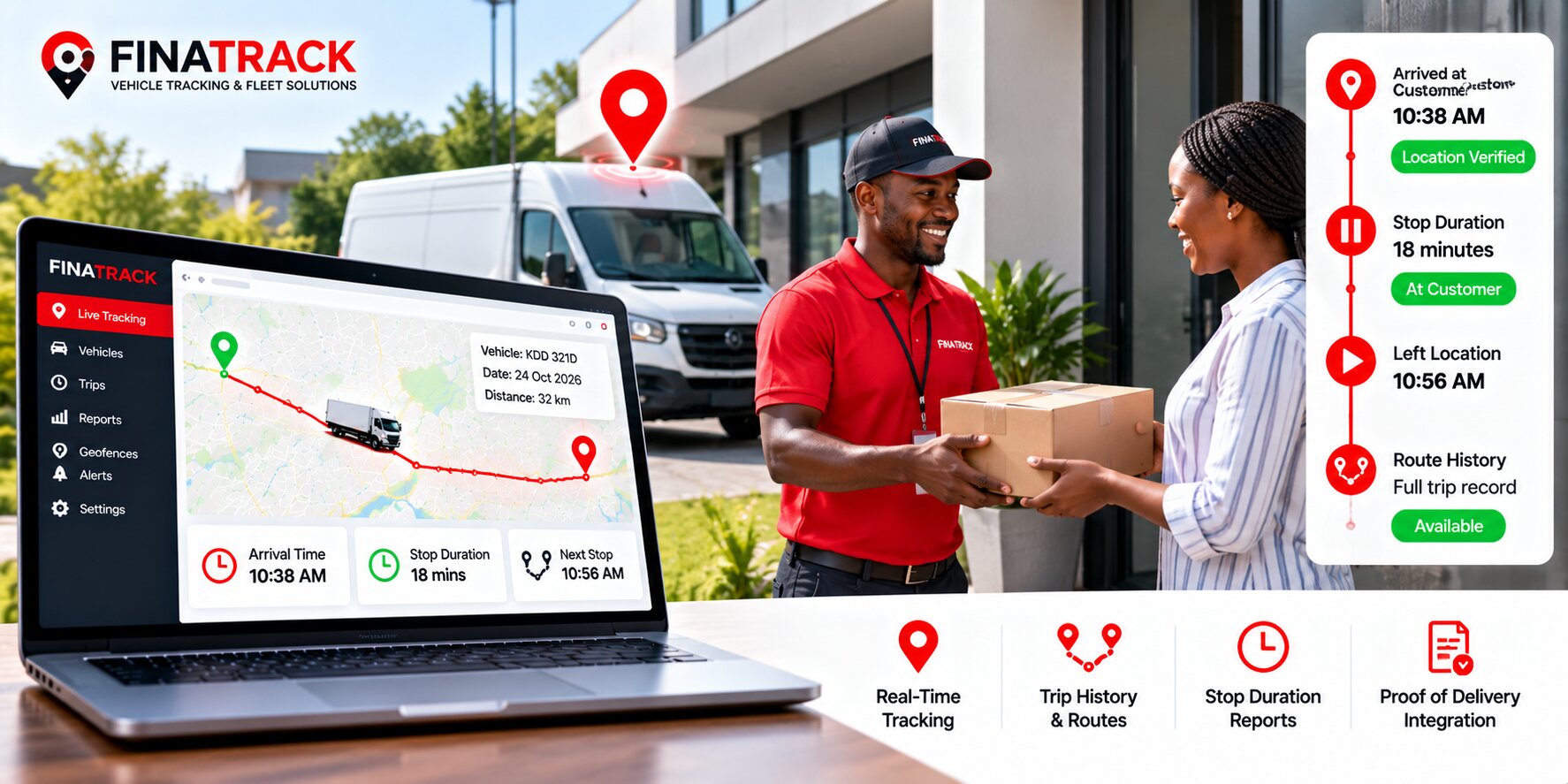
Arrival time can provide another important piece of evidence. A customer may insist that nobody came during the agreed delivery window, while the GPS history shows the company vehicle arriving in the area at 10:38 a.m. If the order was scheduled for between 10:00 a.m. and 11:00 a.m., the location record supports further investigation.
The reverse can also happen. A driver may report arriving at 10:30 a.m., but the vehicle’s trip history shows that it did not reach the customer’s area until after midday. This does not automatically prove dishonesty because job assignments, vehicle changes or tracking issues may need to be considered, but the discrepancy gives management something specific to investigate.
Stop duration can make the arrival record even more useful. A vehicle that passes along the road outside the customer for twenty seconds has a different story from one that remains stationary nearby for twenty minutes. GPS stop reports can help show whether the vehicle appears to have paused long enough for a normal delivery to take place.
Businesses should still be careful about defining what constitutes an adequate stop. Delivering a small envelope may take only a few minutes, while unloading furniture, construction materials or supermarket stock could require considerably longer. The appropriate duration depends on the work being performed.
A disputed delivery therefore becomes stronger when GPS information is compared with the planned job schedule. If the driver was assigned Customer A at 9:00 a.m., Customer B at 10:30 a.m. and Customer C at midday, trip history can show whether the sequence approximately matches those instructions. Large differences between planned and actual movement can reveal scheduling problems, route changes or possible missed assignments.
Geofencing can make this process more systematic. A business can create virtual boundaries around frequent customer locations, warehouses or branches. When a tracked vehicle enters or leaves a configured geofence, the platform can record the event or generate an alert depending on the system.
For regular deliveries, this can create a useful operational history. Management may know that the vehicle entered the customer’s delivery area at 10:38 a.m. and left at 10:57 a.m. That information is much more useful than simply knowing that the driver travelled somewhere in the neighbourhood during the morning.
However, a geofence entry is still not proof that the delivery itself happened. The driver may have reached the property but found the gate locked. The customer may have been unavailable. The wrong goods may have been loaded, or the driver may have delivered to a neighbouring business. GPS shows vehicle movement; it does not independently verify the commercial transaction.
This is why serious delivery operations should combine GPS data with electronic proof of delivery. Depending on the company’s workflow, this can include a customer signature, one-time verification code, photograph, recipient name or confirmation inside a delivery application. The strongest records show both that the vehicle reached the location and that the delivery process was completed.
Consider a dispute involving a delivery van that arrived at a customer’s premises at 2:14 p.m. GPS history shows the vehicle remaining there for sixteen minutes. The driver’s delivery application records the recipient’s name at 2:21 p.m., while a photograph shows the package at the customer’s reception. Those records together provide much stronger evidence than any single item by itself.
In contrast, GPS may show that the vehicle remained outside the location for fifteen minutes but there is no signature, photograph or delivery confirmation. Management may reasonably conclude that the vehicle reached the area while still being unable to confirm whether the goods changed hands.
Dashcam footage can sometimes provide additional context. A road-facing camera may show the vehicle entering the customer compound or approaching the relevant building. Depending on the camera system and recording configuration, footage may also help clarify where the vehicle stopped and what happened immediately before or after the disputed delivery.
Dashcams also have limitations. A windscreen-mounted camera may not see what happens behind the vehicle or inside a building. It may show the driver arriving at a customer but cannot necessarily show the package being signed for. Businesses should therefore treat video as another supporting record rather than automatic proof of delivery.
AI dashcam systems can become particularly useful when an incident occurs around the delivery. If the customer claims that the company’s vehicle damaged property, for example, recorded footage could help management investigate. GPS provides the location and timeline while video provides additional visual context.
Driver communication records can help as well. A delivery driver may have called the customer several times after arriving and received no answer. Combining those call attempts with GPS records showing the vehicle waiting at the location can help management understand why a delivery was unsuccessful.
The company should still avoid collecting unnecessary personal information simply because technology makes it possible. Operational records should be used for legitimate fleet and delivery purposes, and access should be limited to employees who require the information for their responsibilities.
Route history can also reveal whether the driver went to the wrong location. This is especially relevant when customers have similar company names, multiple branches or addresses that are difficult to identify. The driver’s records may show that the vehicle stopped at a branch several kilometres away from the destination on the order.
This does not necessarily mean the driver deliberately ignored instructions. The address entered into the navigation system may have been wrong, or the customer database may contain outdated information. Delivery disputes can therefore uncover data-quality problems inside the business itself.
Fleet managers should verify customer coordinates and addresses when repeated location problems occur. If several drivers struggle to find the same premises, blaming each driver individually may fail to solve the underlying issue. Updating the delivery system with accurate coordinates, landmarks or contact instructions may prevent future disputes.
Another important record is the sequence of stops around the disputed delivery. Suppose the vehicle was scheduled to serve Customer B after Customer A. GPS history shows the driver leaving Customer A, stopping elsewhere for forty-five minutes, then travelling directly to Customer C without reaching Customer B. That pattern deserves investigation.
Conversely, the route may show a clear stop near Customer B between the two other scheduled deliveries. The dispute then shifts from whether the driver travelled there to what happened after arrival.
This ability to narrow the question is one of the biggest advantages of fleet data. Instead of management arguing with the driver about whether they “went there,” the business can focus on the part of the process that remains uncertain.
GPS can also help resolve timing disputes. A customer may say the driver arrived after closing time, while the route record can show the approximate arrival and departure times. If the vehicle reached the location at 5:35 p.m. when the customer’s receiving department closes at 5:00 p.m., the problem may be scheduling rather than driver performance.
This can lead to better route planning. If one delivery route consistently reaches its final customers too late, management may need to change the order of stops, departure time or number of deliveries assigned to the vehicle.
The same information can improve customer service. Instead of telling a customer, “The driver says he came,” staff can review the records before responding. A more professional response might explain that the vehicle reached the area at a particular time and that the company is checking the associated delivery confirmation.
Businesses should still communicate carefully. GPS records should not be used to aggressively dismiss a customer’s complaint. The customer may be correct that the goods never reached them even though the vehicle was present. The objective is to investigate the transaction accurately rather than win an argument.
Repeated delivery disputes involving one vehicle or driver deserve trend analysis. If complaints occur occasionally across a large fleet, they may reflect normal operational complexity. If one driver repeatedly records disputed deliveries, unusual stop patterns or missing proof-of-delivery records, management should investigate the recurring pattern.
The same applies to particular customers. A business may discover that several drivers regularly struggle with deliveries to one location. The customer’s receiving process may be confusing, security may restrict access or multiple branches may share a similar address. Data can help distinguish driver-level problems from customer-location problems.
Delivery motorcycles can also benefit from this approach. A rider may complete many short trips within Nairobi, making manual reconstruction difficult. GPS trip history can provide a chronological record of movement, while electronic proof of delivery confirms the handover.
For courier businesses, the combination can become part of the customer experience. Customers increasingly expect better visibility over deliveries rather than simply being told that a package is “on the way.” Controlled location information and delivery status updates can reduce calls to customer-service teams.
However, businesses should avoid providing customers with unrestricted access to their full tracking platform. A customer should only see information relevant to their own shipment. Exposing the locations of unrelated fleet vehicles could create privacy and security risks.
Integration with dispatch or ERP systems can make delivery records even stronger. The business system knows which order was assigned to the vehicle, while GPS provides movement information. When those systems communicate, management can connect vehicle location directly with a specific job rather than manually matching records afterwards.
A delivery record could therefore include the order number, assigned vehicle, assigned driver, departure time, arrival time, stop duration and proof of delivery in one workflow. This can dramatically reduce the time required to investigate customer complaints.
Fleet managers should preserve relevant records after a serious dispute. Tracking platforms may retain trip history for a particular period depending on the service and configuration. Dashcam footage can also be overwritten as storage fills. If a delivery dispute could result in a significant financial claim, important records should be identified and preserved promptly.
This is particularly important for high-value goods. A dispute involving a low-cost parcel may be resolved through customer service procedures, while a missing shipment of expensive electronics, pharmaceuticals or industrial equipment may require much more detailed investigation.
High-value deliveries may therefore justify stronger monitoring. A vehicle could use primary GPS tracking, AI dashcam footage and an independent tracking device for the cargo or trailer where appropriate. Layered visibility provides more information if something goes wrong.
Businesses should still remember that no technology eliminates the need for good delivery processes. The driver should confirm the customer, check the goods, obtain the required proof of delivery and report unsuccessful deliveries promptly. GPS tracking supports these controls; it does not replace them.
Training matters because drivers need to understand why records are important. A driver who reaches the customer but forgets to obtain a signature creates an unnecessary dispute even when the goods were delivered correctly. Clear procedures reduce this uncertainty.
Management should also avoid using GPS data unfairly. A location record may contain normal positioning variation, especially around large buildings or enclosed areas. Decisions affecting employees should be based on the full set of available information rather than one point on a map.
The best investigation usually asks several questions together. Did the vehicle travel to the correct area? What time did it arrive? How long did it remain? Was the location consistent with the customer’s premises? Was there a delivery confirmation? Did the driver contact the customer? Is there relevant dashcam footage? What happened immediately before and after the stop?
When these records agree, the business can often resolve the dispute quickly. When they conflict, management knows exactly where further investigation is required.
Finatrack Global Ltd provides GPS tracking, fleet management and AI dashcam solutions that can help Kenyan delivery businesses create stronger operational records. Finatrack’s wired GPS tracker is available at KES 15,000, with vehicle location, trip history, geofencing, speed information and other tracking features depending on the configured solution. AI dashcams can provide additional video context for fleets requiring deeper visibility over road and driver events.
For professional installation and enquiries, call or WhatsApp 0723 645 810 or visit www.finatrack.co.ke. When a customer says a delivery vehicle never came, GPS should not be treated as magical proof that the delivery happened. Its real value is more practical: it can establish where the vehicle travelled, when it arrived and how long it stayed, allowing those facts to be combined with proof-of-delivery records, driver communication and video evidence to determine what actually happened.