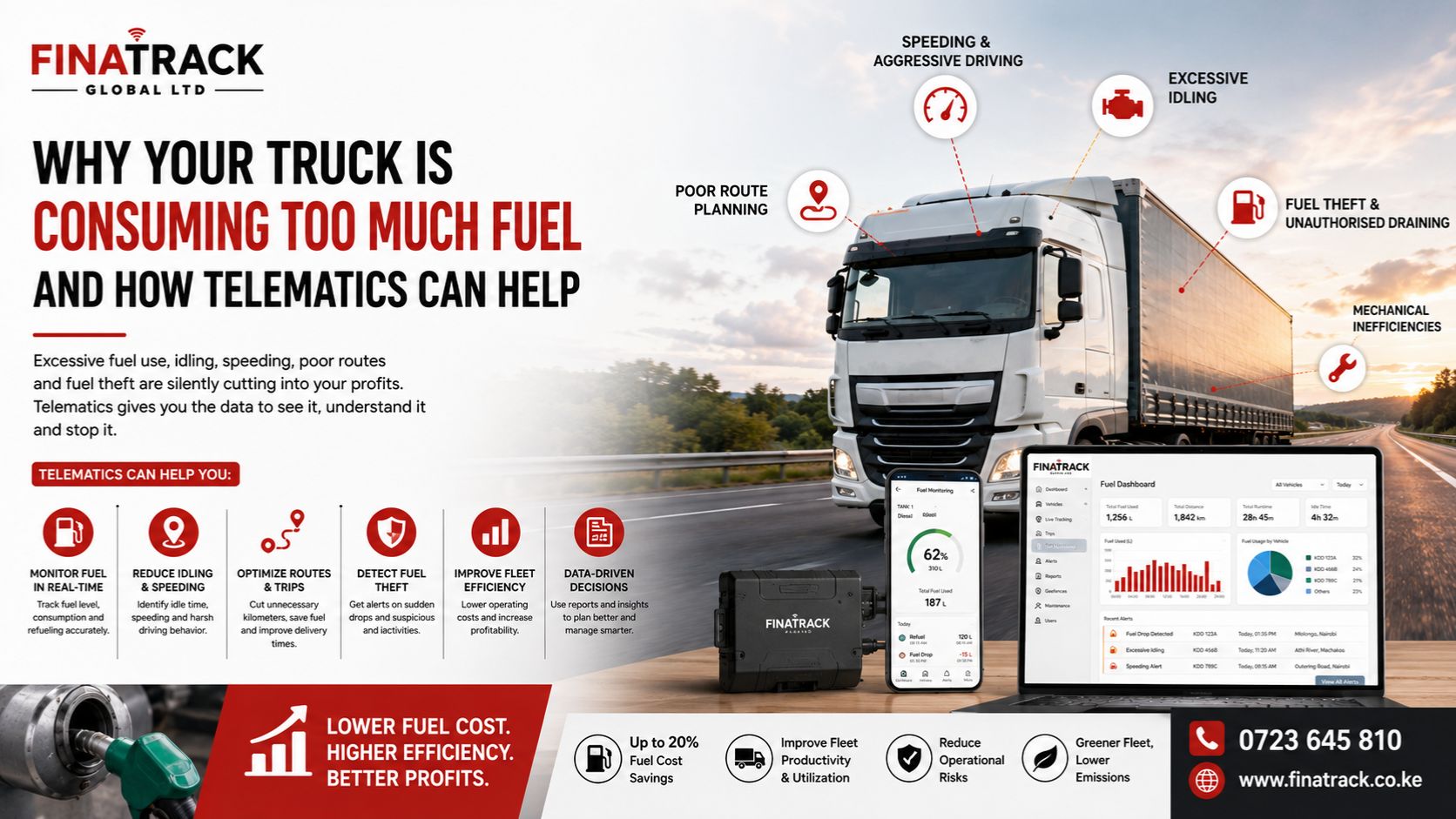
Why Your Truck Is Consuming Too Much Fuel and How Telematics Can Help
When a truck begins consuming more fuel than expected, the first reaction is often to blame the driver. In reality, excessive fuel consumption can come from several sources, including prolonged idling, speeding, aggressive acceleration, poor route planning, mechanical problems, excessive loads and fuel losses that are difficult to detect using receipts alone. For transport companies, the real challenge is not simply knowing that fuel costs have increased, but understanding why.
Fuel is one of the most important operating expenses in commercial transport, which means small inefficiencies can become expensive when they are repeated across several vehicles. A truck that burns slightly more fuel than expected on one trip may not immediately attract attention. Across dozens of trips and several vehicles, however, the same pattern can quietly reduce the profitability of an entire fleet.
Excessive idling is one of the most common sources of unnecessary fuel consumption. A truck can continue burning diesel while producing no productive mileage, whether it is waiting at a loading point, parked with the engine running or stationary while the driver takes a break. The US Department of Energy estimates that a typical heavy-duty truck can consume around 0.8 gallons of fuel per hour while idling, although the actual amount varies according to the vehicle and operating conditions.
For a fleet manager, the important question is therefore not only how much fuel was purchased, but how much time each vehicle spent running without moving. Telematics can help answer that by identifying periods where the ignition is on while vehicle speed remains at zero. Once that information is available, management can begin separating necessary operational idling from habits that are unnecessarily increasing costs.
Driver behaviour can also have a substantial effect on fuel consumption. Frequent harsh acceleration, high-speed driving, aggressive braking and unnecessary changes in speed require the engine to work harder and can increase fuel use. Modern telematics platforms can collect information relating to speed, acceleration, braking and cornering, allowing fleet managers to identify drivers whose operating patterns may be contributing to poor efficiency.
Speed deserves particular attention in heavy commercial vehicles because aerodynamic resistance increases significantly as a vehicle travels faster. The US Environmental Protection Agency has noted that increasing highway speed can reduce fuel economy in heavy trucks, illustrating why consistently driving above efficient operating speeds can have a direct effect on fuel costs.
The solution is not simply to accuse every fast driver of wasting fuel. A professional fleet-management approach looks at patterns. If one truck consistently consumes more fuel than similar vehicles on comparable routes, telematics data can help management determine whether the difference is associated with higher speeds, longer idling periods, unusual routes or another operational factor.
Route inefficiency is another common reason fuel consumption rises. A truck may travel considerably further than management assumes because of unnecessary diversions, poor planning, repeated backtracking or avoidable congestion. Traditional fuel records may show that more diesel was used but provide little explanation for where the extra kilometres came from.
GPS telematics provides that missing context. Fleet managers can compare the route actually travelled with the route that was expected, examine trip distances and identify unnecessary journeys. Modern fleet systems use GPS and trip information to support route optimisation, dispatching and fuel management, particularly where unnecessary mileage and idle time are driving operating costs upward.
For a logistics company, these differences can directly affect the profitability of individual jobs. A truck assigned to move cargo from Nairobi to a particular destination may appear profitable when management uses an estimated fuel cost. If the vehicle repeatedly covers additional kilometres because of poor routing or unauthorised movement, the true cost of the trip can be significantly higher than the amount originally used when pricing the job.
Telematics therefore allows businesses to move toward more accurate cost management. Instead of assuming what a route should cost, the company can examine actual journey distance, travel time, idling and fuel behaviour. This gives management a better foundation for evaluating the true operating cost of each vehicle and route.
Mechanical condition can also affect fuel efficiency. Engine problems, poorly maintained components and other vehicle issues can increase fuel consumption even when the driver is operating responsibly. Tyre condition and pressure, for example, can influence efficiency, while problems that increase rolling resistance or reduce engine performance may gradually raise fuel use without producing an obvious breakdown.
This is why a high-consumption vehicle should not automatically become a disciplinary issue. If two drivers operate similar trucks on similar routes but one vehicle consistently performs worse regardless of who is driving it, maintenance may deserve closer investigation.
Telematics can help identify these patterns by allowing managers to compare vehicles over time. Fleet-management platforms can combine vehicle data, utilisation information and driver behaviour records to help businesses determine whether an efficiency problem appears to follow the driver, the route or the vehicle itself.
Vehicle load is another factor that cannot be ignored. A heavily loaded truck generally requires more energy to accelerate and climb gradients than an empty or lightly loaded vehicle. Stop-and-go operations can also produce poor fuel economy because heavy vehicles repeatedly accelerate from low speeds. US Department of Energy data shows that heavy vehicle categories operating under demanding duty cycles can achieve significantly lower fuel economy than lighter vehicles or trucks operating more consistent highway routes.
For fleet managers, the objective should therefore be comparison rather than arbitrary targets. A loaded long-distance truck should not necessarily be expected to consume fuel at the same rate as an empty vehicle returning on a flat route. Fuel-performance analysis becomes more useful when vehicles are compared under similar operating conditions.
Fuel theft and unauthorised drainage introduce another problem entirely. In these cases, the truck may not actually be consuming the missing fuel through the engine. Fuel can disappear from the tank while management records the loss as poor vehicle efficiency.
This is particularly difficult to identify where businesses depend heavily on fuel receipts and driver reports. A receipt can confirm that fuel was purchased, but it does not necessarily show what happened to the fuel after it entered the tank.
Fuel-level monitoring adds another source of information. Teltonika describes dedicated fuel-level sensors as a particularly useful option for high-precision monitoring in trucks, lorries and other heavy-duty applications, while fuel telematics can also use vehicle data or other sensor inputs depending on the installation.
A properly installed fuel-monitoring system can help show gradual fuel consumption, refuelling events and sudden reductions in tank level. A sharp decrease while the vehicle is stationary may deserve investigation, particularly where the drop does not correspond with normal engine consumption.
The location of the event can make the information considerably more useful. If fuel drops suddenly, GPS data can show where the truck was at the time. Management can determine whether the vehicle was at an authorised fuel station, company yard, customer location or an unexpected roadside stop.
This connection between fuel information and GPS movement is one of the strongest advantages of telematics. Fuel data alone tells management that something happened inside the tank. GPS provides the geographical context needed to investigate what that event may represent.
Finatrack Global Ltd currently provides a fuel-monitoring telematics solution that combines fuel-level monitoring with GPS information. The system is designed to support real-time fuel-level visibility, refuelling records, detection of abnormal fuel drops and analysis of consumption alongside vehicle location, trips and idle time.
For businesses managing trucks, this creates an opportunity to move away from managing fuel only through paperwork. Receipts, fuel cards and driver reports can remain part of the process, but telematics introduces an independent source of operational information that can be compared against those records.
Consider a truck that is allocated 300 litres of diesel for a trip. The fuel receipt confirms that the money was spent, but management later finds that the truck requires significantly more fuel than expected before completing the journey. Without additional data, the company may struggle to determine whether the problem was excessive driving, idling, fuel loss, mechanical inefficiency or an inaccurate original estimate.
With telematics, management can review the route travelled, kilometres covered, periods of idling, speed behaviour and fuel-level changes. The investigation becomes based on several pieces of data rather than on suspicion alone.
This is important for driver relations as well. Fuel monitoring should not be introduced simply as a system for catching drivers. Used properly, it can also protect responsible employees from being blamed for losses they did not cause.
A driver may appear to have used excessive fuel when the actual problem is a mechanical fault. Another may be accused of fuel theft when the truck is simply consuming more because of a heavier load or difficult road conditions. Reliable data helps management distinguish between these possibilities before reaching conclusions.
The most effective fleet operators therefore use telematics as a management system rather than as a surveillance tool. The objective is to identify patterns, improve driver coaching, reduce unnecessary idling, investigate unusual fuel events and understand how individual vehicles perform over time.
There is also an important pricing benefit. Transport companies often quote customers based on assumptions about fuel consumption. If those assumptions are wrong, the business may accept jobs that appear profitable but generate little or no margin once the real operating cost is considered.
Telematics gives management better information about actual route performance. A company can compare the fuel and distance associated with particular journeys and use those records to improve pricing, budgeting and vehicle allocation.
For larger fleets, benchmarking becomes especially useful. Management can compare similar trucks and identify outliers. If nine vehicles operating under comparable conditions achieve similar fuel performance while one truck consistently consumes significantly more, the system can flag that vehicle for closer investigation.
The same approach can be used with drivers. Repeated speeding, long idling periods or aggressive acceleration may indicate where coaching could improve efficiency. The goal should be to identify recurring behaviour rather than overreact to a single event.
Geofencing can provide additional control. A company can define authorised operating areas or fuel stations and receive information when vehicles move outside expected routes. When combined with fuel data, this can help management understand whether unusual fuel events occurred in authorised or unexpected locations.
Driver-monitoring systems and AI dashcams can add another layer by giving managers context around driving behaviour. However, fuel management does not require every fleet to adopt every available technology at once. The strongest starting point is identifying the largest source of uncertainty in the business and selecting technology that provides better information about that problem.
For some fleets, that problem is idling.
For others, it is fuel theft.
For another company, it may be poor route control or inconsistent driver behaviour.
Telematics becomes valuable because it brings several of these issues together within one operational view.
Businesses should also remember that installing a fuel sensor does not automatically guarantee useful data. Fuel tanks can have irregular shapes, internal compartments and other characteristics that influence readings. Calibration is therefore an important part of professional fuel-monitoring installation.
Teltonika’s technical documentation for fuel-sensor integrations specifically recognises calibration as part of fuel-level monitoring configuration, reinforcing the importance of correct installation when businesses require reliable measurements.
Poor calibration can create misleading readings and unnecessary disputes. A business considering fuel monitoring should therefore evaluate the technical capability of the installation provider rather than selecting a system purely on price.
Another important distinction is between detecting fuel loss and proving theft. A sudden reduction in fuel level is an event that deserves investigation, but it should not automatically be treated as evidence that a particular employee stole fuel. Sensor readings, vehicle movement, location and other available information should be considered together.
A professional system should help management ask better questions, not encourage premature accusations.
The financial case for telematics becomes stronger as the fleet grows. A small percentage of wasted fuel may appear insignificant on one vehicle, but the same inefficiency across twenty or fifty trucks can become a substantial recurring expense.
The US Department of Energy’s work on heavy-truck idling illustrates how fuel can be consumed continuously without productive vehicle movement, while modern telematics platforms are designed specifically to identify patterns such as idling, speeding and route inefficiency.
This is why fuel management should be approached as an operational discipline rather than simply as an accounting exercise.
Accounting can tell the business how much it spent on fuel.
Telematics can help explain why.
For a transport company, that difference matters.
A truck that appears expensive to operate may have a mechanical problem.
A route may be poorly planned.
A driver may be idling excessively.
Fuel may be disappearing from the tank.
Or the company’s original fuel assumptions may simply be unrealistic.
The value of telematics is that management can begin separating these possibilities using actual vehicle data.
Finatrack Global Ltd provides GPS tracking, fuel monitoring and fleet telematics solutions for commercial vehicles and businesses in Kenya. Its fuel-monitoring system combines vehicle location with fuel-level information to help organisations monitor consumption, refuelling and unusual fuel activity.
For businesses operating trucks, the objective should not simply be to buy less fuel.
It should be to understand exactly where the fuel already being purchased is going.
Because once fuel consumption becomes measurable, it becomes much easier to manage.
For professional GPS fuel monitoring and fleet telematics solutions in Kenya, contact Finatrack Global Ltd on 0723 645 810 or visit www.finatrack.co.ke.