GPS tracking has become an important part of vehicle security in Kenya, but modern vehicle theft is also becoming more sophisticated. Some criminals understand that many trackers depend on satellite positioning and cellular communication, creating concern among motorists about devices designed to interfere with those signals. That raises an important security question: what happens when somebody deliberately tries to prevent your tracker from communicating?
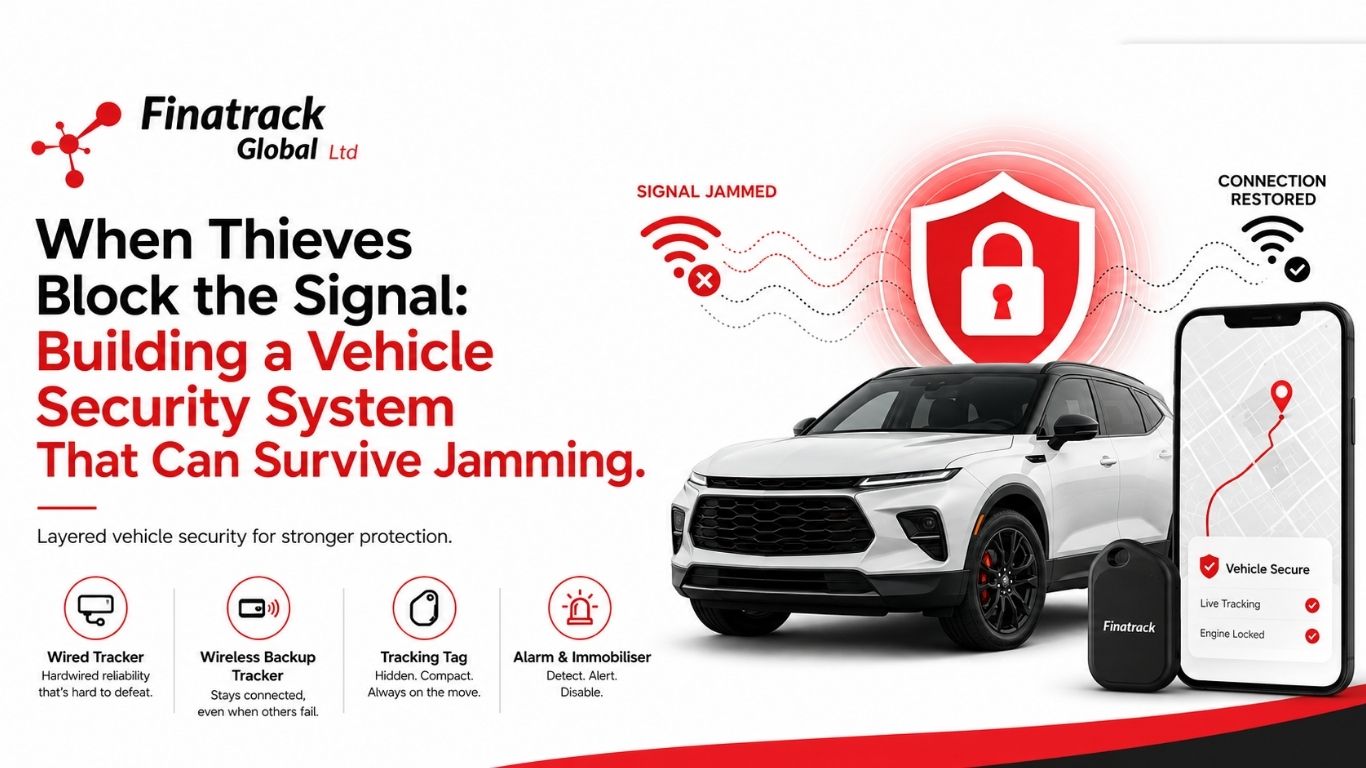
Signal interference should be considered a risk rather than a reason to abandon GPS tracking. The more useful response is to avoid depending entirely on one technology. A layered vehicle-security system can combine different devices and methods so that interfering with one layer does not automatically remove every possibility of monitoring or recovery.
A conventional wired GPS tracker provides useful everyday functionality such as vehicle location, trip history, ignition monitoring and other alerts depending on the system installed. Because it is connected to the vehicle, it can provide continuous monitoring without requiring the owner to repeatedly recharge the device. This makes it an important primary security and telematics tool.
The weakness of relying on only one tracker is that someone who discovers or disables it may remove the owner’s main source of visibility. A backup wireless tracker placed separately can provide an additional location source that does not necessarily depend on the same vehicle wiring. The primary and backup devices therefore fail in different ways.
A tracking tag can provide another independent layer depending on the technology being used. The purpose is not simply to install as many devices as possible, but to create redundancy. If one system is interfered with, another may continue providing useful recovery information.
Vehicle power is another consideration. Someone attempting to interfere with a car’s security may disconnect the battery in the belief that this will immediately disable tracking equipment. Some wired trackers contain backup power that can temporarily support operation after external power disappears, while an independently powered wireless unit may continue working according to its own battery and communication method.
This is why a power-disconnection alert can be particularly useful. An unexpected loss of tracker power outside normal maintenance conditions may provide early warning that something unusual is happening. If that event is followed by unexpected ignition or vehicle movement, the owner has more reason to treat the situation seriously.
Physical security should complement electronic tracking. An alarm, immobiliser or hidden cut-off can make unauthorised vehicle operation more difficult, while tracking supports monitoring and recovery. Building security around several different obstacles forces a thief to defeat multiple systems rather than locating one device and considering the job complete.
Installation discretion matters as well. A tracker that is easily visible behind a dashboard panel or connected using obvious wiring becomes easier to identify and remove. Professional installation should make the security system difficult to locate without compromising the device’s ability to operate reliably.
Motorists should nevertheless avoid becoming overconfident simply because several security devices are installed. No electronic system guarantees that a vehicle cannot be stolen, and criminals continuously change their methods. Layered security reduces exposure and improves recovery options, but owners should continue using sensible parking, physical security and appropriate insurance.
Businesses operating high-value commercial vehicles should consider these risks at fleet level. A truck carrying valuable cargo creates a different security exposure from an ordinary personal vehicle, and the tracking configuration should reflect that difference. Some fleets may justify primary tracking, backup tracking, video telematics and additional security controls on the same asset.
Response procedures are equally important. If tracking information indicates possible theft, vehicle owners and employees should avoid personally chasing or confronting suspected criminals. Location data should support appropriate security and law-enforcement response while personal safety remains the priority.
Finatrack Global Ltd provides wired GPS tracking, wireless tracking, tracking tags, alarms and other vehicle-security solutions that can be combined according to the customer’s risk profile. Vehicle owners can contact 0723 645 810, visit www.finatrack.co.ke, or visit Vision Plaza, 1st Floor, Office 2, Mombasa Road, Nairobi for professional installation.
The strongest vehicle-security strategy is not built around the assumption that one tracker will never fail. It is built around making sure that when one layer is attacked, another layer can still help protect the vehicle.