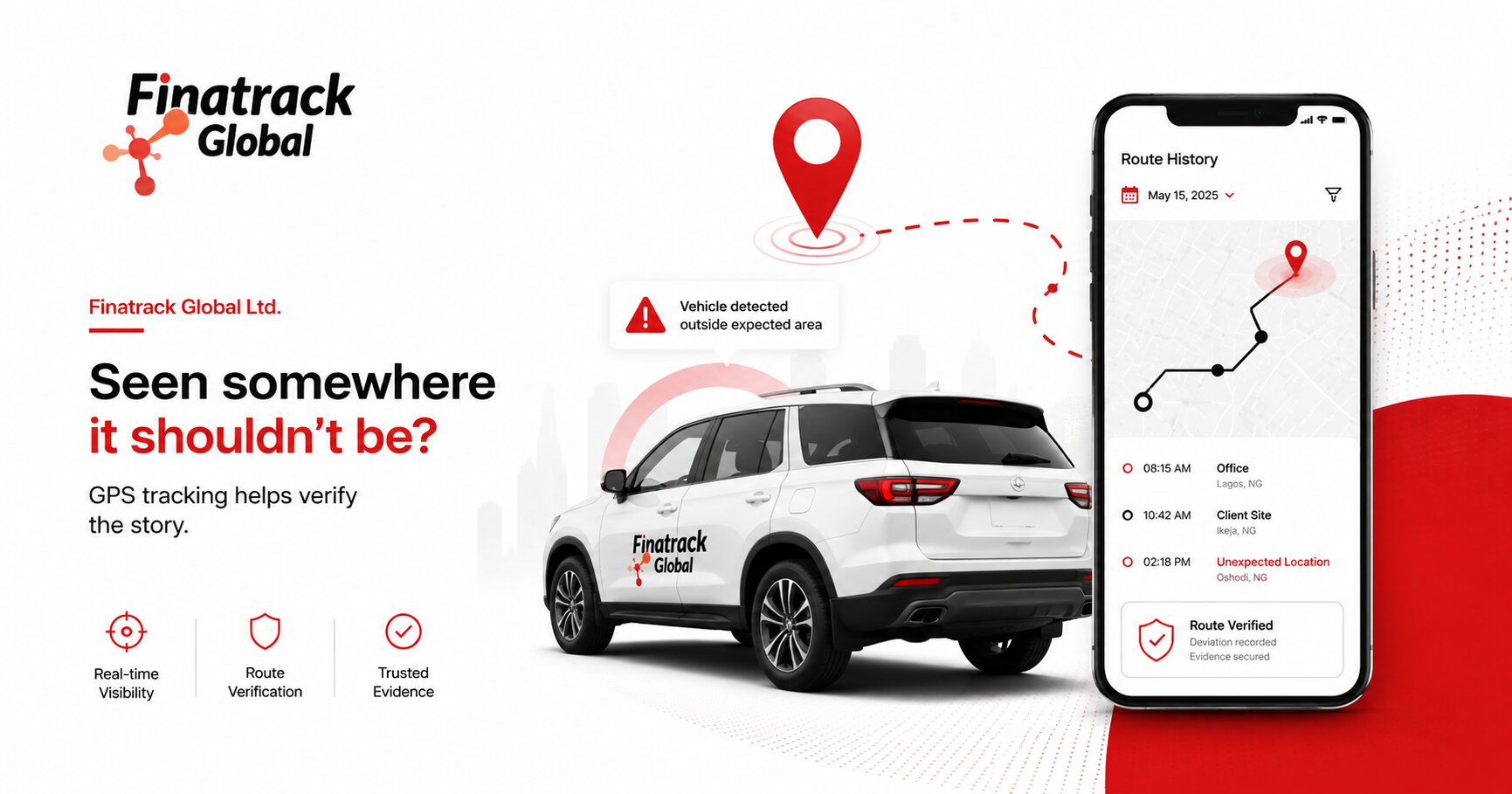
A company vehicle is supposed to support the work of the business, but situations sometimes arise that leave management asking uncomfortable questions. Someone may report seeing a company car outside a shopping centre during working hours, a customer may say the driver never arrived, or the vehicle may appear to have travelled somewhere completely unrelated to the employee’s assignment. Without independent information, management is often left choosing between what somebody claims they saw and what the driver says happened.
GPS tracking can help businesses replace much of that uncertainty with vehicle movement information. Depending on the tracking system installed, authorised managers can review the vehicle’s location, trip history, stops, ignition activity and other selected information from the tracking platform. This does not automatically explain why the vehicle was somewhere unusual, but it provides a much better starting point for establishing what actually happened.
Consider a company salesperson who is expected to spend the afternoon visiting customers in Industrial Area. Later, another employee claims to have seen the company vehicle several kilometres away in Westlands. The driver explains that a customer requested an urgent meeting there, and without further information management may have little way of verifying either version of events.
Trip history can provide useful context. Management can review where the vehicle travelled during the relevant period, approximately when it arrived at different locations and how long it remained there. If the recorded journey supports the driver’s explanation, the matter may be resolved quickly without unnecessary accusations.
The opposite can also happen. A driver may report spending most of the afternoon visiting customers in one part of Nairobi while the tracking records show the vehicle travelling elsewhere for several hours. That difference does not automatically prove misconduct, but it gives management a legitimate reason to ask for a clearer explanation.
This is an important distinction because GPS tracking should support good management rather than replace judgement. Location information can show where a vehicle travelled, but it cannot always explain why the journey occurred. A diversion may have been caused by traffic, an emergency assignment, a customer changing location or another legitimate business reason.
The strongest approach is therefore to compare tracking information with the employee’s assigned work. Customer appointments, delivery instructions, field reports and other business records can be reviewed alongside the journey history. When several sources of information point in the same direction, management can make decisions with much greater confidence.
After hours vehicle movement creates another common concern. A company car may be expected to remain parked after the end of the working day, yet trip history can show it travelling late in the evening or during weekends. If the business pays for fuel, insurance and maintenance, those additional journeys create costs even when no obvious problem appears immediately.
Clear vehicle use policies are essential in this situation. Some companies allow limited personal use of assigned vehicles, while others require cars to be used only for official business. GPS tracking works best when employees already understand the rules rather than discovering after the fact that management considers certain journeys unauthorised.
If personal use is permitted, the company should define the boundaries. Employees may be allowed to drive between home and work but not use the vehicle for unrelated long distance journeys, for example. Tracking records can then help management determine whether the actual use remains within the agreed policy.
The purpose should not be to question every kilometre travelled outside normal working hours. Senior staff, salespeople and field employees may have legitimate assignments that extend beyond a conventional office schedule. Management should focus on repeated unexplained patterns rather than treating one unusual journey as proof of misuse.
GPS trip history becomes particularly valuable when there are conflicting accounts. A customer may claim that a company representative never visited their premises, while the employee insists that the meeting took place. The tracking platform can help establish whether the vehicle reached the customer’s area and approximately how long it remained there.
Location alone should not be treated as proof that the meeting occurred. A vehicle could park outside a building without the employee actually meeting the customer. The GPS record simply confirms the vehicle’s movement and should be considered together with appointment records, phone calls, visitor logs or other evidence where necessary.
The same principle applies to deliveries. If a delivery driver says goods were delivered to a customer at 2 p.m., GPS data may confirm that the vehicle was at the customer’s location around that time. This supports the account, but proper proof of delivery such as a signed delivery note or electronic confirmation remains important.
GPS therefore answers one type of question particularly well: where was the vehicle? It is much less reliable for answering questions about exactly what the employee did after arriving there. Businesses should understand that limitation before using tracking records in internal investigations.
Stops can provide another useful clue. A vehicle may travel along its normal route but remain parked at an unusual location for a long period during working hours. Management can identify that stop in the trip history and ask whether there was a legitimate business reason for it.
A twenty minute stop may have a simple explanation such as lunch, customer paperwork or a phone call. A vehicle repeatedly spending two hours at the same unrelated location every working day may deserve closer review. Patterns usually provide more useful management information than isolated events.
This is where GPS tracking becomes especially useful for companies operating field teams. Managers cannot physically supervise every salesperson, technician or delivery driver while they are away from the office. Trip history provides an independent operating record that can be reviewed when questions arise rather than forcing management to monitor employees continuously.
Real time tracking can also help when the issue is happening at that moment. A manager may receive a call saying that a company vehicle has been spotted somewhere unexpected. Instead of immediately calling the driver with an accusation, the manager can first check the tracking platform and confirm whether the vehicle is actually in that area.
The last update time should always be checked before drawing conclusions. A vehicle icon may remain on the map at an earlier location if the tracker has temporarily stopped communicating. The displayed position may therefore represent the last successfully transmitted location rather than where the car is at that exact moment.
If the timestamp is recent and the vehicle is reporting normally, management has stronger confidence in the location information. If the last update occurred several hours earlier, additional verification may be required. Understanding this difference prevents businesses from making decisions based on outdated tracking data.
Network conditions can also affect how vehicle movement appears. GPS trackers typically use satellite positioning to determine location and mobile communication to send that information to a tracking server. A vehicle travelling through an area with weak cellular coverage may temporarily appear offline even though it continues moving.
Depending on the equipment and configuration, historical journey information may upload later after connectivity returns. Management should therefore review the complete trip history before assuming that a temporary gap means the vehicle remained stationary. This becomes especially important for employees travelling outside major urban centres.
Geofencing can make unusual vehicle movement easier to identify without manually reviewing every trip. A business can create virtual boundaries around offices, warehouses, customer territories or approved operating areas depending on its needs. The tracking system can then identify when vehicles enter or leave those zones according to the configuration.
A sales vehicle assigned primarily to Nairobi may occasionally leave the city because of a legitimate customer assignment. The geofence event simply makes that movement visible so that management can verify it if necessary. It should not automatically be treated as evidence that the driver has broken company rules.
Geofencing is particularly useful for project vehicles. A pickup assigned to a construction site may be expected to remain within the project area for most of the week. If the vehicle regularly leaves the site and travels to unrelated locations, management gains an opportunity to investigate why.
The same approach can be used for vehicles assigned to branches. A company may have cars allocated to different territories, and repeated movement outside those territories can reveal either legitimate cross branch work or poor allocation. Tracking information helps management understand which explanation applies.
Ignition information can provide additional context when investigating unusual vehicle activity. A car may appear parked at an unexpected location, but management may want to know whether the engine was switched off or whether the vehicle was simply stationary for a short period. Depending on the installed system, ignition status can help explain the sequence of events.
Unexpected ignition activity outside working hours may also deserve attention. If a vehicle expected to remain parked overnight starts at 1 a.m. and then begins moving, management has a clear reason to verify what is happening. The combination of time, location and ignition information is more useful than any one signal on its own.
Vehicle security and employee misuse can sometimes produce similar tracking patterns, which is why managers need to respond carefully. A car moving somewhere unexpected may be driven by the assigned employee, another authorised staff member or someone who has taken it without permission. The first priority should be establishing who is in control of the vehicle rather than assuming the reason.
If theft is suspected, tracking information can support security and law enforcement response. Employees and vehicle owners should avoid personally chasing or confronting suspected criminals simply because the location is visible on a phone. Personal safety should remain more important than recovering the asset through direct confrontation.
Power disconnection information can add another layer during a security incident. If the tracker suddenly loses external power while the vehicle is in an unexpected location, this could indicate battery work, an electrical fault or possible interference with the tracking system. Management should examine the surrounding events before deciding what the alert means.
A sequence of unusual activity deserves more attention than a single isolated notification. Unexpected after hours ignition, movement outside an approved area and a subsequent power disconnection create a different risk picture from a simple route deviation during the working day. Good fleet management looks at the full sequence rather than reacting to alerts separately.
Businesses should also consider whether the employee had authority to change the route. Field work is rarely completely predictable, and customers frequently change meeting locations, deliveries are redirected and urgent assignments arise. A rigid tracking policy that treats every deviation as misconduct can quickly become impractical.
A better policy defines what employees are expected to communicate. A significant route change may require notifying the office, while minor adjustments may not. GPS tracking then becomes a tool for accountability when movements cannot be explained rather than a mechanism for controlling every driving decision.
Transparency with employees is important. Staff using company vehicles should understand that the vehicles are tracked for legitimate purposes such as security, fleet management, fuel control, maintenance and accountability. Clear communication reduces the likelihood that tracking will be viewed as secret surveillance.
Access to tracking information should also remain limited. A company vehicle’s history can reveal where employees, customers and business assets have been, so detailed data should only be available to authorised managers with a legitimate operational reason to view it. Giving broad access across the organisation creates unnecessary privacy and security risks.
This becomes particularly important for management and executive vehicles. A senior employee may travel to confidential client meetings, banks, legal offices or other sensitive locations. The fact that the vehicle is company owned does not mean every member of staff needs access to its movement history.
Tracking information should also be retained and used responsibly. Businesses should understand their internal data policies and ensure that fleet records are handled consistently with legitimate operational purposes. The technology should strengthen business management rather than create unnecessary exposure of personal or commercial information.
GPS data can help resolve disputes fairly for drivers as well. Employees are sometimes blamed for delays or unauthorised movement when they actually followed instructions. Trip history can support a driver’s explanation by showing that the vehicle was at the customer location or travelling along the required route.
This is one reason tracking should not be treated only as a tool for catching employees. Accurate information can protect responsible drivers from false accusations just as easily as it can expose repeated misuse. A fair system improves confidence on both sides.
Mileage information can reveal another dimension of unusual vehicle use. A company may notice that one vehicle is accumulating far more distance than comparable cars despite performing similar work. Trip records can help determine whether the difference comes from legitimate workload, inefficient routing or unnecessary journeys.
Unexplained mileage carries a direct financial cost. Every additional kilometre consumes fuel and brings the vehicle closer to servicing, tyre replacement and other maintenance requirements. Even if the employee pays for some fuel personally, the company still carries additional wear and depreciation on its asset.
This is why vehicle misuse should not be considered only as a disciplinary issue. It is also a fleet cost issue. A few unnecessary journeys repeated every week can gradually shorten the useful life of the vehicle and increase operating expenditure.
Fuel expenditure can be reviewed in the same context. If one company car regularly claims substantially more fuel while performing similar assignments to another vehicle, management can compare mileage and routes. The difference may be completely legitimate, but GPS data provides a starting point for understanding it.
Mechanical condition should also be considered before blaming vehicle use. A car with poor engine performance or another mechanical issue may consume more fuel despite travelling normal routes. Tracking provides operational context, while professional mechanical inspection helps determine whether the vehicle itself is contributing to the higher cost.
Driver behaviour can also influence fuel and maintenance expenditure. Repeated high speed, aggressive acceleration and harsh braking can increase operating costs while exposing the company to additional road risk. Depending on the telematics system installed, these patterns can be reviewed alongside journey information.
Individual events should always be interpreted carefully. Kenyan roads can require sudden braking because of pedestrians, motorcycles, potholes and unpredictable traffic. Repeated patterns over several journeys generally provide more useful information than one isolated event.
A vehicle appearing somewhere unexpected may also reveal poor scheduling rather than employee misconduct. A field employee may be driving across Nairobi repeatedly because customer appointments have been arranged inefficiently. Management may initially question why the car is in certain areas before discovering that the real problem lies in how assignments are being planned.
Trip history can therefore expose management inefficiencies as well as driver behaviour. If several vehicles regularly travel unnecessary distances between the same areas, the company may need to reorganise territories or appointments. GPS information should improve the entire fleet operation, not simply monitor individual employees.
The same is true for dispatching. A technician may appear far outside their usual territory because the office repeatedly sends them to urgent jobs while another closer vehicle remains available. Real time tracking can help management choose the nearest suitable resource and reduce unnecessary movement.
Understanding the reason behind unusual vehicle location is therefore the real objective. The map itself is only the beginning of the investigation. Management should ask what assignment the vehicle had, what route it took, how long it stopped and whether the movement was consistent with the employee’s explanation.
GPS tracking can also improve internal vehicle booking systems. When several employees share pool cars, confusion may arise about who used which vehicle at a particular time. Combining a booking or key control process with GPS trip records creates much stronger accountability.
The tracking platform can show when the vehicle moved, while internal records establish which employee had responsibility for the keys. This makes investigations easier when mileage, damage or unusual journeys are discovered later. Neither system is as useful alone as they are together.
Damage investigations can benefit from the same approach. A company car may return with new body damage while no employee accepts responsibility. GPS records may help establish which journeys occurred and who was using the vehicle, although they generally cannot show exactly how physical damage happened unless additional video or other evidence is available.
AI dashcams can provide more context where businesses require advanced monitoring. Video may help explain accidents or road incidents that GPS information alone cannot. The combination of location, telematics and video can provide a more complete record when significant disputes arise.
Businesses should still be cautious about excessive monitoring. Technology should be proportionate to the risk and operational needs of the organisation. A company operating three sales cars may not require the same level of telematics as a logistics business managing fifty trucks.
For many SMEs, basic information such as real time location, trip history, mileage, ignition status and selected alerts may already provide substantial value. More advanced systems can be introduced when the business has a clear reason for them. The objective is useful fleet management rather than collecting data simply because technology allows it.
Tracking reliability must also be considered before GPS information is used in serious internal decisions. A poorly installed tracker can produce communication gaps, incorrect ignition information or other inconsistencies. Businesses should ensure that devices are professionally installed and functioning normally.
If the tracking information appears unusual, technical verification may be appropriate before accusing an employee. A device that suddenly reports impossible movement or repeatedly drops offline may require inspection. Fair management depends on reliable information.
Trackers should also be checked after battery replacement or significant electrical work. A mechanic may accidentally disturb tracker wiring while performing an unrelated repair. The vehicle can continue operating normally while the tracking system becomes unreliable.
Regular fleet health checks help prevent this. Managers should periodically review last update times and confirm that recent journeys are appearing normally. Identifying an offline tracker during routine operations is far better than discovering the problem during an investigation.
Businesses should also know what to do when a vehicle genuinely appears somewhere it should not be. The first response should normally be verification rather than accusation. Check the location timestamp, trip history, ignition information and the employee’s assigned work before deciding how serious the situation may be.
If the movement has a legitimate explanation, the matter can be resolved quickly. If the explanation does not match the tracking record, management can investigate further using other relevant business information. This approach creates a much fairer process than relying on rumours or assumptions.
Repeated unexplained activity is where tracking becomes particularly valuable. One unusual trip may have an innocent explanation, but the same pattern every week deserves attention. Historical data makes recurring behaviour easier to identify than relying on managers remembering individual incidents.
Companies can then address the underlying problem through clearer policies, better scheduling, driver coaching or disciplinary procedures where appropriate. GPS provides the evidence required to understand the pattern, but management still determines the appropriate response.
The strongest fleet culture is one where employees understand that company vehicles are valuable business assets. They consume fuel, require maintenance and expose the organisation to financial and road safety risks whenever they move. Tracking helps make the management of those assets more structured and transparent.
Finatrack Global Ltd provides professionally installed GPS tracking and fleet telematics solutions for Kenyan businesses managing company vehicles, field teams and commercial fleets. Depending on the selected solution, businesses can access real time vehicle location, trip history, ignition monitoring, geofencing and other fleet management information.
Professional installation can be arranged at the customer’s convenient location or at Vision Plaza, 1st Floor, Office 2, Mombasa Road, Nairobi. Businesses seeking better visibility and accountability over company vehicles can contact Finatrack Global Ltd on 0723 645 810 or visit www.finatrack.co.ke to discuss an appropriate tracking solution.
When somebody says your company vehicle was somewhere it should not have been, the right response is not automatically to believe the story or dismiss it. GPS tracking gives management an independent record of vehicle movement that can help establish the facts, understand the context and make fairer decisions. For businesses managing vehicles away from direct supervision, that ability to replace assumptions with information can be one of the most valuable benefits of GPS tracking.