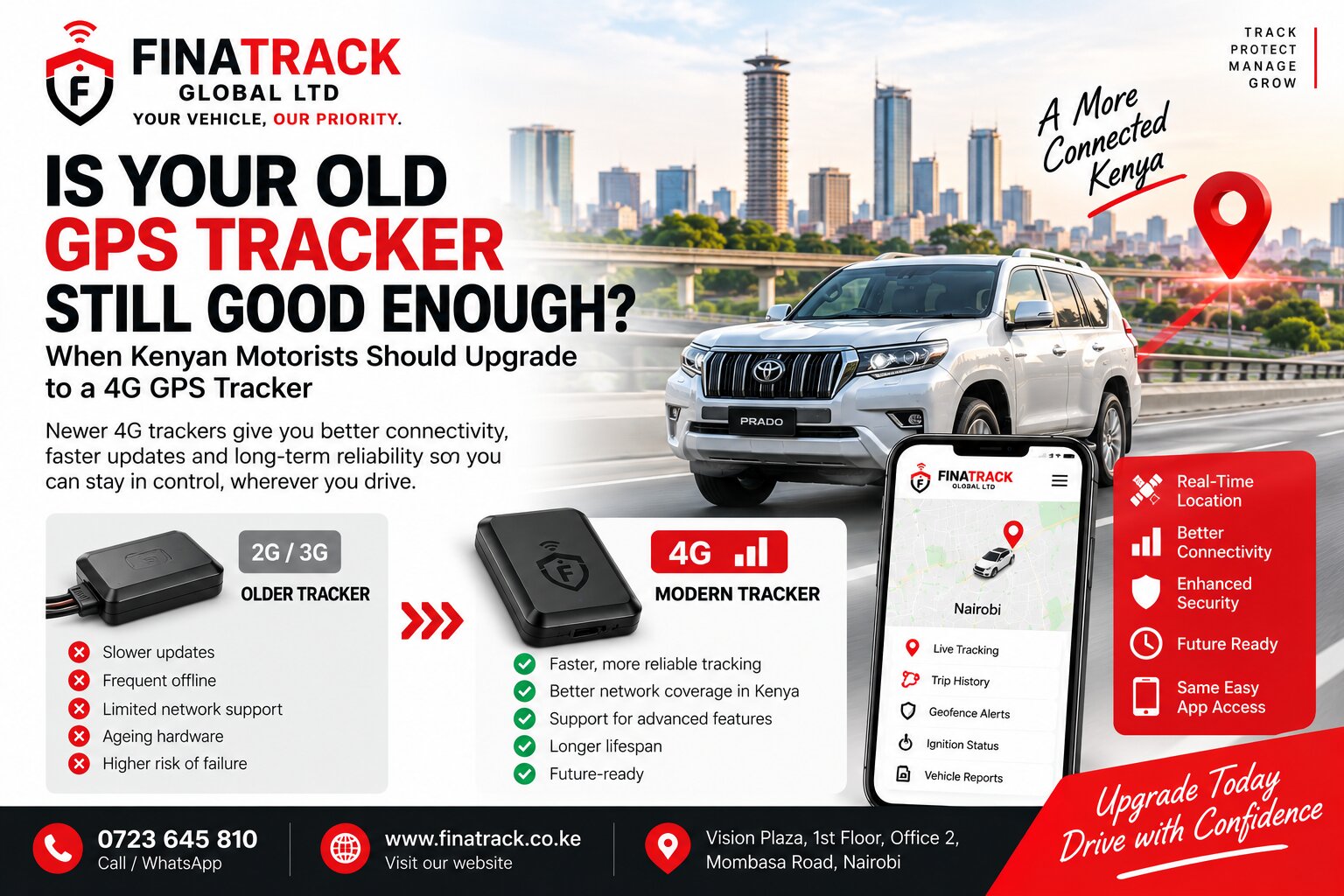
A GPS tracker can remain hidden inside a vehicle for years without attracting much attention. As long as the tracking application opens and the car appears somewhere on the map, many vehicle owners assume there is no reason to think about replacing the device. The problem is that mobile communication technology continues changing even when the tracker itself appears physically fine.
This matters because a vehicle tracker is not only a GPS receiver. The device normally determines the vehicle’s position using satellite navigation and then depends on a mobile communication network to send that information to the tracking platform. A tracker can therefore still be capable of determining its location while becoming increasingly limited by the cellular technology it uses to communicate.
For Kenyan motorists and businesses, the shift toward newer mobile-network technologies is already visible. The Communications Authority of Kenya reported in 2026 that 2G and 3G subscriptions were continuing to decline while 4G and 5G usage grew, and the Authority has said that nearly 98 percent of Kenya’s population is now covered by 4G networks. This does not mean every older GPS tracker has suddenly stopped working, but it does show clearly where the country’s communications infrastructure is moving.
The question for a vehicle owner should therefore not be whether every old tracker must immediately be thrown away. A better question is whether the device installed several years ago still provides the reliability, connectivity and security capability expected from a vehicle tracking system today. In some cases, an older tracker may continue operating adequately; in others, upgrading before the device becomes unreliable can be the more sensible decision.
It is important first to understand what “4G GPS tracker” actually means. The GPS or GNSS part of the tracker determines where the vehicle is, while 4G describes the cellular technology the device can use to transmit that information. Upgrading from an older cellular tracker to a 4G model does not automatically make the satellite position dramatically more accurate simply because the device now says 4G.
Location accuracy depends on several factors, including the GNSS receiver, antenna design, satellite visibility, installation position and surrounding environment. What 4G primarily changes is the communication channel through which the tracker sends information to the monitoring server. This distinction helps motorists avoid buying a tracker based on marketing terminology alone.
Modern 4G vehicle trackers are often built around LTE technologies designed for connected devices. For example, commercial telematics hardware is available using LTE Cat 1 while retaining 2G fallback on supported networks. Current tracker designs can combine 4G cellular communication with GNSS positioning, internal backup batteries, digital inputs and outputs, and other telematics functions.
For a vehicle owner, the practical advantage is longer-term network compatibility. A tracker installed today may remain in the vehicle for several years, meaning it makes sense to consider where communications technology is going rather than only what works this afternoon. Choosing equipment designed around a newer network generation reduces dependence on ageing technology.
This does not mean Kenya’s older mobile networks have disappeared. Communications Authority statistics still show 2G and 3G usage, although both have been trending downward while 4G has become increasingly dominant. Vehicle owners should therefore be cautious about dramatic claims that every 2G tracker in Kenya is already useless.
A functioning older tracker may continue providing acceptable service depending on its network, SIM arrangement and operating area. The case for upgrading becomes stronger when the device is showing signs of ageing or when the owner wants greater confidence that the installation will remain suitable for the coming years. Replacing equipment before failure is very different from replacing it simply because a newer model exists.
One of the clearest warning signs is frequent unexplained offline status. A vehicle that normally operates in areas with good mobile coverage should not repeatedly disappear from the tracking platform for long periods without explanation. Temporary network gaps can happen, but increasing communication failures deserve investigation.
The first step should not automatically be buying another tracker. Technical support should determine whether the problem comes from network coverage, wiring, SIM connectivity, device configuration, subscription status or the hardware itself. If an ageing tracker repeatedly struggles to communicate despite the rest of the installation being healthy, replacement may become the more economical option.
The last update time provides one of the easiest ways to identify this problem. A vehicle can appear on the map while the displayed position is actually several hours old. Owners should therefore look beyond the location pin and check when the device last successfully communicated.
If you drove the car this morning but the tracker still says the last update occurred yesterday, something needs attention. The issue may be temporary, but repeating this pattern creates a serious security weakness because the owner cannot confidently rely on the system during an emergency.
A second reason to consider upgrading is slow or inconsistent reporting. Vehicle trackers can be configured to send information at different intervals, and reporting frequency should not be confused directly with network generation. A poorly configured 4G tracker can still report slowly, while a properly configured older unit may perform well for its intended purpose.
However, newer hardware may provide better support for modern telematics applications and network communication. LTE Cat 1, for example, provides substantially greater data capability than older GPRS-based communication, which can be useful as tracking solutions become more sophisticated.
For basic location tracking, a vehicle does not require smartphone-level internet speeds. GPS coordinates themselves use relatively little data. The advantage of newer communication becomes more significant when the vehicle-security system is expected to handle more frequent reporting, additional sensor information, remote configuration or other telematics functions.
This becomes particularly relevant for businesses. A private owner may mainly want to check where one vehicle is, while a company fleet can generate location records, trip histories, ignition events, driver behaviour information and multiple alerts across many vehicles. The communication system behind the tracker needs to support that workload reliably.
Kenya’s machine-to-machine communications market is also growing. The Communications Authority reported that M2M subscriptions, which include SIM connections used by machines and connected devices for automated communication, reached around two million during the third quarter of the 2025/2026 financial year after growing 8.8 percent during the period. Vehicle telematics sits within this broader movement toward connected equipment.
Another warning sign is an ageing internal backup battery. Many wired trackers contain a small rechargeable battery that can keep the device operating temporarily after the main vehicle power is disconnected. This can be valuable during battery work, electrical problems or possible interference with the tracker.
Like every rechargeable battery, however, the internal battery ages. A device installed several years ago may still track normally while connected to the car but provide much less backup time than it originally did. Owners may only discover this weakness when the vehicle battery is disconnected.
Tracker replacement provides an opportunity to restore this security layer. Some modern 4G devices include integrated backup batteries along with cellular and GNSS connectivity. The presence and capacity of backup power still depend on the particular tracker, so owners should confirm the specification rather than assuming every 4G unit includes identical features.
Vehicle owners should also consider physical hardware condition. A tracker spends years exposed to heat, vibration and continuous electrical operation inside a vehicle. Even well-manufactured electronics eventually age, particularly where installation conditions are demanding.
Commercial trucks, motorcycles, construction vehicles and agricultural equipment may expose tracking hardware to even more vibration, dust or temperature variation than a private car. A device that has worked reliably for many years deserves credit, but age should still become part of maintenance planning.
Repeated unexplained resets, inconsistent ignition readings, missing trips or random offline events may indicate that an older installation requires attention. Sometimes the solution is rewiring rather than replacement; sometimes the device itself is reaching the point where upgrading becomes more sensible than repeatedly repairing it.
Another reason to consider 4G is future serviceability. As hardware generations change, manufacturers eventually reduce support for older products, firmware and components. A tracker may technically remain functional while becoming harder for providers to maintain efficiently.
Newer hardware generally gives the customer a longer support horizon. This becomes especially important for businesses that want to standardise a fleet rather than operate a mixture of devices installed over ten different years. Standardisation makes technical support, replacement and configuration easier.
A fleet company might have twenty vehicles where twelve use older tracker models and eight use newer 4G devices. If older units begin failing individually, management can choose to replace them gradually rather than waiting until several become problematic simultaneously. This creates a controlled migration rather than an emergency replacement programme.
Businesses purchasing new vehicles should consider the same issue. Installing an ageing tracker removed from an old car into a new vehicle may save money in the short term, but management should ask whether the hardware is suitable for another several years of service. A technically healthy modern tracker may be worth transferring, while an older device may be better retired.
The cost of installation should also be considered. Removing and reinstalling an old tracker requires technician time and vehicle access. If the hardware is likely to need replacement soon afterwards, paying for two installations can make less financial sense than upgrading during the vehicle change.
A 4G upgrade can also provide an opportunity to review remote immobilisation. Some vehicle tracking devices include digital outputs capable of controlling an external relay as part of an appropriately designed immobilisation installation. The exact functionality depends on the hardware, vehicle and installation configuration.
Owners should not assume that upgrading from 2G to 4G automatically creates remote engine control. Immobilisation is a separate feature requiring suitable hardware and professional wiring. Customers should ask exactly what is included in the proposed installation.
Where remote immobilisation is installed, safety remains essential. The system should not be used irresponsibly to disable a vehicle while it is moving in circumstances that could create an accident. Technology should strengthen security without introducing additional road risk.
A tracker upgrade is also an ideal time to review ignition detection. If an old tracking application repeatedly shows ignition off while the car is moving or ignition on long after the vehicle has been parked, the problem may involve wiring or configuration rather than the network itself. The installer should diagnose the system before blaming old cellular technology.
Accurate ignition information improves several other features. It can help distinguish normal parked status from vehicle activity, support trip reporting and provide useful context around unexpected movement. Businesses may also use ignition activity when reviewing idling and vehicle utilisation.
Power-disconnection alerts should be tested at the same time. A new tracker is not useful simply because it communicates over 4G if critical security settings are not configured properly. Hardware and configuration must work together.
This is one of the most important lessons for motorists comparing GPS trackers: 4G alone does not define a good tracking system. A poorly installed 4G device can provide worse security than a professionally installed older tracker that is operating correctly. Network technology is only one component of the overall solution.
Installation quality affects power reliability, antenna performance, ignition detection and concealment. The tracker also needs an appropriate SIM and active connection to a functioning monitoring platform. Technical support becomes critical when something goes wrong.
The monitoring software deserves equal attention. A vehicle owner should be able to identify the latest location, last update time, recent journeys and important alerts without struggling through a confusing application. A modern tracker connected to an unusable platform provides limited practical value.
Fleet customers may need even more functionality. Reports, geofencing, user access, vehicle groups and multiple-device management can become more important than the mobile network technology printed on the tracker specification. Businesses should therefore evaluate the complete service.
Another consideration is mobile network band compatibility. A device advertised online as “4G” is not automatically ideal for every country or network. LTE equipment supports specific frequency bands, and different hardware variants may be produced for different regions. Modern trackers can therefore have multiple versions with different supported LTE bands.
This is one reason importing the cheapest tracker from an overseas marketplace can create problems. The box may say 4G, but the buyer still needs to know whether the cellular module, SIM configuration and network bands are appropriate for Kenya. A professional local provider should select equipment intended for the operating environment.
Fallback capability can also be useful. Some modern LTE trackers support 4G communication while retaining 2G fallback where that older network remains available. This can provide additional communication resilience in areas where one network layer is temporarily more accessible than another.
Fallback should not be confused with depending permanently on 2G. The purpose of buying newer hardware is to make 4G the primary modern communication option while retaining additional compatibility where supported. This can be especially useful for vehicles travelling through diverse regions.
Kenyan businesses operating nationally need to consider more than Nairobi coverage. Trucks, sales vehicles, NGO fleets and project cars may travel through rural areas where network conditions differ significantly. The tracker should be selected according to the actual routes the vehicle operates.
The Communications Authority’s reporting shows substantial 4G expansion nationally, but no mobile network provides identical performance in every location. Nearly 98 percent population coverage is a strong indication of the direction of infrastructure, yet vehicle owners should still expect occasional weak-coverage areas.
GPS tracking should therefore be designed to handle temporary connectivity loss gracefully. Depending on the tracker and configuration, the device may store records internally and transmit them later when communication becomes available. Modern telematics devices can include significant internal storage for tracking records.
This feature is valuable because offline does not necessarily mean no journey data exists. A vehicle may temporarily disappear from live tracking and later upload historical records after reconnecting. Businesses operating in remote areas should ask whether their tracker supports this behaviour.
Owners must still distinguish between temporary network gaps and an unhealthy tracker. A vehicle that reconnects after leaving a weak-coverage area behaves differently from one that remains offline after returning to Nairobi. The second situation requires technical investigation.
The move toward newer tracking hardware is particularly relevant for long-term fleet investments. A company purchasing ten trackers today is not only buying ten devices for 2026; it may expect them to operate well into the next several years. Choosing a technology already aligned with current network growth makes greater strategic sense than deliberately building a new fleet around older connectivity.
The same principle applies to financed vehicles. Banks, SACCOs and other lenders may expect tracking equipment to remain active throughout a financing period. A tracker that becomes increasingly difficult to support halfway through that period creates unnecessary operational risk.
Private motorists should think similarly. If you plan to keep your car for another five years, the cost difference between maintaining an ageing tracker and installing a modern device should be considered over the full ownership period. Reliable security is more important than simply preserving old hardware because it still turns on.
Another argument for upgrading is security confidence. A tracking system often remains invisible during ordinary ownership and becomes most important during the one moment something goes wrong. Vehicle theft, hijacking or unexpected movement is a poor time to discover that the tracker had become unreliable months earlier.
This is why tracker health should be checked regularly regardless of network generation. Open the application periodically, confirm that the last update is recent and review one recent journey. The entire check can take less than a minute.
If the device repeatedly fails that simple test, technical support should investigate. The solution may be network configuration, SIM service, wiring or replacement. What matters is resolving the weakness before the vehicle faces a security incident.
An old tracker should also be checked after vehicle battery replacement. The device may have worked perfectly for years before a mechanic accidentally disturbed its connection. Upgrading to 4G will not fix poor workshop practices unless the new installation is also properly verified afterwards.
The same applies after dashboard work, alarm installation, audio modifications or other electrical repairs. Any work around aftermarket wiring can affect the tracking system. Owners should confirm normal operation before leaving the issue forgotten for months.
A 4G upgrade can provide an opportunity to reorganise a messy historical installation. Older vehicles sometimes accumulate alarms, trackers, immobilisers and other accessories installed by different technicians over several years. Removing obsolete equipment and installing one properly documented system can improve both reliability and future serviceability.
Documentation matters especially for business fleets. The company should know which tracker is installed in which vehicle, the installation date and the responsible account. When devices are replaced, the asset register should be updated rather than leaving old hardware identifiers attached to new vehicles.
Historical data should also be considered during replacement. Before removing an old tracker, businesses may need to preserve relevant trip or mileage information according to their reporting requirements. The new device should then begin with a clearly documented installation date.
User access provides another opportunity for improvement. A tracking platform that has been operating for years may still contain former employees or old administrators. An upgrade should include reviewing who can see the vehicle rather than simply exchanging hardware.
The same applies to private cars that have changed ownership. If you purchased a used vehicle with an existing GPS tracker, you should know whether previous users still have account access. Installing a new system or formally transferring account ownership provides a cleaner security starting point.
Motorists should also be cautious about the idea that 5G automatically makes 4G trackers obsolete. Vehicle tracking generally does not require the enormous bandwidth associated with consumer video streaming or similar applications. LTE technologies such as Cat 1 remain specifically useful for IoT and telematics applications.
A well-selected 4G tracker can therefore remain a sensible vehicle-tracking choice even as 5G expands. The objective is not always to install the fastest possible network technology; it is to use communication technology that provides appropriate coverage, reliability, longevity and device economics for the application.
The Communications Authority’s data shows both 4G and 5G growing while older technologies decline, but 4G remains a major part of Kenya’s mobile ecosystem. For vehicle tracking, this makes 4G a practical technology to consider when replacing ageing equipment rather than assuming every vehicle needs a 5G tracker.
Businesses should also avoid replacing every older tracker blindly. A fleet upgrade should begin with an inventory. Identify the device model, network technology, age, reliability, installation condition and whether it still meets operational requirements.
The company can then prioritise the weakest devices. Trackers that frequently go offline, have ageing backup batteries or depend entirely on older network technology may be replaced first. Recently installed reliable units can remain in service until there is a genuine reason to change them.
This staged approach controls cost while improving the overall fleet. Instead of waiting for widespread failures, the business gradually moves toward a more modern and standardised tracking environment. Replacement becomes planned maintenance rather than crisis management.
Private motorists can use a simpler version of the same decision. If your tracker has been installed for several years, ask your provider what cellular technology it uses. Then check whether the device is still supported and whether 4G replacement offers meaningful improvement.
Do not replace it simply because a salesperson says “4G is faster.” Ask what practical benefit the new installation provides. Does it improve long-term network compatibility, replace an ageing backup battery, provide better reporting or add functionality you genuinely need?
Also ask whether the quoted device has fallback capability and appropriate network-band support for Kenya. The specification should match the environment where the vehicle will operate. A professionally supplied tracker should not depend on guesswork about regional compatibility.
The cost of the complete service should be clear as well. Hardware, installation, subscription, technical support and any additional security features should be understood before purchase. Comparing only the physical device price can hide important differences between providers.
Finatrack Global Ltd provides professionally installed GPS tracking and vehicle-security solutions for private motorists and businesses in Kenya. Customers with ageing or unreliable trackers can have their current system assessed to determine whether technical repair, reinstallation or replacement with newer tracking hardware is the more appropriate option.
For motorists purchasing a new tracker, Finatrack can also advise on current tracking functionality, installation, vehicle compatibility and the security features required for the particular car or fleet. Customers should always confirm the exact specification and network capability of the device being installed rather than assuming every tracker marketed today uses the same cellular technology.
Professional installation can be arranged at the customer’s convenient location or through Finatrack Global Ltd at Vision Plaza, 1st Floor, Office 2, Mombasa Road, Nairobi. For GPS tracking enquiries and tracker upgrades, contact 0723 645 810 or visit www.finatrack.co.ke.
An old GPS tracker does not become useless simply because 4G has become dominant, and replacing functioning equipment unnecessarily does not make good financial sense. The real warning signs are repeated offline periods, unreliable reporting, ageing hardware, poor backup power and dependence on technology that no longer fits the owner’s long-term requirements. With Kenya’s mobile ecosystem continuing to move toward 4G and 5G, upgrading at the right time allows motorists and businesses to modernise vehicle security before an ageing tracker becomes the weakest part of the system.