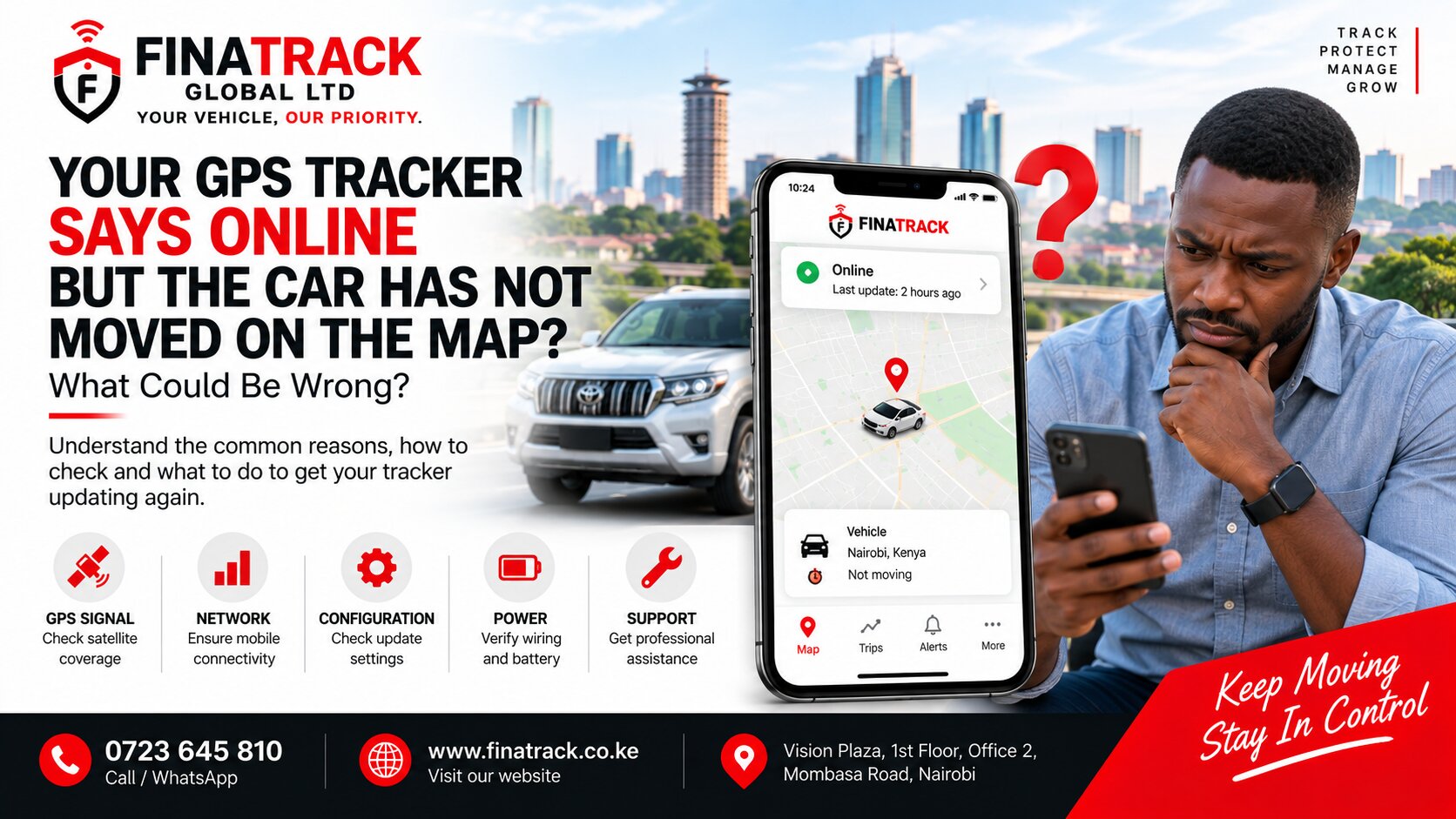
A GPS tracker can create confusion when the monitoring application shows the device as online but the vehicle icon appears stuck in one position. The owner may have driven several kilometres, yet the map still shows the car at home, at the office or at a location visited earlier in the day. Because the tracker is marked online, it is easy to assume the system is working normally even when the location information is no longer updating as expected.
This situation does not automatically mean the tracker is faulty. Vehicle tracking depends on several different systems working together, including satellite positioning, mobile network communication, device power, tracking configuration and the monitoring platform itself. A tracker can sometimes maintain communication with the server while failing to obtain or transmit a fresh location, which explains why “online” and “accurately updating” are not always the same thing.
For Kenyan motorists and fleet managers, understanding this distinction is important because the tracker is often relied upon during theft, vehicle recovery, employee monitoring or fleet operations. A tracker that appears online but continues displaying an old position can create a false sense of security if the user does not check the timestamp and movement history carefully. The first thing to look at should therefore be the last location update time, not simply the online status.
If the platform says the tracker is online but the location was last updated several hours ago, the vehicle position displayed on the map may already be historical. The tracker may still be communicating basic status information with the server while the GPS portion of the device has not produced a fresh position. This is why every vehicle owner should become familiar with the difference between device connectivity and location freshness.
A properly functioning tracker normally uses satellite signals to determine the vehicle’s position. The device then sends that position through the mobile network to the tracking server, where it appears in the application or web platform. If either side of that process becomes interrupted, the user can receive incomplete information even though the tracker itself has not completely gone offline.
One common explanation is poor satellite visibility. GPS receivers need access to signals from satellites, and those signals can become weaker when a vehicle is inside a basement, underground parking structure, enclosed garage or heavily shielded environment. In such cases, the tracker may remain powered and connected to the mobile network while struggling to calculate an accurate new position.
A car parked several floors underground in Nairobi, for example, may continue appearing online because mobile connectivity is still available inside the building. The actual GPS location, however, may remain the last successful position recorded before the vehicle entered the basement. Once the car returns to an open area with better satellite visibility, normal location updates may resume.
This can also happen in certain covered parking areas, shipping containers or buildings with substantial metal structures. The tracker may function perfectly once the vehicle returns outdoors, meaning there is no permanent hardware problem. The environment simply prevented the GPS receiver from obtaining a reliable satellite fix.
Vehicle owners should therefore consider where the car is physically located before assuming the tracker has failed. If the problem occurs only inside underground parking and disappears after driving outside, the behaviour may be explained by temporary GPS signal limitation. A tracker that remains stuck even after the vehicle spends several minutes in an open outdoor location deserves further investigation.
Another possibility is location update configuration. GPS trackers do not necessarily send a new location every second. The reporting interval can be configured according to vehicle movement, ignition status, time or other rules, depending on the device and tracking platform.
A tracker may report frequently while the vehicle is moving and reduce communication when the car is parked. This helps manage mobile data usage and device power consumption. The exact behaviour depends on how the unit has been programmed.
If the configuration has been changed accidentally or incorrectly, the tracker may appear to update far less frequently than the customer expects. The device can remain online while the map seems frozen for several minutes at a time. Technical support may need to review the reporting settings before deciding that the hardware is defective.
The difference between real-time tracking and periodic tracking is therefore important. Marketing descriptions often use the phrase real-time tracking, but in practice vehicle trackers normally transmit at configured intervals rather than producing a continuous video-like stream of location data. For ordinary fleet and security use, frequent updates can still provide effective visibility without the tracker sending information every second.
The appropriate reporting interval depends on the purpose of the tracker. A fleet vehicle being monitored actively may require more frequent position updates than a backup security tracker designed mainly to preserve battery life. There is no single configuration that is ideal for every type of vehicle and tracker.
A customer who expects second-by-second movement may therefore believe the system is failing when the tracker is actually operating according to its programmed reporting schedule. The tracking provider should explain how frequently the device is expected to update during normal movement. Understanding the configuration prevents unnecessary concern.
Another possible explanation is weak mobile network connectivity. Even when the tracker successfully calculates the vehicle’s GPS position, it still needs a communication network to transmit the information to the monitoring platform. If cellular coverage is weak or unstable, location information may be delayed.
This can create situations where the tracker appears intermittently online but the map is not updating smoothly. A vehicle travelling through rural areas, remote project sites or locations with weak mobile coverage may continue recording positions internally while struggling to transmit them immediately. Once connectivity improves, some devices may upload stored journey records depending on their configuration and storage capability.
For a fleet manager, this means a location gap does not automatically mean the vehicle stopped moving. The map may simply be waiting for information that the tracker has not yet been able to send. Historical trip records can sometimes fill the gap after communication returns.
The most important clue is whether the problem happens consistently in the same geographical area. If several vehicles lose updates around one remote route and reconnect normally afterwards, network conditions may be responsible. A tracker that remains stuck after returning to an area where it normally works should be examined more closely.
SIM or data-service problems can also contribute to delayed location reporting. Many GPS trackers contain a SIM used to send information to the tracking server. If the SIM has a service problem, incorrect network configuration or another connectivity issue, the tracker may behave unpredictably.
The user may occasionally see the device online because the tracker manages to connect briefly, but regular data transmission may remain unreliable. Technical support can check whether the communication service associated with the device is operating normally. This is one reason professionally managed tracking services can be easier for motorists than systems where customers are responsible for maintaining their own SIM cards.
Subscription status should also be checked. A tracker may remain installed and powered even where some part of the communication or tracking service has expired. Depending on the provider and platform, the user may still be able to open the application and see older information while new movement data is no longer being received normally.
Vehicle owners should therefore know when their tracking service requires renewal and what functionality depends on that renewal. The physical tracker and the tracking service are connected parts of the same system. Maintaining one while ignoring the other can lead to confusion.
Another common cause is poor tracker installation or wiring. A wired GPS tracker requires a stable electrical connection to operate consistently. A loose connection can allow the device to switch on and off intermittently, creating unusual behaviour on the tracking platform.
The tracker may reconnect frequently enough to appear online whenever the owner checks the application, yet repeated power interruptions can disrupt location reporting. This type of fault can be difficult to diagnose from the app alone because the problem happens inside the vehicle electrical system.
Professional inspection becomes especially important when the issue began after workshop repairs. Battery replacement, dashboard work, audio installation, alarm fitting or other electrical repairs can accidentally disturb tracker wiring. The car may work perfectly while the hidden tracking device develops an intermittent connection.
Owners should therefore ask themselves when the problem first appeared. If the tracker worked normally before a recent garage visit and became unreliable immediately afterwards, wiring should be one of the possibilities investigated. The mechanic may not have intentionally interfered with the device.
A simple visual inspection is not always enough because the tracker is normally concealed. An authorised tracking technician should test power, ground, ignition detection and communication rather than simply confirming that the device has a light showing. An unreliable connection can appear normal while the vehicle is stationary and fail only during vibration or movement.
Vehicle battery condition can also influence tracker performance. A weak battery may produce unstable voltage during starting or after the car has been parked for long periods. Some trackers are designed to tolerate a wide voltage range, but severe power problems can still cause resets or communication interruptions.
If the vehicle itself is experiencing slow starting, battery warnings or repeated electrical issues, the tracker problem may be part of a larger battery problem. Replacing the GPS tracker without checking the vehicle’s electrical condition could leave the original cause unresolved. Technical diagnosis should therefore look at both the tracker and the car.
The same applies after battery replacement. The new battery may work perfectly while the tracker connection was accidentally left loose or disconnected during the work. A vehicle owner should check tracking immediately after battery-related repairs rather than discovering the problem weeks later.
Another possibility is incorrect ignition detection. Some trackers use a wired ignition signal to determine when the vehicle is active. If that connection becomes faulty, the platform may think the vehicle is parked even while it is moving.
Depending on the device configuration, the tracker may then use a reduced reporting mode designed for stationary vehicles. The result can be delayed or missing movement updates even though the device itself remains online. A technician should verify whether ignition status in the application changes correctly when the car is started and switched off.
This is especially important for fleets because ignition data can influence trip reports, idling analysis and other management information. A tracker displaying incorrect ignition status can create more problems than simply a stuck map icon. The business may also receive inaccurate operating reports.
A quick check can sometimes reveal the issue. Start the vehicle while looking at the tracking application and confirm whether ignition status changes within the expected period. If the vehicle is clearly running but the system continues reporting ignition off, the installation may need attention.
GPS antenna performance is another possible cause. Some tracking devices contain internal antennas while others may use external antenna arrangements. Device placement therefore matters because certain materials and installation positions can reduce the ability to receive satellite signals.
A tracker hidden deep inside a metal enclosure may be difficult to find, but it may also struggle to obtain a reliable location. Professional concealment should balance security with communication performance. Hiding a tracker where it cannot function properly defeats the purpose of concealing it.
This problem can sometimes appear after the device has been physically moved. A mechanic or installer may reposition the tracker during unrelated work, leaving it in a location with poorer satellite visibility than before. The device stays powered and connected to the server but location accuracy deteriorates.
Professional testing should therefore include verifying GPS reception from the installed position. The technician should not assume that because the tracker appears online, the placement is suitable. Both cellular connectivity and satellite positioning need to work reliably.
Software or platform delays can also occur. The tracker may be transmitting correctly while the mobile application is temporarily showing cached or delayed information. Refreshing the app, checking the web platform or logging out and back in can sometimes help determine whether the problem is local to the application.
Users should avoid repeatedly uninstalling or resetting systems before confirming where the problem lies. If several vehicles on the same account appear stuck at the same time, the issue may involve the platform rather than each individual tracker. Technical support can usually determine whether the server is receiving fresh data.
Comparing the application with another device can also help. If the vehicle updates normally on the web platform but not on one phone, the tracker itself is probably not the problem. The user’s application or internet connection may need attention.
Location permissions on the owner’s phone should not generally determine whether the vehicle tracker itself sends GPS information, because the vehicle device has its own positioning system. However, phone settings can affect certain app functions, map behaviour or the owner’s location relative to the vehicle. This distinction prevents users from confusing the phone’s GPS with the tracker’s GPS.
A vehicle tracker is therefore fundamentally different from simply sharing a smartphone location. The tracker remains with the car and uses its own hardware to determine and transmit position. The phone primarily provides the interface through which the owner views that information.
Another issue can arise from device sleep modes. Some trackers are designed to reduce power use when the vehicle remains stationary. During sleep, the device may communicate less frequently or temporarily disable certain functions until movement, ignition or another configured event wakes it.
This is particularly relevant for vehicles that remain parked for several days. A motorist may open the application and notice the tracker has not generated a new position recently even though the vehicle has not moved. That behaviour may be normal depending on the sleep configuration.
The question becomes whether the device wakes correctly when the car starts moving. If location updates resume after the vehicle is driven, the system may be working exactly as intended. If it remains stuck despite normal movement, further diagnosis is required.
Wireless trackers can use even more aggressive power-saving strategies because they depend on internal batteries. A wireless backup device intended to operate for several weeks may not behave like a permanently powered wired tracker. It may report periodically rather than continuously.
Customers should therefore understand what kind of tracker they have. Expecting a long-battery-life wireless tracker to behave exactly like a wired fleet tracker can create unnecessary concern. Reporting frequency is often part of the trade-off between battery life and constant visibility.
The same principle applies to tracking tags and other backup technologies. They may operate differently from conventional GPS trackers and should be evaluated according to their intended role. Backup security devices are often designed for resilience rather than full-time fleet reporting.
For ordinary motorists using a wired GPS tracker, prolonged failure to update while driving should not simply be ignored. The tracking system exists specifically to provide movement visibility, so consistent delays deserve technical attention. The longer the owner waits, the greater the risk of discovering the failure during an actual theft.
This is why routine tracker checks are valuable. A vehicle owner does not need to monitor the car continuously, but opening the tracking platform periodically and reviewing one recent trip can confirm that the system remains healthy. A problem identified while the car is safely parked can be repaired without urgency.
Fleet managers should formalise this process. A monthly or weekly device health review can identify trackers with unusually old last-update times or missing trips. Large fleets should not wait for drivers to report the problem because the driver may have no reason to open the tracking application themselves.
A tracker marked online but showing no movement can also distort fleet utilisation data. Management may conclude that a vehicle spent the day parked when it was actually working normally. Mileage, trip history and driver accountability reports can therefore become inaccurate.
This can create financial consequences. A business may underestimate mileage and delay servicing because tracker data is incomplete. Fuel consumption can appear abnormal because the recorded distance is too low, while driver performance comparisons become unreliable.
Reliable telematics depends on reliable devices. Companies using tracking data for operational decisions should therefore treat tracker health as part of fleet maintenance. The technology is not simply installed and forgotten.
When troubleshooting a stuck location, it helps to compare several pieces of information together. Look at online status, last update time, GPS signal information where available, ignition status and recent trip history. One indicator by itself rarely provides the full answer.
For example, an online tracker with recent communication but no GPS position may suggest a satellite reception issue. A device with old communication and no recent trips may point more toward cellular, power or service problems. Incorrect ignition status can point toward installation or configuration.
This is why screenshots alone are sometimes insufficient for diagnosis. Technical support may need to review device logs or server records to understand what the tracker is doing. A professionally managed system gives the provider access to information the ordinary user may not see.
The vehicle owner should also describe the circumstances clearly. Did the problem begin suddenly or gradually? Does it happen everywhere or only in one location? Did it begin after repairs, battery replacement or moving the tracker?
These details can shorten troubleshooting considerably. A problem that occurs only inside a basement has a very different likely cause from one that began immediately after dashboard work. Good technical diagnosis starts with understanding the pattern.
Vehicle owners should resist the temptation to immediately disconnect or reset the tracker themselves. Unnecessary interference can erase useful diagnostic information or create new wiring problems. If the device forms part of an immobilisation system, careless disconnection can also affect vehicle operation.
Professional assistance is particularly important where remote immobilisation is installed. The tracker may be connected to a relay or control circuit that should not be disturbed casually. The technician should understand the complete security installation before making changes.
Owners should also avoid moving the tracker to a more visible location simply to improve GPS signal without professional advice. Better satellite reception is important, but security concealment is also part of the installation. The correct solution should preserve both performance and protection.
A backup tracker can provide useful reassurance while the primary device is being repaired, particularly for high-value vehicles. A wireless tracker or tracking tag can create an additional security layer that does not depend on the same wiring as the wired tracker. This can be valuable if the primary system develops a fault unexpectedly.
Backup tracking should still be maintained. A device with an exhausted battery or inactive service provides little protection. Layered security only works when each layer is functioning.
For businesses, tracker maintenance should be included alongside ordinary vehicle maintenance. When vehicles go to the garage for major electrical work, the tracking system should be checked before they return to service. This prevents months of missing data caused by one accidental wiring change.
The same approach applies when vehicles are sold or trackers are transferred. Device configuration and vehicle identity should be updated correctly so that the map and reports correspond to the right asset. An online tracker attached to the wrong vehicle profile can create confusion during a security incident.
Account access also matters when troubleshooting. A user may believe the tracker has stopped updating when they are actually viewing the wrong vehicle, an old device profile or a previous tracker that was replaced. Fleet accounts should be kept organised as vehicles and devices change.
Historical devices should be labelled clearly or removed from normal operational views where appropriate. This becomes increasingly important for companies that have operated tracking systems for several years. Good account administration is part of good fleet management.
For motorists, a useful troubleshooting sequence is to first check the timestamp, then move the vehicle into an open area and drive for several minutes. If the tracker remains stuck, check whether ignition status changes and whether new trips appear. If the problem continues, contact the tracking provider rather than repeatedly restarting the application.
The provider can then investigate device communication, service status and installation. If technical testing shows that the tracker itself is healthy, the problem may be configuration or positioning. If the hardware is ageing or repeatedly unreliable, replacement may be the better long-term solution.
A tracker does not need to be completely dead before replacement becomes justified. Frequent unexplained communication problems can reduce security confidence even when the device eventually reconnects. The owner should consider whether maintaining an unreliable old unit is worth the risk.
Modern 4G tracking hardware may be a sensible upgrade where older equipment has become unreliable or no longer matches the user’s requirements. The decision should still be based on the actual cause of the problem rather than assuming every stuck map requires new hardware. Professional diagnosis should come first.
Finatrack Global Ltd provides professionally installed GPS tracking and fleet telematics solutions for private motorists and businesses in Kenya. Customers experiencing trackers that appear online but fail to update properly can have the system checked for connectivity, installation, configuration and device-related issues.
Professional support and installation can be arranged at the customer’s convenient location or through Finatrack Global Ltd at Vision Plaza, 1st Floor, Office 2, Mombasa Road, Nairobi. For GPS tracker troubleshooting, installation or upgrades, contact 0723 645 810 or visit www.finatrack.co.ke.
A tracker saying “online” should never be the only reason you assume your vehicle is being monitored correctly. The important question is whether the location is fresh, the trip history is updating and the device behaves normally when the vehicle moves. When the car moves but the map does not, checking the timestamp, signal environment, connectivity, wiring and configuration can reveal whether the problem is temporary or whether the tracking system needs professional attention.