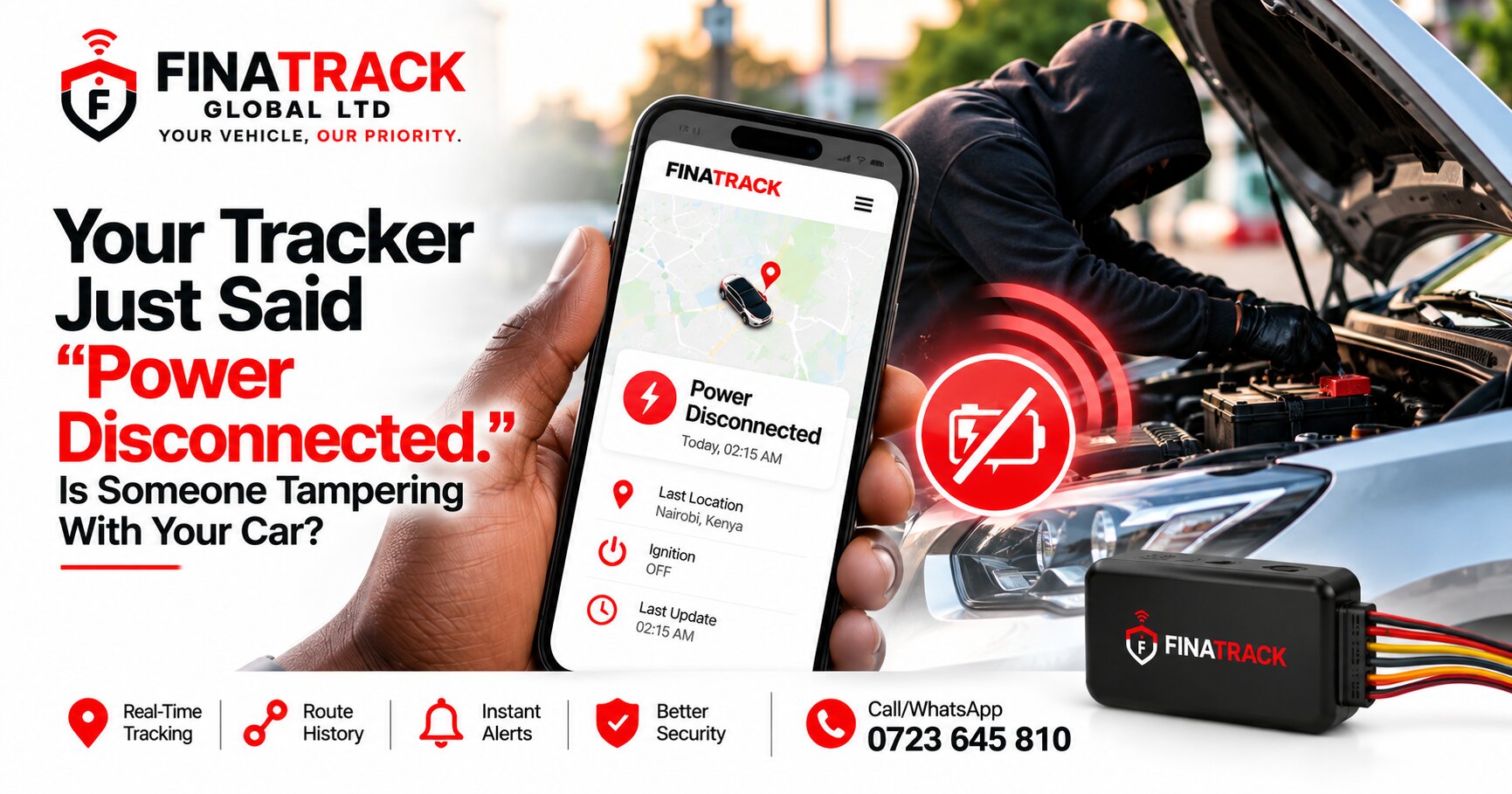
A GPS tracker power disconnection alert can be one of the most alarming notifications a vehicle owner receives. Your car may be parked outside the house, at the office, in a shopping centre or hundreds of kilometres away with a driver, and suddenly your phone reports that the tracker has lost its normal power supply. The immediate fear is understandable: has somebody disconnected the battery, found the tracker or started interfering with the vehicle?
The answer is not always theft. A power disconnection alert simply means that the wired GPS tracker has detected the loss of the external electrical supply it normally receives from the vehicle. That loss can happen for perfectly legitimate reasons, including battery replacement, workshop repairs, electrical maintenance or a loose connection. It can also happen during deliberate interference with the vehicle, which is why the alert deserves attention rather than panic.
The most important thing is to understand the alert within the context of everything else the tracking system is showing. Location, ignition status, last update time, recent movement and the circumstances surrounding the vehicle can help determine whether the power loss is routine or something that requires immediate action.
A professionally installed wired GPS tracker normally receives its main operating power from the vehicle electrical system. As long as that connection remains healthy, the tracker can continue monitoring the vehicle and communicating with the tracking platform according to its configuration and network availability.
When the external supply disappears, certain tracking devices can detect the change and report it to the monitoring platform. If communication remains available long enough, the owner may receive a power disconnection notification. The exact wording may vary between systems, but the meaning is broadly similar: the tracker is no longer receiving the normal external power it expected.
This does not necessarily mean the entire car has lost power. The problem may exist only within the circuit supplying the tracker. A loose connection, damaged fuse, workshop interference or faulty wiring can interrupt tracker power while the vehicle continues operating normally.
That is why the notification should be treated as an indicator rather than proof of a specific event. The tracker is telling you that its electrical environment changed. Your next task is to determine why.
Consider a routine battery replacement. A technician disconnects the old battery, installs a new one and reconnects the vehicle. During the short period when the battery is removed, the GPS tracker loses its external power source.
If the device supports power loss detection, this may generate a notification even though nothing suspicious is happening. Once the new battery is connected correctly, the tracker should normally return to its regular operating state after the vehicle electrical system and communications recover.
A similar event can happen when mechanics carry out electrical work. Dashboard repairs, alternator replacement, starter work, alarm installation, audio upgrades and other maintenance procedures may require the battery to be disconnected. In these situations, receiving a power disconnection alert can actually confirm that the tracker is responding to the change as expected.
The context makes all the difference. A power loss notification arriving at 11 a.m. while the vehicle is booked into a workshop is very different from the same alert arriving at 2 a.m. when the car is supposed to be parked outside your home.
Time is therefore one of the first details to check. Ask yourself whether there is any legitimate reason the battery or tracker supply could have been disconnected at that moment. If the answer is yes, the event may simply be connected to authorised maintenance.
If the answer is no, the next step is to check the vehicle’s latest reported location. Open the tracking application and see where the tracker last communicated. The location can help determine whether the vehicle was still where you expected it to be when the power disappeared.
The timestamp is just as important as the map position. A vehicle icon can remain on the screen even after the tracker has stopped communicating. If the last update occurred several hours ago, the location may no longer represent where the vehicle is now.
A fresh timestamp close to the time of the power disconnection provides more useful information. It can show where the vehicle was when the tracker detected the loss of power and whether any movement occurred shortly beforehand.
The next piece of information to review is ignition status. Depending on the tracking system and installation, the platform may show whether the vehicle ignition was active before the power interruption.
An unexpected ignition event followed by movement and then a power disconnection can deserve more attention than a power notification appearing on an otherwise stationary vehicle. The sequence of events matters because individual alerts often tell only part of the story.
For example, imagine a car parked at home overnight. At 2:13 a.m., the tracking system records ignition activity. At 2:15 a.m., the vehicle begins moving. A few minutes later, the tracker reports power disconnection and then stops updating.
That combination of events would reasonably justify urgent verification. It does not independently prove theft, but the pattern is substantially more concerning than a single power alert.
Now consider a different situation. The car remains at an authorised garage, the tracking platform shows no unexpected movement and the power alert occurs during normal working hours. The mechanic confirms that the battery was disconnected during repair work. The same technical notification now has a completely different meaning.
This is why vehicle owners should avoid interpreting alerts in isolation. GPS tracking becomes much more useful when location, movement, ignition and timestamps are considered together.
A power disconnection alert can also occur because of poor installation or ageing wiring. A tracker that has worked for several years may develop an intermittent electrical connection, particularly if wiring has been disturbed by later repairs.
Road vibration can gradually worsen a weak connection. The tracker may lose power temporarily while the car drives over rough surfaces, reconnect a few minutes later and then repeat the problem days later. The owner may receive confusing alerts even though nobody is interfering with the vehicle.
This kind of behaviour should not be ignored. A tracker that receives unreliable power can produce gaps in trip history and may be unavailable during a genuine security incident. Professional inspection should therefore be arranged if unexplained power alerts keep returning.
The technician should check the tracker power source, ground connection, related fuse and any other relevant wiring. Simply replacing the tracker without examining the installation may not solve the problem if the actual fault is electrical.
Battery condition can also influence tracker stability. A vehicle with a weak battery may experience unusual voltage behaviour, particularly during engine starting. Some tracking devices are designed to tolerate wide voltage ranges, but severe electrical problems can still cause resets or communication interruptions.
If the vehicle itself has been showing signs of electrical trouble such as difficult starting, dashboard resets or repeated battery problems, the tracker alert may be connected to the larger issue. In that case, both the car and the tracking installation should be assessed.
Some wired GPS trackers include an internal backup battery. This can allow the tracker to continue operating for a limited period after external vehicle power disappears, depending on the device, battery condition and configuration.
The backup battery can be extremely valuable during a suspicious event because it may provide additional time for the tracker to report its location after the main power connection has been interrupted. It can also help the device communicate during routine battery replacement.
Vehicle owners should not assume, however, that every tracker contains a backup battery or that backup power will last indefinitely. The capacity and behaviour vary between devices, while rechargeable batteries gradually lose performance as they age.
A tracker that has been installed for several years may still operate perfectly while connected to vehicle power but provide much less backup time than when it was new. This is one reason older trackers should occasionally be assessed rather than simply assumed to remain in their original condition forever.
Backup power also does not eliminate the value of an independent wireless tracker. A wireless GPS tracker uses its own battery and does not depend directly on the vehicle’s main electrical supply.
For motorists protecting higher value vehicles, combining a primary wired tracker with a separate wireless device can provide another security layer. If the wired unit loses vehicle power, the second device may continue operating independently, subject to its own battery condition and communication environment.
The two devices serve different roles. The wired tracker is generally more convenient for everyday monitoring because it receives continuous vehicle power, while the wireless tracker can provide independent backup visibility.
This approach is especially useful because no single tracker should be treated as impossible to defeat. A determined person who discovers one device may still not know that another independent tracking layer exists elsewhere in the vehicle.
A tracking tag can provide another layer depending on the technology used. Different tracking technologies have different strengths, which is why layered security is often more resilient than depending entirely on one device and one communication method.
Power disconnection should also be considered alongside car alarms and immobilisation systems. An alarm may respond to intrusion or interference around the vehicle, while the tracker provides remote information. An immobilisation or hidden cut off system can make unauthorised vehicle operation more difficult where professionally installed.
If an alarm event is followed by ignition activity, unexpected movement and then GPS power loss, the owner receives several different pieces of information pointing to a potentially serious incident. Each security layer contributes something different.
This does not mean the vehicle becomes impossible to steal. The objective is to increase the number of obstacles and preserve more opportunities for detection and recovery.
For businesses, power disconnection alerts can become particularly important because company vehicles are often far from the person responsible for them. A fleet manager may be sitting at the office while a pickup, truck or sales car is hundreds of kilometres away.
An unexpected power interruption can therefore provide an early reason to contact the driver or investigate vehicle status. Without tracking, management may not discover that the system was disconnected until much later.
Businesses should establish clear procedures for handling these alerts. The person responsible for the fleet should know what to check first and who to contact if the event appears suspicious.
The first check should normally be whether the vehicle is undergoing authorised maintenance. Fleet records should indicate when vehicles are at workshops, receiving battery replacements or undergoing electrical repairs.
The second step is reviewing the tracking platform. Confirm the latest location, timestamp, recent route and ignition state. These details help determine whether the event fits normal operations.
The third step is contacting the authorised driver or person responsible for the vehicle where appropriate. A simple call may immediately explain the situation.
If the driver confirms that the vehicle is safe and being repaired, management can record the event and later confirm that tracking returns normally. If nobody can account for the vehicle and the movement appears suspicious, escalation may be necessary.
Vehicle owners should avoid personally pursuing a suspected stolen vehicle simply because the GPS platform shows a location. Tracking information is valuable, but vehicle theft can involve dangerous individuals. The safer approach is to use the information to support appropriate security and law enforcement procedures.
Another important scenario occurs when the tracker reports power disconnection and then goes offline completely. This can happen if the device loses external power and has no usable backup battery, or if communication is interrupted for another reason.
The last known location then becomes particularly important. The map can show where the device was before communication stopped, but it should not be mistaken for the vehicle’s confirmed current position.
If the tracker later reconnects, the platform may receive additional information depending on the device and configuration. Some trackers can store journey data temporarily and upload it after communication is restored.
This means an offline period does not always mean every movement record is permanently lost. The behaviour depends on the specific hardware and settings, which is why customers should understand how their installed tracker works.
A tracker may also lose communication while still receiving vehicle power. Weak mobile network coverage, underground parking or technical problems can interrupt reporting without any physical disconnection.
This is another reason offline status and power disconnection should not be treated as identical events. One refers to communication with the tracking platform, while the other refers to the external electrical supply detected by the device.
The distinction helps troubleshoot problems more accurately. A tracker may be offline because it has no network while still fully powered. Another may be offline because its power was physically interrupted.
For fleet managers, repeated power loss events on one vehicle can reveal maintenance issues. If the same unit generates alerts every few days while comparable vehicles do not, technical inspection should be arranged.
The tracker may have been installed poorly, the connection may have deteriorated or another electrical accessory may be interfering with the circuit. Ignoring the problem can lead to incomplete fleet records.
This matters because GPS tracking is often used for more than security. Mileage, route history, geofence events and driver-management reports all depend on consistent device operation.
If power drops repeatedly, trip records may become incomplete. Management can then make incorrect decisions because the underlying data is unreliable.
A company comparing fuel consumption with mileage, for example, may believe one vehicle is consuming too much fuel when the real problem is missing tracking distance caused by device outages. Data quality matters when telematics information is used for business decisions.
Vehicle owners should therefore perform a basic tracker health check after any power-related alert. Once the battery or electrical work has been completed, confirm that the tracking application shows a recent update.
Start the vehicle and check whether ignition information changes correctly. Complete a short journey where practical and make sure the movement appears in trip history.
If the tracker does not return to normal operation, contact the tracking provider rather than assuming it will correct itself eventually. A security device should not remain unreliable for days or weeks after vehicle maintenance.
The same principle applies after installing other aftermarket accessories. Car alarms, audio systems, dashcams and additional electrical equipment may involve work around the dashboard or wiring. Existing tracking connections can be disturbed unintentionally.
Using experienced technicians reduces this risk, but post-work verification remains sensible. The tracker should always be checked after substantial electrical modification.
Motorists should also consider tracker age. An older device may begin showing more frequent power-related or communication problems even when the installation appears intact.
Age alone does not mean the tracker must be replaced. A healthy device can continue functioning well for years. The important issue is whether repeated faults are reducing confidence in the system.
If the hardware frequently resets, the internal backup battery has deteriorated and connectivity has become unreliable, replacement may be more economical than repeated troubleshooting. Newer equipment may also provide improved long-term network compatibility.
Upgrading should still be based on the actual problem rather than marketing pressure. Replacing a tracker will not correct poor wiring unless the installation is also inspected and improved.
The monitoring application itself should be considered during troubleshooting. A notification may arrive, but the customer should know how to interpret the information on the screen.
Finatrack customers should be comfortable checking the latest vehicle position, the last update time, recent journeys and available alert information. Vehicle tracking creates the most value when the owner understands what the system is showing.
This training is especially important for family members or business managers who may need to respond when the primary vehicle owner is unavailable. One person should not be the only individual who understands the tracking platform in a commercial fleet.
At the same time, account access must remain secure. Tracking credentials can reveal where valuable vehicles are parked and which routes they use. Only authorised people should be able to access that information.
Former employees or previous vehicle users should have access removed when appropriate. Digital security is part of vehicle security.
Businesses should also document tracker installations clearly. The vehicle registration, device identity, installation date and relevant security configuration should be recorded. If a tracker is later transferred to another vehicle, the records should be updated.
This prevents confusion when technical problems arise. A fleet administrator should know which device is actually installed in which vehicle rather than depending on outdated labels inside the software.
Power alerts can also become useful during a vehicle theft investigation because they help establish a timeline. Management may be able to identify when ignition occurred, when the car began moving, where it travelled and when tracker power disappeared.
The tracking data should still be treated as technical information rather than a complete explanation of what happened. Other evidence and appropriate investigation may be needed.
The most useful role of GPS is reducing uncertainty. Instead of discovering only that a vehicle is missing, the owner may have a sequence of digital events that helps responders understand what occurred.
This is why vehicle security should be proactive rather than reactive. A tracker should not be installed and then ignored until the day a theft occurs. The device needs occasional checks to confirm it is healthy.
Opening the tracking application once in a while takes very little time. Confirm that the last location is recent after the car has been used and review one recent trip.
For businesses, the process can be incorporated into a weekly fleet review. Vehicles that have not reported recently, generated repeated power alerts or shown unusual communication gaps can be flagged for technical inspection.
This exception-based approach is more efficient than watching every car continuously. Management focuses attention on vehicles whose data suggests something unusual.
Finatrack Global Ltd provides professionally installed GPS tracking and vehicle-security solutions for private motorists and businesses in Kenya. Finatrack’s wired GPS tracker is available at KES 15,000, giving customers access to practical vehicle tracking features that can support both everyday monitoring and security awareness.
Customers who want additional redundancy can also consider Finatrack’s wireless tracking solutions and tracking tags as part of a layered vehicle-security strategy. The correct configuration depends on the value of the vehicle, where it operates and the level of risk the owner wants to manage.
Professional installation can be arranged at the customer’s convenient location or through Finatrack Global Ltd at Vision Plaza, 1st Floor, Office 2, Mombasa Road, Nairobi. Vehicle owners who receive repeated power disconnection alerts or notice that their tracker has stopped updating can contact 0723 645 810 for assistance.
A tracker power disconnection alert should therefore neither be ignored nor automatically treated as proof that someone is stealing the car. It is an important signal telling you that the tracker has lost its normal external supply. The real meaning becomes clearer when you combine that alert with location, ignition status, movement, timestamps and the circumstances surrounding the vehicle.
The strongest response is simple: verify first, interpret the pattern and act according to the level of risk. When the vehicle is safely at a workshop, the alert may merely confirm that the battery was disconnected. When the same notification appears unexpectedly in the middle of the night after unusual vehicle activity, it can become one of the earliest warnings that something deserves immediate attention.