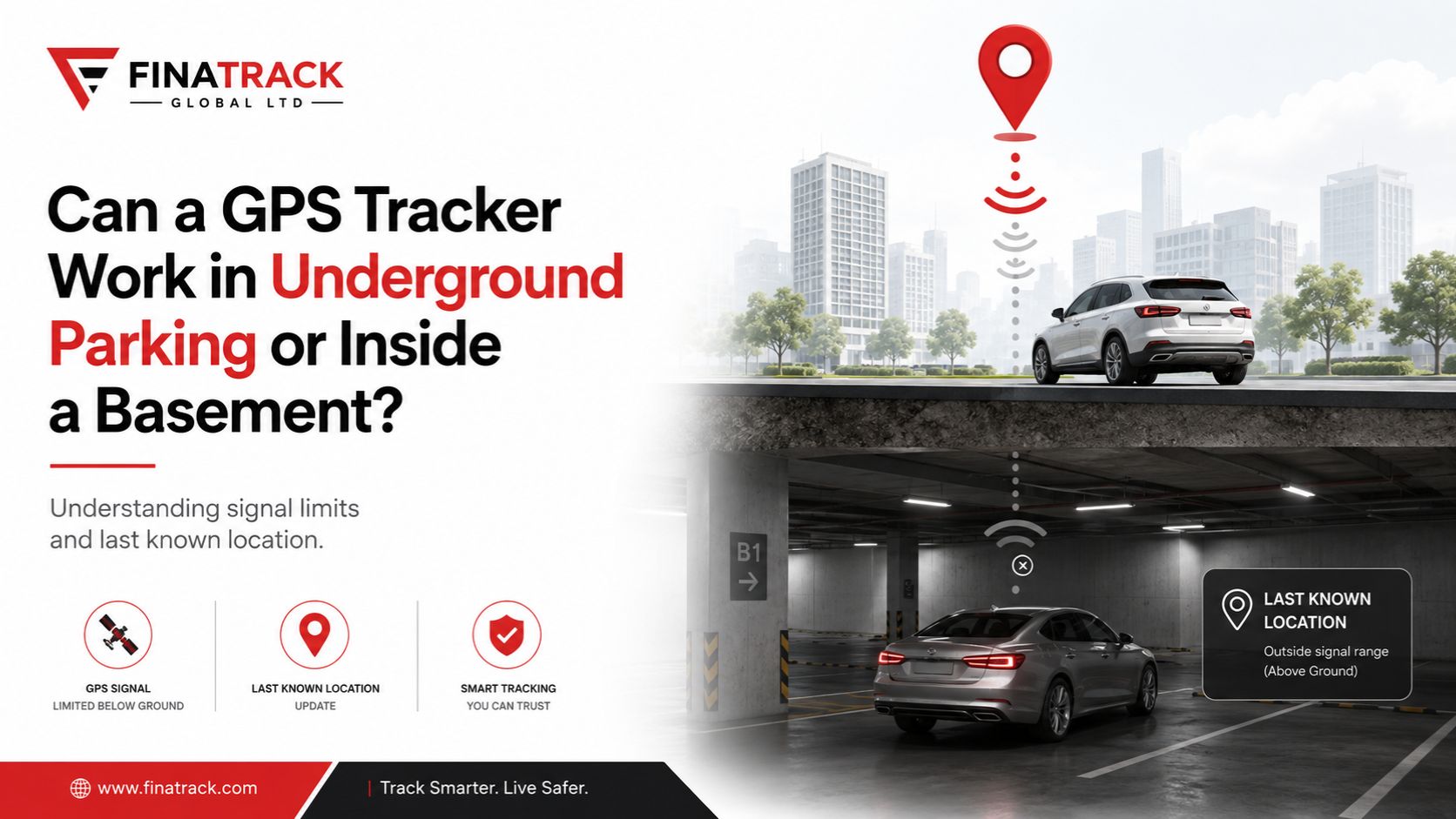
A vehicle enters the basement parking of a shopping mall, apartment block or office building and suddenly appears to stop moving on the tracking platform. The owner knows the car is several floors underground, yet the GPS application may still show the vehicle near the entrance or display an older location. For many motorists, the first assumption is that the tracker has stopped working.
In many cases, nothing is actually wrong with the tracking device. The difficulty comes from the environment in which the vehicle is parked. GPS trackers depend on signals received from satellites above the Earth, and those signals can become significantly weaker when a vehicle moves beneath thick concrete floors, underground structures or other obstacles that block a clear view of the sky.
This is why GPS tracking normally performs best outdoors. When a vehicle is travelling on an open road, the tracker can receive signals from several satellites and calculate its position. When the same vehicle moves several levels underground, those signals may become weak or disappear completely.
The tracker itself can still have power and continue operating electronically. What it may temporarily lose is the ability to calculate a fresh satellite position.
This distinction is important because many vehicle owners interpret a frozen map location as complete tracker failure. In reality, the tracking system may simply be displaying the last valid location it received before the vehicle went underground.
A car entering basement parking may therefore appear to remain near the entrance even though it has continued moving to a parking bay several floors below. The tracker is not necessarily saying the car is still physically outside. The system may simply have no newer reliable GPS coordinate to display.
How severe the signal loss becomes depends partly on the building. A vehicle parked close to a large open entrance may still receive enough satellite signal to produce a location. A vehicle parked deep inside a multi-level basement surrounded by reinforced concrete is much more likely to lose accurate GPS positioning.
The same issue can occur in tunnels, enclosed garages and some heavily built-up areas. Tall buildings can also interfere with GPS reception because satellite signals may be blocked or reflected before reaching the tracking device.
This means GPS performance should not be judged only by what happens in an underground environment.
A tracker that temporarily stops updating in a basement but resumes normal reporting shortly after the vehicle returns outside may be operating exactly as expected. A tracker that remains offline long after the vehicle reaches open roads deserves a different investigation.
Mobile network coverage introduces another complication. Most vehicle GPS trackers do two separate jobs. The first is determining the vehicle’s position using satellite navigation. The second is transmitting that information to a tracking server using a mobile network.
An underground structure can interfere with both.
The tracker may know where the vehicle was before entering the basement but lose the mobile connection needed to send new information. In another situation, the device may still have cellular network coverage but be unable to obtain a fresh GPS position because satellite signals cannot penetrate the building effectively.
To the person looking at the tracking application, both situations may appear similar. The vehicle seems to stop updating.
This is why checking only the map may not always tell the complete story.
The user should also look at information such as the last update time, device status and ignition information where available. If the tracker was communicating normally until the vehicle entered underground parking and then resumed reporting after leaving, the environment is the most likely explanation.
Some professional GPS tracking devices can continue storing certain journey records during temporary communication interruptions. When network connectivity returns, those records may later be transmitted to the server depending on how the device has been configured.
This can help preserve more of the journey history even when live tracking temporarily becomes unavailable.
There is, however, an important limitation. If the tracker cannot obtain satellite positioning while the vehicle is deep underground, it cannot simply invent an accurate GPS position. The system may retain the last valid coordinate until it obtains a reliable new one.
More advanced tracking technologies can improve performance in these situations. Some telematics devices use sensors such as accelerometers, gyroscopes or vehicle movement information to estimate how the vehicle has moved after satellite positioning disappears.
This approach is commonly referred to as dead reckoning.
Instead of receiving a fresh satellite position every moment, the system estimates movement from the last known reliable location until GPS reception becomes available again. It can be useful in tunnels, underground parking and other places where satellite signals are temporarily blocked.
Dead reckoning should not be confused with GPS somehow passing through concrete.
The tracker is estimating movement using additional sensor information rather than receiving normal satellite positioning underground.
Not every vehicle tracking device supports this capability. Standard wired GPS trackers, wireless trackers and advanced telematics units can behave differently depending on their hardware and configuration.
This is why customers should understand the type of tracking equipment installed in their vehicles rather than assuming that every GPS tracker provides exactly the same performance.
Installation quality can also influence tracking performance.
A professionally installed GPS tracker should be hidden discreetly for security, but it should not be positioned in a way that unnecessarily interferes with satellite reception. The installer has to balance concealment with reliable operation.
Placing a device behind heavy metal components simply because the position is difficult to discover may affect how effectively it receives signals. On the other hand, installing it somewhere obvious simply to maximise reception can reduce the security value of the tracker.
Professional installation therefore involves finding a location that supports both reliable communication and discreet vehicle security.
Even an excellent installation, however, cannot overcome every physical limitation. A tracker installed correctly in a vehicle parked four floors beneath reinforced concrete may still lose satellite reception.
That is not necessarily evidence of poor workmanship.
Vehicle owners should also understand that temporary GPS loss can affect the apparent accuracy of the location immediately after leaving a basement. The tracker may initially need a short period to reacquire satellite signals and establish a reliable position.
The map may therefore update from the last known location to a newer position once the vehicle emerges into a better environment.
In most normal situations, tracking should stabilise once the car is back in an area with clearer satellite visibility and mobile network connectivity.
Basement parking also raises an important vehicle security question.
What happens if someone steals a vehicle and deliberately drives it underground to reduce GPS visibility?
A conventional GPS tracker may temporarily lose accurate satellite positioning if the vehicle enters a sufficiently enclosed underground structure. However, the last known location before the signal disappeared can still provide valuable information.
If a stolen vehicle’s final reliable coordinate shows that it entered a particular building or parking facility, that location can become an important starting point for a properly coordinated investigation.
A functioning tracker may also resume transmitting a new location when the vehicle eventually leaves the underground structure.
This is one reason vehicle owners should avoid depending on one security technology alone.
GPS tracking is extremely useful for vehicle visibility, but it should form part of a layered security approach. An alarm can provide warning of interference, an immobiliser can make unauthorised starting more difficult and a tracking system can help provide vehicle location.
A wireless backup tracker or tracking tag can provide another layer depending on the vehicle’s value and risk profile.
The objective is not to assume that one device will perform perfectly in every possible situation.
Instead, each security technology should address a different risk.
For example, an immobiliser may prevent somebody from starting the engine normally, but it cannot tell the owner where the vehicle is. A GPS tracker can provide location information but may experience temporary limitations in environments where satellite signals are heavily blocked.
Layering these systems creates stronger overall protection.
Businesses operating company vehicles should also consider underground parking when interpreting driver reports and trip history.
A sales representative may visit a customer at an office complex and park several floors underground. The tracking platform may show the vehicle arriving at the building before location updates temporarily become limited.
That does not automatically mean the driver interfered with the tracker.
The physical environment may simply have reduced GPS reception.
Fleet managers should therefore interpret tracking information with operational context. A temporary location gap that occurs every time a vehicle enters the same underground facility is very different from a tracker that repeatedly disappears while travelling on ordinary open roads.
Patterns matter.
Geofencing may still provide useful information in some situations. If the vehicle obtains a position while approaching the building, the platform may record that it reached the customer area before GPS reception becomes limited underground.
For many business applications, knowing that the vehicle arrived at the customer’s premises may be sufficient even if the system cannot identify the exact parking bay beneath the building.
Companies requiring precise indoor positioning would need technologies designed specifically for indoor environments. Conventional satellite GPS was primarily designed for location determination where satellite signals can reach the receiver.
Vehicle owners should therefore have realistic expectations.
A GPS tracker is not faulty simply because it cannot reliably identify a car several floors beneath a concrete building.
What matters is how the device behaves before the vehicle enters the basement and after it leaves.
A practical test is straightforward. Check the vehicle’s location before entering underground parking. After leaving the basement and returning to an open area, allow the tracker an opportunity to update and confirm whether normal reporting resumes.
If it does, the temporary interruption was most likely caused by the environment.
If the tracker remains offline or continues showing an outdated location long after the vehicle is outside, technical support may be required.
Possible causes could include power issues, wiring problems, mobile network communication problems or a device fault. At that point, the situation should not simply be blamed on underground parking.
The tracking device should be professionally inspected.
Customers can also reduce uncertainty by learning what the tracking application displays when a device loses GPS or network communication. Some platforms may show the last update time, while others may display an offline status or another indicator.
Understanding these details makes it easier to distinguish normal temporary signal limitations from genuine technical problems.
This is especially important for businesses that rely heavily on their tracking platform.
A fleet manager responsible for dozens of vehicles should know the difference between a vehicle that has been parked underground for an hour and one whose tracker stopped communicating several days ago.
The first may be completely normal.
The second requires investigation.
For private motorists, the main lesson is reassuring. Your GPS tracker can continue functioning as an electronic device while the vehicle is in underground parking, but it may temporarily be unable to provide an accurate new satellite position.
When the vehicle returns outside, normal tracking should generally resume if the device, installation and mobile connection are working correctly.
For security-conscious vehicle owners, the situation also reinforces the value of layered protection.
No security technology should be treated as magical or infallible.
Understanding what GPS can do—and where its limitations begin—allows vehicle owners to build a much stronger security strategy.
Finatrack Global Ltd provides professionally installed GPS tracking, wireless tracking, tracking tags, car alarms, immobilisation and other vehicle security solutions for private vehicles and commercial fleets in Kenya.
Customers experiencing unusual tracking behaviour can have their system inspected to determine whether the issue relates to GPS reception, mobile network connectivity, installation or the tracking device itself.
Professional installation and technical support can be arranged at the customer’s convenient location or at Vision Plaza, 1st Floor, Office 2, Mombasa Road, Nairobi.
For GPS tracking and vehicle security solutions, contact Finatrack Global Ltd on 0723 645 810 or visit www.finatrack.co.ke.
A vehicle disappearing from the map when it enters a basement does not necessarily mean the tracker has stopped working.
Sometimes the problem is simply that satellites cannot see through concrete.