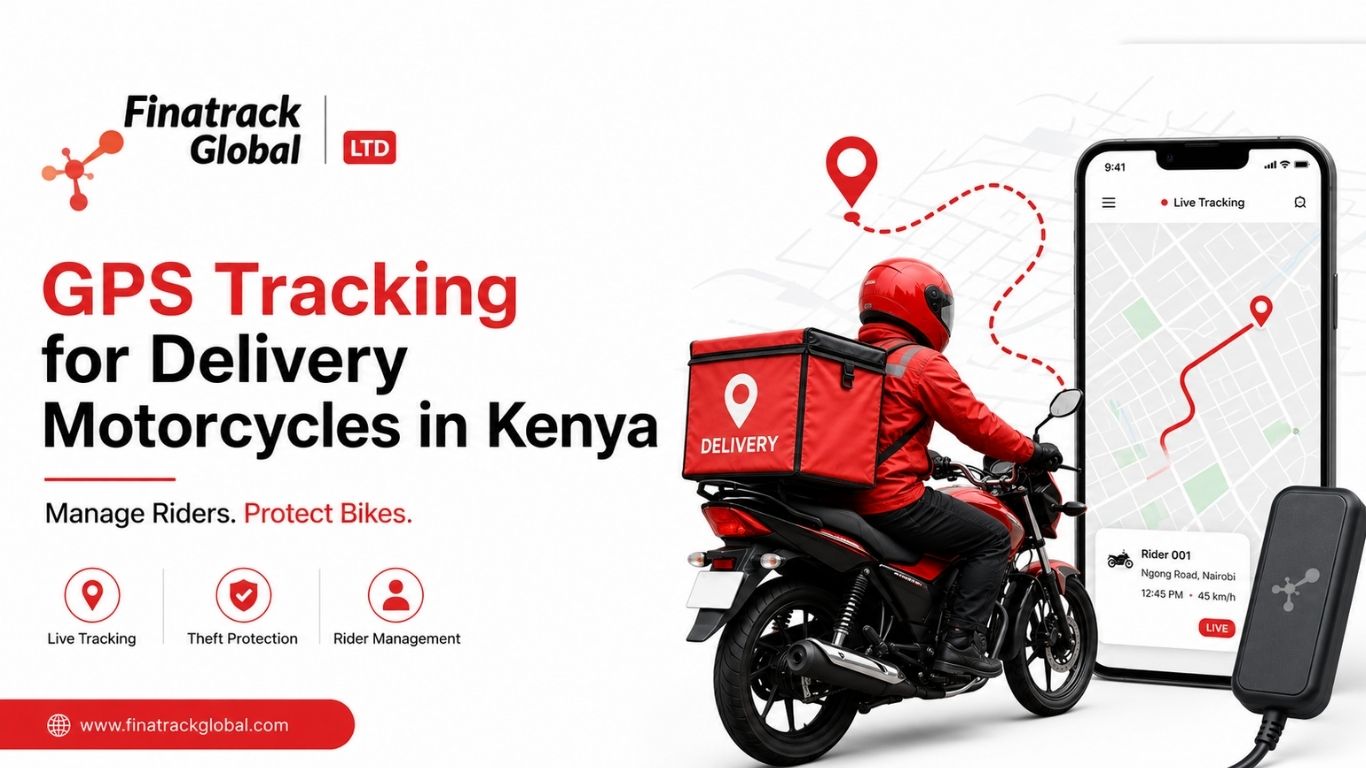
Motorcycle delivery has become an important part of business operations in Kenya. Restaurants, pharmacies, online shops, courier companies and retailers increasingly depend on riders to move products quickly between businesses and customers. As delivery volumes grow, however, managing several motorcycles through phone calls and rider updates alone can become difficult, especially when bikes spend most of the working day away from the office.
GPS tracking gives businesses a clearer way to manage delivery motorcycles while also improving security around the bikes themselves. Through a tracking platform, authorised managers can monitor vehicle location, review previous journeys and see selected operational information depending on the tracker installed. Instead of constantly calling riders to ask where they are, management gains an independent view of how the delivery fleet is moving.
For a small business operating one motorcycle, informal management may initially work well. The owner usually knows which rider has the bike, which delivery they are completing and approximately when they should return. Once the company adds several motorcycles and begins serving customers across Nairobi or other towns, that level of personal supervision becomes much harder to maintain.
A restaurant, for example, may have five riders simultaneously delivering orders to different neighbourhoods. Without live vehicle visibility, the dispatcher may not know which rider is closest when a new order arrives, leading to unnecessary calls and inefficient job allocation. GPS tracking allows management to compare rider locations and assign the next suitable delivery more efficiently.
This can help reduce unnecessary kilometres. Instead of sending a rider from the business premises to a customer several kilometres away, management may discover that another rider is already completing a delivery nearby. Using the closest suitable motorcycle can reduce fuel consumption, shorten delivery times and allow the same fleet to complete more orders during the day.
Route visibility becomes particularly useful when customers ask where their delivery is. The office does not necessarily need to interrupt the rider every time somebody requests an update because the latest motorcycle location can be checked from the tracking platform. Better information helps businesses provide more realistic customer updates rather than repeatedly saying that an order is “almost there.”
Trip history adds another layer of control after deliveries are completed. Management can review where a motorcycle travelled, where it stopped and how long different journeys took. This provides useful context when there are disagreements about delivery times, unusual route changes or the amount of mileage accumulated during a shift.
GPS data should not, however, be treated as proof that a customer actually received an order. A motorcycle reaching a customer’s location confirms vehicle movement, but the business still needs appropriate delivery records, signatures, application confirmations or other evidence where necessary. Tracking works best when it supports the delivery process rather than attempting to replace it.
Delivery motorcycles can also accumulate significant mileage surprisingly quickly. A bike completing several deliveries every day may cover far more kilometres in a month than the business owner realises, particularly when riders are working across a large urban area. That mileage affects fuel consumption, servicing, tyres, brakes and the overall life of the motorcycle.
GPS tracking makes the workload easier to understand. Management can compare which motorcycles are covering the greatest distances and whether deliveries are being distributed evenly across the fleet. A bike that consistently carries far more workload than the others may need more frequent maintenance or a different allocation of deliveries.
Mileage information can therefore contribute to maintenance planning. One motorcycle may reach a service interval much sooner than another even though both were purchased at the same time. Using actual operating information helps businesses avoid treating every bike as though it experiences the same workload.
This is especially important because breakdowns can immediately disrupt a delivery operation. When one motorcycle becomes unavailable, orders may need to be transferred to other riders, increasing pressure on the remaining fleet. Preventive maintenance based on actual usage can help reduce avoidable downtime and keep more motorcycles available for work.
When a breakdown still occurs, location information can support a faster response. A rider stranded in an unfamiliar neighbourhood may struggle to describe exactly where the motorcycle has stopped, particularly if they are away from major landmarks. GPS tracking allows management to identify the latest reported location and coordinate a mechanic, recovery service or another employee more accurately.
Fuel management is another important consideration. Although motorcycles generally consume less fuel than cars and vans, the savings can disappear when riders make unnecessary journeys, take inefficient routes or use company bikes for activities outside approved work. When a business operates several motorcycles, small daily losses can accumulate into meaningful monthly costs.
Trip records help managers understand how fuel expenditure relates to actual movement. If one motorcycle consistently requires much more fuel than similar bikes performing comparable work, management has a reason to investigate. The cause could involve mechanical condition, riding style, excessive mileage or unauthorised use rather than simply assuming the rider is responsible.
After-hours motorcycle use can be particularly difficult to control where riders are allowed to take company bikes home. The arrangement may make operational sense because the rider can begin deliveries directly the following morning, but it can also make personal and business use difficult to separate. Clear company policies should therefore define when motorcycles may be used outside working hours and what journeys require authorisation.
GPS trip history can support those policies by showing when the motorcycle moves and where journeys occur. Management should still interpret the information reasonably because emergency assignments or authorised activities may explain unusual travel. The purpose should be better asset management rather than creating unnecessary suspicion around every rider.
Motorcycle theft is another major reason for installing GPS tracking. Delivery bikes may spend the day parked outside apartment buildings, offices, restaurants, shops and customer premises, often in locations where the business owner has no direct physical control. A motorcycle can therefore be exposed to security risk repeatedly throughout a normal working shift.
Real-time or recently reported location information can provide an important recovery advantage when a motorcycle moves unexpectedly. Depending on the tracking system installed, the owner may also have access to ignition or movement information that provides additional context. Early awareness can be particularly valuable because motorcycles can disappear from an area quickly once stolen.
The tracker should nevertheless be considered one part of motorcycle security rather than the only defence. Strong locks, appropriate parking practices and other security measures remain important because electronic tracking cannot guarantee that theft will not occur. Businesses with higher-risk bikes may consider additional security layers depending on their operating environment.
Installation quality becomes especially important on motorcycles because the electrical system and available installation space differ from ordinary cars. Wiring needs to be secure, discreet and protected from weather, vibration and normal motorcycle use. A poor connection may work initially and later develop intermittent problems after repeated exposure to rough roads and vibration.
The business should therefore confirm that the tracker is actually reporting after installation. Location, movement and other configured information should be tested before the motorcycle returns to normal delivery work. Riders and supervisors should also know how to recognise when a device has stopped communicating so that the problem can be addressed early.
Regular tracker checks are particularly important for fleets. A motorcycle may continue completing deliveries normally even though its tracker stopped reporting several weeks earlier. If nobody checks the tracking platform, management may only discover the problem after a theft or other incident when the location information is urgently needed.
A simple fleet-health review can prevent this. Managers can periodically check whether each motorcycle has a recent update and whether recent journeys are appearing as expected. Any unit that has been offline unusually long can then be inspected while the bike is still available.
Network coverage should also be understood correctly. A GPS tracker may determine the motorcycle’s position using satellite signals while relying on mobile connectivity to send that information to the tracking server. When a rider enters an area with weak mobile coverage, live updates may temporarily stop even though the device itself has not necessarily failed.
Depending on the equipment and configuration, journey records may be stored and uploaded when connectivity returns. This means an offline status should be interpreted together with the motorcycle’s location, last update time and normal operating environment. A tracker that reconnects after leaving a weak-coverage area presents a different situation from one that remains offline for days in a normally well-connected location.
Driver or rider behaviour can also become part of motorcycle fleet management. Delivery riders often work under pressure because customers expect orders quickly, particularly in food delivery, pharmaceuticals and ecommerce. Pressure to complete more deliveries should not encourage dangerous speeding or aggressive riding.
Depending on the system installed, GPS telematics may help businesses identify repeated speed-related events. Management can then investigate whether the issue is rider behaviour or whether unrealistic delivery schedules are putting unnecessary pressure on employees. Safer delivery operations protect the rider, the motorcycle, the customer’s goods and the reputation of the business.
Tracking data should always be used with context. A long stop may mean the rider was delayed waiting for a customer, collecting payment or resolving a delivery problem rather than avoiding work. An unexpected route may have been caused by traffic, road construction or a customer changing the delivery point.
This is why GPS tracking should support good management rather than replace it. The platform provides information about the motorcycle’s movement, while managers still need to understand what was happening operationally. When both are combined, businesses can make fairer and more informed decisions.
Geofencing can further improve control for companies with defined delivery territories. A virtual boundary can be created around a city zone, warehouse, restaurant or other operating area, allowing management to identify when motorcycles enter or leave selected locations depending on the tracking configuration. This can be useful for businesses trying to organise riders by delivery zones.
For example, a business may have one group of riders mainly serving Embakasi and another covering Westlands and surrounding areas. If motorcycles repeatedly cross territories unnecessarily, management may discover that delivery allocation is creating more mileage than required. GPS records can help redesign those zones based on how deliveries are actually occurring.
The same information can support business expansion. Before purchasing additional motorcycles, management can review whether the existing fleet is genuinely operating at high utilisation. If several bikes spend substantial periods parked while others are overloaded with deliveries, better allocation may solve part of the problem without immediately increasing fleet costs.
The opposite conclusion can also be valuable. If tracking records show that every motorcycle is operating intensively throughout the day and customers are still waiting too long, the business has stronger evidence that additional delivery capacity may be justified. Fleet expansion can then be based on actual operating information rather than assumptions.
For courier and ecommerce companies, central fleet visibility becomes increasingly important as delivery volumes grow. Managers should be able to see several motorcycles together instead of monitoring every rider separately. Organising bikes by rider, branch or operating area can make dispatching easier and reduce the amount of time spent searching for information.
Access to tracking data should remain controlled. A dispatcher may need visibility over delivery motorcycles during the working day, while senior management may primarily need reports and performance information. Businesses should avoid giving unnecessary fleet-location access to employees who do not require it for their responsibilities.
GPS tracking is therefore not only about protecting a motorcycle from theft. Used properly, it can support dispatching, route management, mileage control, maintenance planning, customer communication and better utilisation of the entire delivery fleet. These operational benefits become increasingly valuable as a business grows from a few riders into a structured delivery operation.
Finatrack Global Ltd provides professionally installed motorcycle GPS tracking and fleet-management solutions for courier companies, restaurants, pharmacies, ecommerce businesses and other organisations operating delivery motorcycles in Kenya. Installation and support can be arranged according to the size of the fleet and the security or operational requirements of the business.