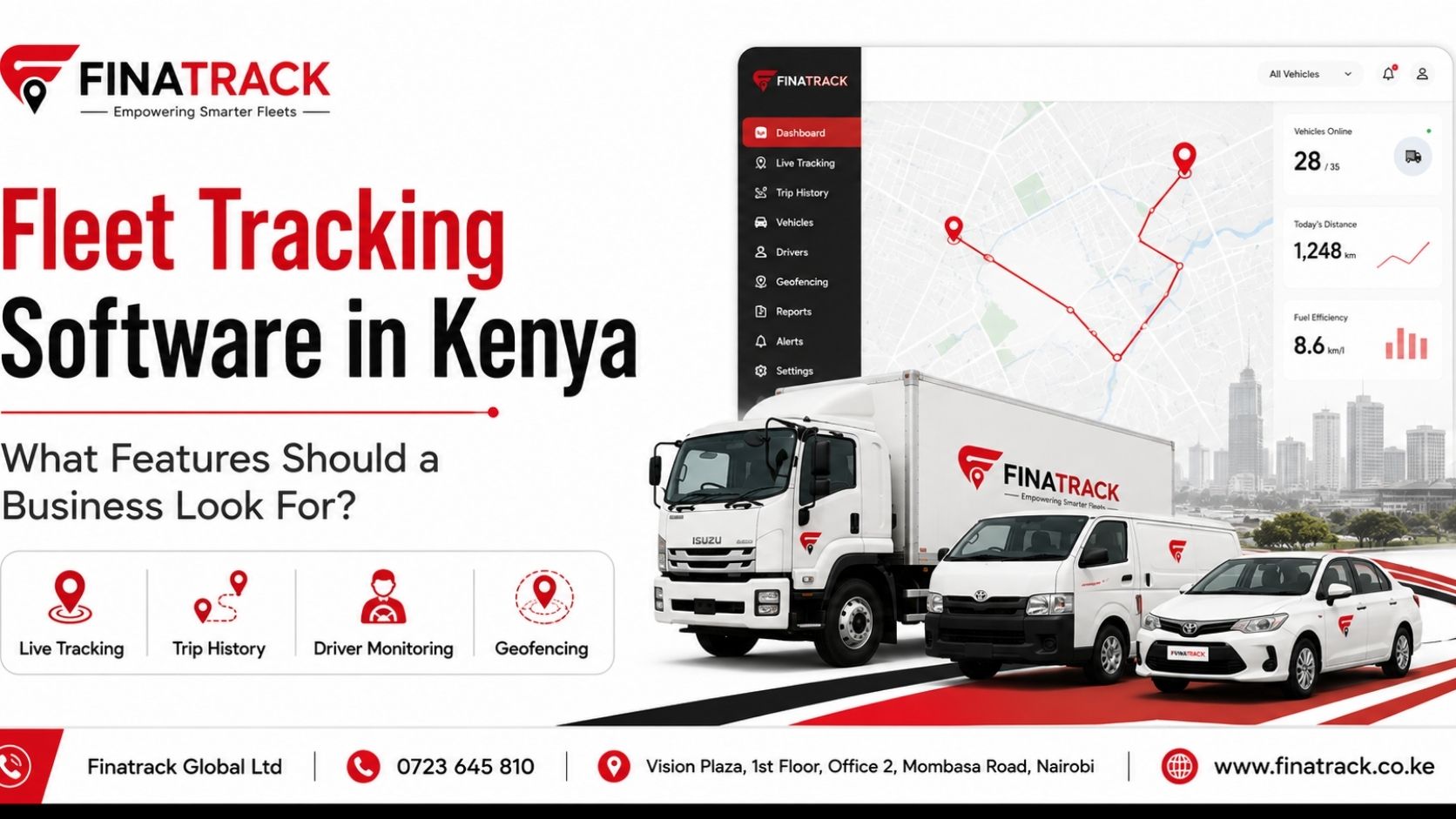
For many Kenyan businesses, vehicles are among the most expensive assets used in daily operations. A logistics company may have trucks moving between counties, a distributor may have vans delivering products across Nairobi, while a construction company may have pickups and machinery operating far from the main office. Once these vehicles leave the yard, management needs a reliable way to understand where they are, how they are being used and whether unnecessary costs are accumulating.
This is where fleet tracking software becomes valuable. A good fleet tracking platform does much more than place vehicles on a digital map. It can provide information about journeys, driver behaviour, vehicle utilisation, fuel activity and security events that help managers make better operational decisions.
However, not every fleet tracking system offers the same capabilities. Businesses searching for fleet tracking software in Kenya should therefore look beyond the initial installation price and consider how well the platform will support their operations over several years. The right system should be easy to use, reliable and capable of producing information that management can actually act on.
One of the first features to consider is real-time vehicle tracking. A fleet manager should be able to open the platform and see the current or most recently reported location of each vehicle. This can make dispatching easier, reduce unnecessary calls to drivers and help management respond more quickly when a customer asks where a delivery vehicle is.
Real-time tracking becomes particularly valuable when a company manages several vehicles simultaneously. Instead of calling five drivers to determine which vehicle is closest to a customer, management can check the fleet map and identify the most suitable unit. This can improve response times while reducing unnecessary travel.
Businesses should also pay attention to how frequently location information is updated. A tracker that communicates only occasionally may be sufficient for basic security but less useful for active fleet dispatching. The appropriate update interval should reflect how the business intends to use the system and the type of vehicles being monitored.
The last update time is another important feature that should be clearly visible. A vehicle icon may appear on the map, but the manager needs to know whether that location was received thirty seconds ago or six hours earlier. Without a clear timestamp, users can mistakenly assume they are seeing a current vehicle position when the tracker has actually stopped communicating.
Trip history is equally important. A useful fleet tracking platform should allow management to review where a vehicle travelled previously, including its route, departure point, stops and destination. This information can help businesses investigate customer complaints, unauthorised journeys and differences between planned and actual vehicle activity.
Historical journeys can also help companies improve route planning. A distributor may discover that delivery vehicles repeatedly travel back and forth across the same part of Nairobi because customer visits are poorly organised. By reviewing actual journeys, management can redesign routes to reduce unnecessary mileage and give drivers more productive schedules.
Mileage information provides further value. Fleet managers need to understand how much individual vehicles are travelling because mileage affects fuel consumption, servicing, tyres and depreciation. Two vehicles purchased at the same time can have very different operating costs if one travels three times as far as the other.
Tracking information can therefore support maintenance planning. A heavily utilised truck may reach its next service interval much sooner than another vehicle that spends most of its time parked. Using actual mileage gives fleet managers a better basis for planning servicing than relying only on calendar dates or driver estimates.
Geofencing is another feature businesses should consider carefully. A geofence creates a virtual boundary around a location such as a warehouse, office, construction site, customer location or approved operating area. Depending on the system configuration, management can identify when a vehicle enters or leaves that location.
This can be useful for businesses that need to verify regular visits to important locations. A logistics company can monitor vehicles arriving at depots, while a construction business can see when project vehicles leave designated sites. Companies can also use geofences around parking yards to identify unexpected vehicle movement outside normal operating hours.
Vehicle alerts become more useful when they are connected to real business risks. A good tracking system may provide notifications for events such as ignition changes, overspeeding, power disconnection or geofence activity depending on the installed equipment. The business should be able to decide which alerts genuinely require attention rather than receiving unnecessary notifications throughout the day.
Too many alerts can create a problem of their own. If managers receive hundreds of routine messages, they may eventually stop paying attention and miss an important security event. Effective fleet tracking software should therefore allow alerts to be configured around the organisation’s actual operational priorities.
Driver behaviour monitoring can provide another layer of fleet control. Depending on the tracking equipment installed, fleet managers may be able to identify repeated speeding, harsh acceleration or sudden braking. These patterns can help companies improve driver coaching and investigate operating practices that may be increasing fuel and maintenance costs.
Driver information should always be interpreted within context. Kenyan roads can require sudden braking because of pedestrians, motorcycles, traffic congestion or unexpected road conditions. One isolated event may therefore mean very little, while repeated patterns across many journeys can provide much more useful management information.
Speed monitoring can be particularly important for businesses transporting passengers, expensive cargo or employees. A driver attempting to recover time by speeding can create accident risk while exposing the company to additional financial and reputational consequences. Fleet tracking allows management to identify repeated behaviour before it becomes accepted as normal.
Fuel management is another major consideration when choosing fleet tracking software. Fuel represents a significant operating expense for many Kenyan fleets, particularly logistics companies, distributors, construction firms and transport businesses. GPS tracking can provide useful mileage and trip information that helps management understand whether fuel expenditure broadly matches vehicle activity.
For businesses requiring more detailed fuel visibility, the tracking platform should also support appropriate fuel-monitoring equipment. Depending on the vehicle and system installed, this can help managers monitor refilling events and changes in fuel levels. Combining fuel information with location and trip history provides far more operational context than fuel receipts alone.
Idling information can also reveal hidden costs. A vehicle can consume fuel while remaining stationary, especially where drivers leave the engine running during loading, customer visits or long waits. Some idling is unavoidable, but repeated excessive idling across a fleet can become a significant expense.
Fleet managers should therefore look for software that helps distinguish between productive movement and long stationary periods. The objective is not simply to reduce every minute of idling, but to identify patterns that management can realistically improve. A small saving on one vehicle may appear insignificant, but the effect can become substantial when multiplied across twenty or fifty vehicles.
Vehicle utilisation reporting is another feature that can influence major investment decisions. A company may believe it needs to purchase additional vehicles because employees frequently complain that transport is unavailable. Tracking information may reveal that some existing vehicles are heavily used while others remain parked for large portions of the week.
This gives management an opportunity to reorganise the fleet before committing additional capital. In another situation, the records may demonstrate that every vehicle is operating intensively, providing stronger evidence that expansion is genuinely required. Fleet tracking software can therefore help companies make better asset-allocation decisions.
For businesses with vehicles assigned to employees, after-hours monitoring can also be useful. A company car that should remain parked after working hours may continue accumulating mileage during evenings or weekends. Trip history allows management to determine whether those journeys are authorised business activities or something that requires clarification.
Companies should handle this information responsibly. Employees should understand that company vehicles are monitored for legitimate purposes such as security, cost control and fleet management. Access to detailed tracking data should remain restricted to authorised people rather than becoming an unnecessary surveillance tool.
Vehicle security should remain a central feature of any fleet tracking system. If a vehicle moves unexpectedly, management should be able to access its current or last reported position quickly. Ignition and movement information can provide additional context when a company vehicle becomes active outside its expected operating schedule.
Businesses operating higher-risk fleets may also require remote immobilisation. Where properly installed, this feature can provide an additional vehicle-security layer, but it should always be used according to appropriate safety procedures. A vehicle should never be disabled in circumstances where doing so could create danger for the driver, passengers or other road users.
A good fleet security strategy should also avoid depending entirely on one device. Some businesses may use a primary wired GPS tracker together with a wireless tracker or tracking tag as an additional backup layer. This can improve resilience if the main tracking installation is discovered or interfered with.
AI dashcam integration is becoming increasingly relevant for larger fleets. Traditional GPS information can show where a vehicle was and how it was moving, while video can provide additional context during an accident or disputed road incident. Driver-monitoring features can also support organisations seeking greater visibility into distraction, fatigue and other safety concerns depending on the equipment installed.
Businesses should nevertheless choose technology according to genuine operational need. A company managing three sales vehicles may not require the same advanced telematics package as a logistics business operating one hundred trucks. The best fleet tracking platform is not necessarily the system with the longest feature list, but the one that matches the fleet’s actual problems.
Reporting is therefore extremely important. Managers should be able to review useful information without spending hours interpreting complicated data. Reports may include trips, mileage, speed events, stops, vehicle utilisation and other information depending on the platform and tracker configuration.
Good reports turn tracking data into management information. A fleet manager should be able to identify which vehicle covered the most kilometres, which vehicle remained idle for long periods or which driver repeatedly exceeded expected operating parameters. Information becomes valuable when it helps management decide what to do next.
Multi-user access can also matter as a company grows. A fleet manager may need full access to all vehicles, while a branch manager may only need to see vehicles assigned to that branch. A senior manager may primarily require reports rather than daily operational monitoring.
The tracking solution should therefore provide appropriate access controls where available. Giving every employee access to every company vehicle creates unnecessary security and privacy risks. Users should have access to the information they genuinely need to perform their responsibilities.
Mobile access is equally important because fleet managers are not always sitting behind desktop computers. A good system should allow authorised users to check vehicles conveniently from a smartphone as well as through a web platform where appropriate. During an emergency, being able to view the vehicle immediately can be more important than waiting to reach the office.
The quality of the GPS hardware behind the software should not be ignored. An impressive tracking platform cannot provide reliable information if the devices installed in the vehicles repeatedly lose power or communication. Businesses should therefore evaluate both the software and the tracking equipment as one complete solution.
Professional installation is especially important for wired trackers. Devices should have secure power connections, proper ignition detection and suitable mounting positions. Poor installation can produce intermittent outages, inaccurate ignition information and other problems that undermine confidence in the entire fleet system.
Businesses should also ask what happens when mobile network coverage disappears. Vehicles operating outside major towns may occasionally travel through areas with weak cellular connectivity. Depending on the equipment and configuration, professional trackers may store journey records and upload them later when communication becomes available again.
Understanding this behaviour helps fleet managers distinguish a temporary communication gap from a genuine tracker failure. If a vehicle regularly loses connectivity along the same rural section of road and later returns online, network conditions may be responsible. A device that remains offline after returning to a normally well-covered area should be investigated.
Technical support should therefore be treated as an important part of the purchase decision. Fleet tracking is not simply a device that is installed once and forgotten. Companies need someone who can help when a tracker stops reporting, a vehicle is replaced or the fleet grows.
A business purchasing the cheapest available tracker without considering ongoing support may save money initially but experience greater costs later. When a vehicle disappears from the platform during an urgent delivery or security incident, access to competent technical support becomes far more valuable than the difference between two installation quotations.
The platform should also make it easy to identify vehicles. Registration numbers, vehicle names, departments or other fleet identifiers should be organised clearly. A company operating fifty vehicles should not have to search through meaningless device serial numbers to find the truck it needs.
Fleet organisation becomes even more important as vehicles are bought, sold or reassigned. The tracking provider should have a clear process for transferring devices, updating vehicle information and removing sold vehicles from the organisation’s tracking account. Poor account management can create confusion and unnecessary privacy concerns.
Data retention is another question worth asking. Different businesses require different periods of historical information depending on operational and reporting needs. A fleet manager investigating a journey from several months earlier needs to know whether the required data is still available on the platform.
Companies should therefore understand what trip history and reports are retained under the tracking service they purchase. The answer may influence how the organisation integrates GPS information with other fleet-management records.
Businesses should also evaluate how easy the platform is to use. A sophisticated system that nobody understands will eventually be ignored. Fleet supervisors should be able to perform routine tasks such as locating a vehicle, reviewing a journey and checking a last update without depending on technical staff every time.
Training should form part of the implementation process. The people responsible for the fleet should understand the meaning of statuses such as online, offline, ignition ON, ignition OFF and last update. They should also know how to respond when information appears unusual.
The same applies to senior management. Executives may not need to monitor individual vehicles every day, but they should understand which fleet indicators matter to the business. Monthly mileage, utilisation, fuel performance and driver-risk patterns can provide management information far beyond basic vehicle security.
The best fleet tracking software therefore connects several parts of vehicle management. It should help answer where vehicles are, where they have been, how they are being driven and whether they are being used efficiently. The system should also support faster responses when breakdowns, unauthorised movement or security incidents occur.
For a small Kenyan business with five vehicles, the most important features may be real-time location, trip history, ignition alerts and geofencing. For a larger fleet, driver behaviour, fuel monitoring, AI dashcams, reports, user permissions and advanced telematics may become increasingly important. The technology should be scalable so that the system can continue serving the organisation as the fleet grows.
Price remains important, but it should not be the only consideration. The cheapest GPS tracking solution can become expensive if devices repeatedly fail, the software is difficult to use or technical support is unavailable when problems occur. Businesses should evaluate the complete cost of reliable fleet visibility rather than only the initial installation figure.
Finatrack Global Ltd provides GPS tracking and fleet telematics solutions for businesses operating private and commercial vehicles in Kenya. Solutions can include real-time tracking, trip history, geofencing, driver monitoring, fuel monitoring, AI dashcams and additional vehicle-security technologies according to the organisation’s requirements.
Professional installation can be arranged at the customer’s convenient location or at Vision Plaza, 1st Floor, Office 2, Mombasa Road, Nairobi. Businesses seeking a fleet tracking solution can contact Finatrack Global Ltd on 0723 645 810 or visit www.finatrack.co.ke to discuss a system suited to the size and operational requirements of their fleet.
Choosing fleet tracking software should therefore begin with the problems the business needs to solve rather than the number of features advertised. A platform that provides reliable location information, useful reports, appropriate alerts and dependable technical support can turn vehicle tracking from a security expense into a practical management tool that helps the organisation operate its fleet with greater visibility and control.