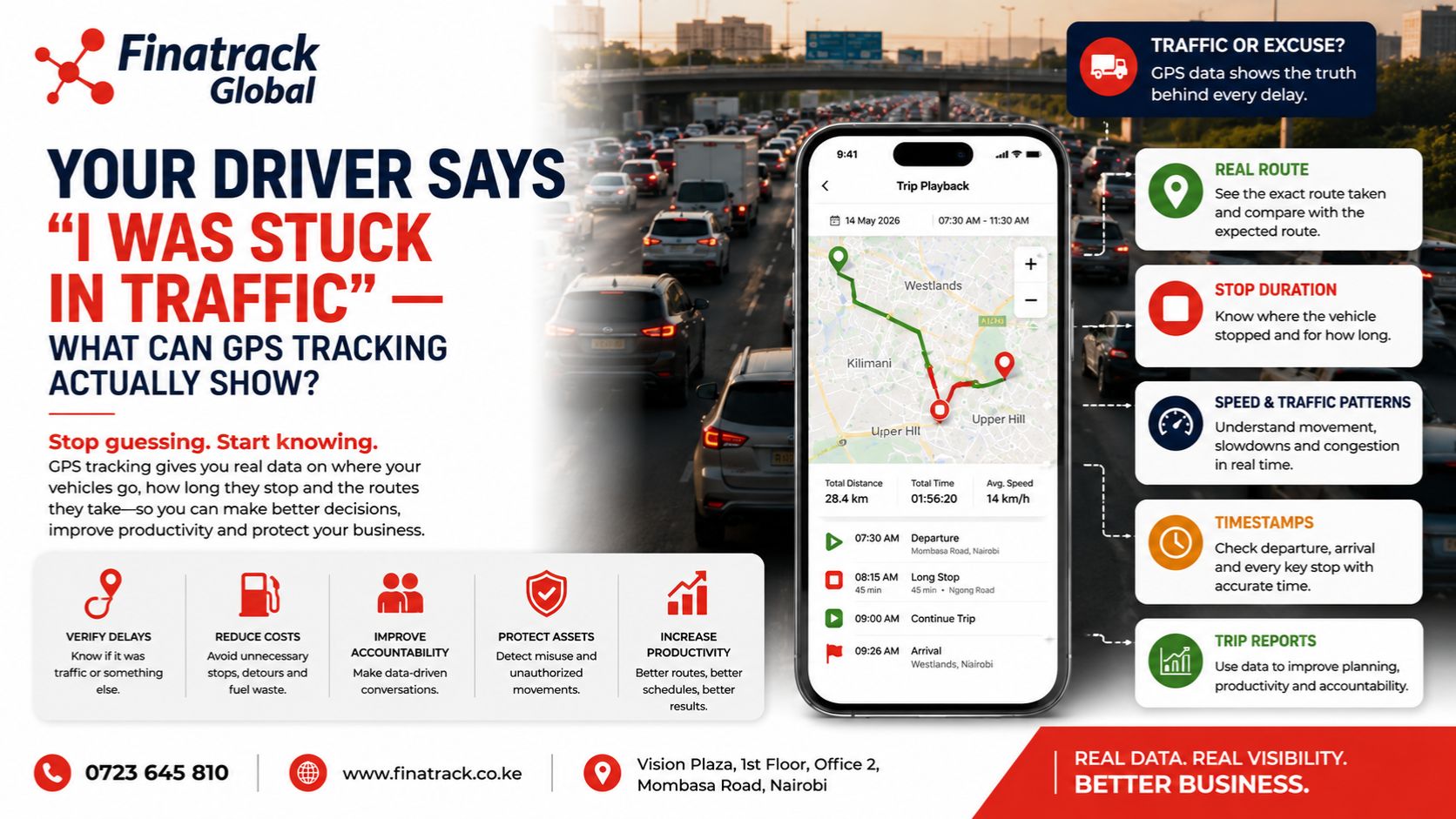
Traffic is part of everyday business in Kenya. A delivery that should take 40 minutes can easily stretch beyond an hour, a technician may arrive late to a customer and a company vehicle may spend much longer on the road than management expected. When a driver explains the delay by saying, “I was stuck in traffic,” the explanation may be completely genuine.
The challenge for a business is that traffic can also become an easy explanation for almost any delay. Without reliable vehicle information, managers may have no practical way of knowing whether a vehicle was genuinely delayed on the expected route, remained parked somewhere for an extended period or took an entirely different journey.
GPS tracking helps replace assumptions with information. A professionally installed tracking system can show where a vehicle travelled, when the journey started, the route followed, where the vehicle stopped and how long it remained at particular locations. Rather than immediately questioning the driver, management can review the journey and understand what actually happened.
Consider a company vehicle expected to travel from Mombasa Road to Westlands for a customer appointment. If the driver arrives an hour late and reports heavy traffic, trip history can show whether the vehicle followed a reasonable route toward Westlands and experienced slow movement along the way.
If the tracking record shows the vehicle moving slowly along Uhuru Highway or another congested section of the route, the driver’s explanation becomes easier to understand. GPS tracking does not necessarily identify the exact cause of congestion, but the pattern of movement can provide important context.
The situation looks different if the same vehicle spent 45 minutes stationary at an unrelated location before continuing toward the customer. In that case, the business has additional information worth discussing with the driver.
This distinction is important because fleet management should not be based on suspicion. Traffic conditions are unpredictable, especially in major urban areas, and drivers often deal with road closures, accidents, diversions and customer instructions that management may not immediately know about.
Tracking information allows managers to ask better questions. Instead of accusing an employee of wasting time, the manager can ask why the vehicle remained at a particular location or why an alternative route was taken. The discussion begins with facts rather than assumptions.
Trip playback is particularly useful when reviewing delays after they have already occurred. Management can examine the vehicle’s historical journey and see the sequence of movement from departure to arrival.
This may show that the driver left the office later than planned, spent unnecessary time at an intermediate stop or followed a considerably longer route. Alternatively, the records may show that the driver left on time and experienced prolonged slow movement along the expected route.
Both outcomes are useful.
When the driver’s explanation is correct, the tracking information protects the employee from unfair blame. When the information reveals an operational problem, management has a basis for investigating it constructively.
Stop duration can provide another important clue. A GPS tracking platform may record locations where a vehicle remained stationary during the journey, allowing fleet managers to distinguish short traffic interruptions from longer stops.
A vehicle that moves slowly for several kilometres presents a different pattern from one that remains at exactly the same location for an hour. The first may be consistent with congestion, while the second may indicate a delivery stop, customer visit, mechanical problem, personal errand or another event requiring explanation.
Managers should nevertheless be careful not to assume that every stationary period represents misuse. A driver may be waiting at a customer’s premises, queuing for loading, attending a meeting or responding to an operational instruction.
Good fleet management therefore combines GPS data with business context.
Timestamps can also help clarify when delays actually occurred. The system can show approximately when a vehicle departed, reached particular areas and completed its journey.
This information is valuable when businesses operate scheduled deliveries, customer appointments or service-level agreements. If a technician was expected to arrive by 10 a.m., management can review whether the delay began because the vehicle left the office late or because the journey itself took longer than expected.
That difference can reveal whether the real problem is traffic, scheduling or internal dispatch procedures.
Route history can also expose unnecessary mileage. A driver may take a longer route to avoid congestion, which can sometimes be a sensible decision. However, repeated detours that do not appear to improve travel time may increase fuel consumption and reduce productivity.
Over time, fleet managers can compare journeys and identify routes that consistently perform better at particular times of day. GPS tracking therefore becomes more than a tool for investigating drivers; it can help businesses improve route planning.
This is especially useful for companies that make repetitive journeys between the same locations. Delivery vans, field service vehicles and sales teams may travel along similar corridors every day.
By reviewing historical trips, the business may discover that changing departure times or adjusting the order of customer visits reduces travel time significantly.
That is a more productive use of fleet data than simply asking whether a driver was telling the truth.
GPS tracking can also help customer service teams respond more professionally when delays occur. If a customer calls asking where a technician or delivery vehicle is, the office can check the vehicle’s current location instead of repeatedly calling the driver.
The company can then provide a more informed update based on actual movement. This is particularly useful when the driver should be concentrating on the road rather than answering calls from the office.
Real-time visibility can also help dispatchers respond when one vehicle becomes heavily delayed. If another technician or delivery vehicle is nearby, management may be able to reallocate a job rather than allowing one customer’s appointment to be disrupted completely.
In this way, GPS tracking does not simply explain delays after they happen. It can help businesses manage them while they are happening.
Speed information can add further context. A vehicle travelling at very low speeds for a prolonged period may be experiencing genuine congestion. A vehicle travelling normally before remaining stationary at an unrelated location presents a different pattern.
Speed records should not be interpreted in isolation, however. Road conditions change constantly, and a single number rarely tells the complete story.
The strongest conclusions normally come from looking at several pieces of information together: route, time, speed, stops and destination.
Fleet managers should also recognise that the driver’s explanation may reveal a wider business problem. If several vehicles are repeatedly delayed along the same route, the issue may not be driver performance at all.
The company may need to adjust schedules, departure times or customer appointment windows to reflect real traffic conditions.
A business that regularly schedules appointments using unrealistic travel times will continue experiencing delays regardless of how closely it monitors drivers.
Tracking data can therefore help managers create more realistic expectations.
The information can also be useful when monitoring productivity. A driver who spends two hours completing a journey that normally takes one hour may deserve investigation, but the business should first understand whether the extra time resulted from congestion, customer delays or unnecessary stops.
Patterns matter more than isolated incidents.
One unusually long journey may be completely reasonable. A repeated pattern of long unexplained stops or unnecessary detours is more significant.
This is why historical tracking reports can be valuable to businesses managing multiple vehicles. Managers can identify which routes, drivers and periods consistently produce unusual results rather than reacting to every delay individually.
GPS tracking can also improve fairness between employees. Without objective records, managers may believe the driver who communicates most confidently while questioning another employee who simply struggles to explain a complicated journey.
Vehicle data provides a more neutral starting point.
If the records support the driver’s account, management can close the matter quickly. If they raise questions, the driver has an opportunity to explain the circumstances before conclusions are reached.
That approach can strengthen accountability without creating unnecessary conflict.
The same information helps businesses address unauthorised vehicle use. A driver may report that a long journey was caused by traffic when the trip history shows that the vehicle travelled to an area unrelated to the assigned work.
In that situation, management has a legitimate reason to investigate whether company time, fuel and mileage were used for an unauthorised purpose.
For fleets operating many vehicles, even small inefficiencies can become expensive. An unnecessary 20-minute delay may seem insignificant until similar delays occur across several vehicles every day.
Lost time reduces the number of customers that can be served, while unnecessary kilometres increase fuel consumption, vehicle wear and maintenance costs.
GPS tracking gives management the visibility needed to identify where some of that time is going.
Businesses should nevertheless use this information responsibly. Employees should understand that company vehicles are being tracked for legitimate purposes such as security, operational management, route planning and cost control.
Access to the tracking platform should also remain limited to authorised personnel who genuinely require the information for their work.
The purpose of GPS tracking should not be to turn every delay into a disciplinary investigation. Used properly, the technology helps businesses separate genuine road challenges from operational inefficiencies and unauthorised use.
Sometimes the driver really was stuck in traffic.
Sometimes the vehicle was parked somewhere it should not have been.
The value of GPS tracking is that management no longer has to guess.
Finatrack Global Ltd provides professionally installed GPS tracking, fleet telematics, fuel monitoring, AI dashcams and vehicle security solutions for businesses operating vehicles in Kenya. Tracking systems can help authorised managers review live vehicle locations, previous trips, stops, routes and other fleet information depending on the solution installed.
Professional installation can be arranged at the customer’s convenient location or at Vision Plaza, 1st Floor, Office 2, Mombasa Road, Nairobi.
For businesses seeking better visibility over vehicle movement and driver activity, contact Finatrack Global Ltd on 0723 645 810 or visit www.finatrack.co.ke.
The next time the explanation is “I was stuck in traffic,” the best response may not be an argument. It may simply be to check the trip.
Recommended SEO focus keyphrase: GPS tracking trip history Kenya
SEO title: Driver Says He Was Stuck in Traffic? What GPS Tracking Can Show
Meta description: See how GPS tracking helps Kenyan businesses review routes, stops, trip times and vehicle movement when drivers report traffic delays.