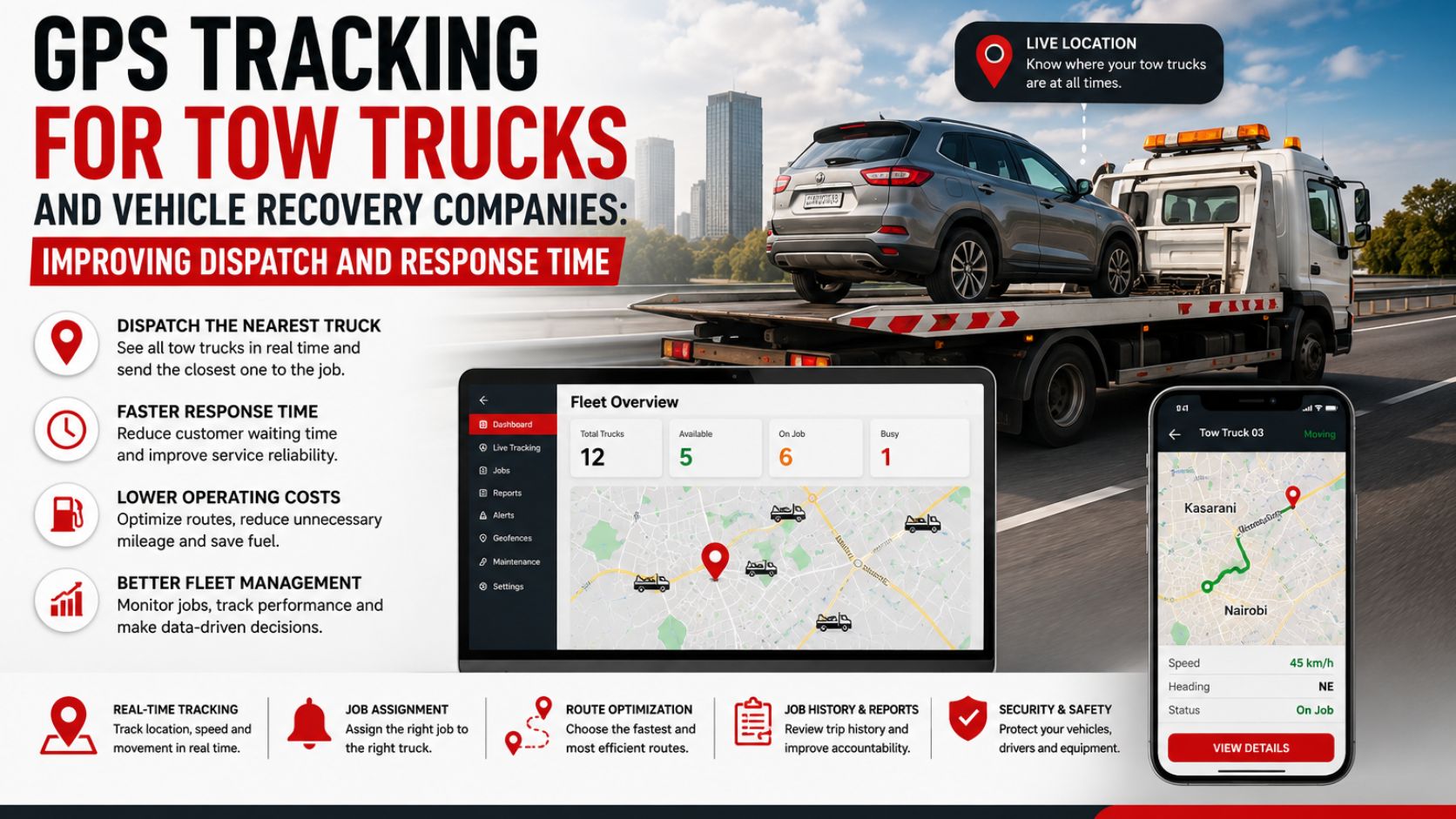
GPS Tracking for Tow Trucks and Vehicle Recovery Companies: Improving Dispatch and Response Time
When a motorist breaks down on the highway, gets involved in an accident or needs a vehicle recovered from an unfamiliar location, one question usually matters more than anything else: how quickly can help arrive?
For tow truck and vehicle recovery companies, answering that question accurately can determine whether a customer accepts the job or calls another provider. Yet many operators still coordinate recovery vehicles largely through phone calls, WhatsApp messages and estimates from drivers about where they are.
The problem becomes more difficult as the fleet grows. A recovery company may have several tow trucks operating across Nairobi and its surrounding areas, but the dispatcher may not immediately know which one is genuinely closest to a stranded customer. A truck may appear available while it is still completing another recovery, while another vehicle may be only a few kilometres away.
GPS tracking can give recovery companies a clearer view of their fleet. Through a tracking platform, an authorised dispatcher can see the current location of tow trucks and use that information when deciding which vehicle should respond to the next job.
Consider a motorist stranded along Thika Road. The recovery office may have one tow truck near Industrial Area, another around Westlands and a third finishing a job closer to Kasarani. Without live location information, the dispatcher may simply assign whichever driver answers the phone first.
That decision could send a truck across Nairobi unnecessarily while another recovery vehicle was already much closer to the customer. The result is additional fuel consumption, longer response time and a frustrated motorist waiting at the roadside.
Real-time GPS visibility changes the dispatch process from guesswork to informed allocation. The dispatcher can first establish where the available recovery vehicles are and then contact the most suitable driver.
The closest vehicle will not always be the correct one. Different recovery jobs may require different equipment, towing capacity or technical capability. A motorcycle recovery is very different from recovering a heavily damaged commercial vehicle.
Location information should therefore support the dispatcher’s decision rather than replace professional judgement. Once the company identifies trucks capable of handling the job, GPS tracking can help determine which of those vehicles can reach the customer most efficiently.
For a recovery business, response time is part of the product being sold. A customer stranded beside a busy road is unlikely to judge the company only by the quality of its tow truck. The customer will remember how quickly the company responded, whether communication was clear and whether the promised arrival time was realistic.
GPS tracking can help the office provide better estimates. Instead of telling a customer that the truck will arrive “soon,” the dispatcher can check the assigned vehicle’s location and provide an estimate based on its actual progress.
Traffic will always make exact arrival times difficult, particularly in Nairobi. GPS tracking cannot remove congestion, road closures or unexpected incidents, but it gives the company better information than relying entirely on verbal updates from the driver.
The same visibility can reduce unnecessary calls to drivers. A recovery driver negotiating traffic or towing a damaged vehicle should not repeatedly be asked, “Where are you now?”
If the office already has access to the vehicle’s location, routine progress checks can be done from the tracking platform. The driver can concentrate on the road while the dispatcher continues communicating with the customer.
Trip history can become useful after the job is completed. Management can review where the tow truck travelled, approximately when it arrived at the recovery location and how the journey progressed.
This creates a useful operational record, particularly when customers question response times or when commercial clients require evidence that a recovery assignment was attended.
A fleet customer may report that one of its vehicles broke down at 10 a.m. and later ask when the recovery truck arrived. Instead of depending entirely on handwritten records or memory, the recovery company can review vehicle movement information from the relevant period.
These records can also help management analyse performance across multiple jobs. If a particular tow truck consistently takes significantly longer to reach customers, the company can investigate whether the problem is route allocation, vehicle condition, driver behaviour or where that truck is normally stationed.
Over time, GPS information can influence where recovery vehicles should be positioned.
A business may discover that a large percentage of its calls originate around certain highways, industrial areas or transport corridors. Keeping recovery vehicles closer to those areas during busy periods could reduce response times without purchasing additional trucks.
That is an important distinction. Better fleet performance does not always require more vehicles. Sometimes the existing vehicles simply need to be positioned and dispatched more intelligently.
Route history can reveal another source of unnecessary cost. Tow trucks are generally heavier than ordinary vehicles and can consume substantial amounts of fuel. Sending one on an unnecessarily long journey affects the profitability of the recovery job.
If a truck travels 25 kilometres to reach a customer when another suitable vehicle was only eight kilometres away, the business has added unnecessary distance before the paid recovery journey has even started.
Repeat that mistake across several jobs every day and the additional fuel, mileage and vehicle wear can become significant.
GPS tracking can therefore contribute directly to cost control. The company can allocate jobs more efficiently and review whether drivers are using sensible routes between assignments.
This becomes especially important when recovery companies quote customers fixed prices. If poor dispatching causes the company to travel far more kilometres than expected, part of the profit from the job can disappear into fuel and operating expenses.
Vehicle utilisation is another area worth monitoring. One tow truck may complete five recoveries in a day while another completes only one or two despite both being available for similar work.
That difference may have a reasonable explanation. One truck may handle more complicated recoveries or operate in an area with fewer calls. But without reliable fleet information, management may never know whether work is being distributed efficiently.
Tracking records can help identify which vehicles are being heavily utilised and which spend significant periods parked. The information can then support decisions about driver shifts, vehicle positioning and future fleet expansion.
For companies considering purchasing another tow truck, utilisation data can be particularly valuable. If every existing recovery vehicle is operating close to practical capacity, adding another truck may be justified.
If several trucks regularly remain underutilised, management may first need to improve dispatching and allocation.
GPS tracking can also help when recovery companies work with insurers, fleet operators, banks, garages and other corporate clients. These customers often expect professional records and reliable service.
A recovery company that can demonstrate when a truck was dispatched, where it travelled and when it reached a location may be better positioned to provide structured service to organisations managing large numbers of vehicles.
This does not mean tracking information should replace job sheets, invoices or customer documentation. It can complement those records by providing another operational source of information.
Security is another important consideration because tow trucks themselves are valuable commercial assets. Recovery vehicles carry specialised equipment and may operate at unusual hours in unfamiliar locations.
Real-time tracking allows management to maintain visibility when trucks are away from the yard. Unexpected after-hours movement or activity outside normal operating patterns can be investigated when necessary.
Recovery companies frequently operate around the clock, which means after-hours movement is often legitimate. The advantage of tracking is not automatically treating night movement as suspicious. It is knowing which truck is moving and whether that movement corresponds with an authorised assignment.
Geofencing can provide additional control around yards, workshops and other important locations. Depending on the configuration, management can be alerted when a vehicle enters or leaves selected areas.
This can be useful at the beginning and end of shifts or when recovery vehicles are expected to remain at particular locations between assignments.
Driver behaviour matters as well. Tow trucks often carry or pull other people’s valuable vehicles, making safe driving particularly important.
Excessive speeding, harsh acceleration and sudden braking may increase accident risk while also contributing to fuel consumption and vehicle wear. A driver towing a damaged or immobilised vehicle needs to operate with even greater care than under normal conditions.
Telematics information can help management identify repeated driving patterns that require attention. Individual events should always be considered in context, but repeated aggressive driving may indicate a need for additional training.
AI dashcams can add another layer of operational information. Recovery work frequently happens on busy roads, accident scenes and other environments where disputes can occur.
Video footage may help provide context if a customer claims that a vehicle was damaged during transportation or if the recovery truck becomes involved in a road incident.
Combined with GPS information, video can help management understand where the truck was, how it was moving and what happened around it.
Tow truck businesses can also benefit from monitoring vehicles travelling outside their normal service area. Long-distance recovery jobs can take a truck away from the company’s core operating region for several hours.
While that vehicle is away, dispatchers need to understand that it is no longer available for nearby jobs. Real-time fleet visibility makes that availability clearer.
This can prevent situations where a customer is promised a recovery truck that management assumes is nearby when it is actually returning from a distant assignment.
Better information also improves shift handovers. A dispatcher starting an evening shift should be able to understand which trucks are available, which are completing jobs and where each vehicle currently is.
Without a central system, that information may depend on conversations between employees. Important details can easily be missed during busy periods.
A tracking platform gives authorised staff a common operational view.
The technology should nevertheless be supported by clear procedures. Every recovery company should establish how jobs are assigned, how vehicle availability is recorded and who is responsible for monitoring active recoveries.
Drivers should also understand how tracking information is used. The purpose should be operational efficiency, security, customer service and responsible fleet management.
Access to the tracking platform should remain limited to employees who require the information. The location of recovery vehicles can be commercially and operationally sensitive, particularly where trucks are transporting customers’ vehicles.
Professional installation is equally important. Tow trucks operate for long hours and may experience vibration, difficult road conditions and demanding daily use.
Tracking devices should be installed securely and tested properly so that the company can depend on them when vehicles are on active assignments.
The office team should also understand how to use the tracking platform. Having trackers installed in every truck is of limited value if dispatchers continue calling every driver because nobody knows how to find the nearest vehicle on the system.
Training turns tracking hardware into a business tool.
For a small recovery operator with two tow trucks, GPS tracking can help identify which vehicle should respond first. For a larger company covering Nairobi and other regions, the same technology can become part of a central dispatch system supporting dozens of daily jobs.
The underlying opportunity is the same.
The recovery business is built around moving the right truck to the right customer as quickly and efficiently as possible.
Knowing where every vehicle is makes that decision easier.
Finatrack Global Ltd provides professionally installed GPS tracking, fleet telematics, AI dashcams and vehicle security solutions for tow truck operators, recovery companies and other commercial fleets in Kenya. Installation can be arranged at the customer’s convenient location or at Vision Plaza, 1st Floor, Office 2, Mombasa Road, Nairobi.
For vehicle recovery companies seeking better dispatch visibility, faster response coordination and greater control over their tow trucks, contact Finatrack Global Ltd on 0723 645 810 or visit www.finatrack.co.ke.
When a stranded motorist calls for help, the best tow truck is not simply the one that is available. It is the right truck that can reach them fastest.