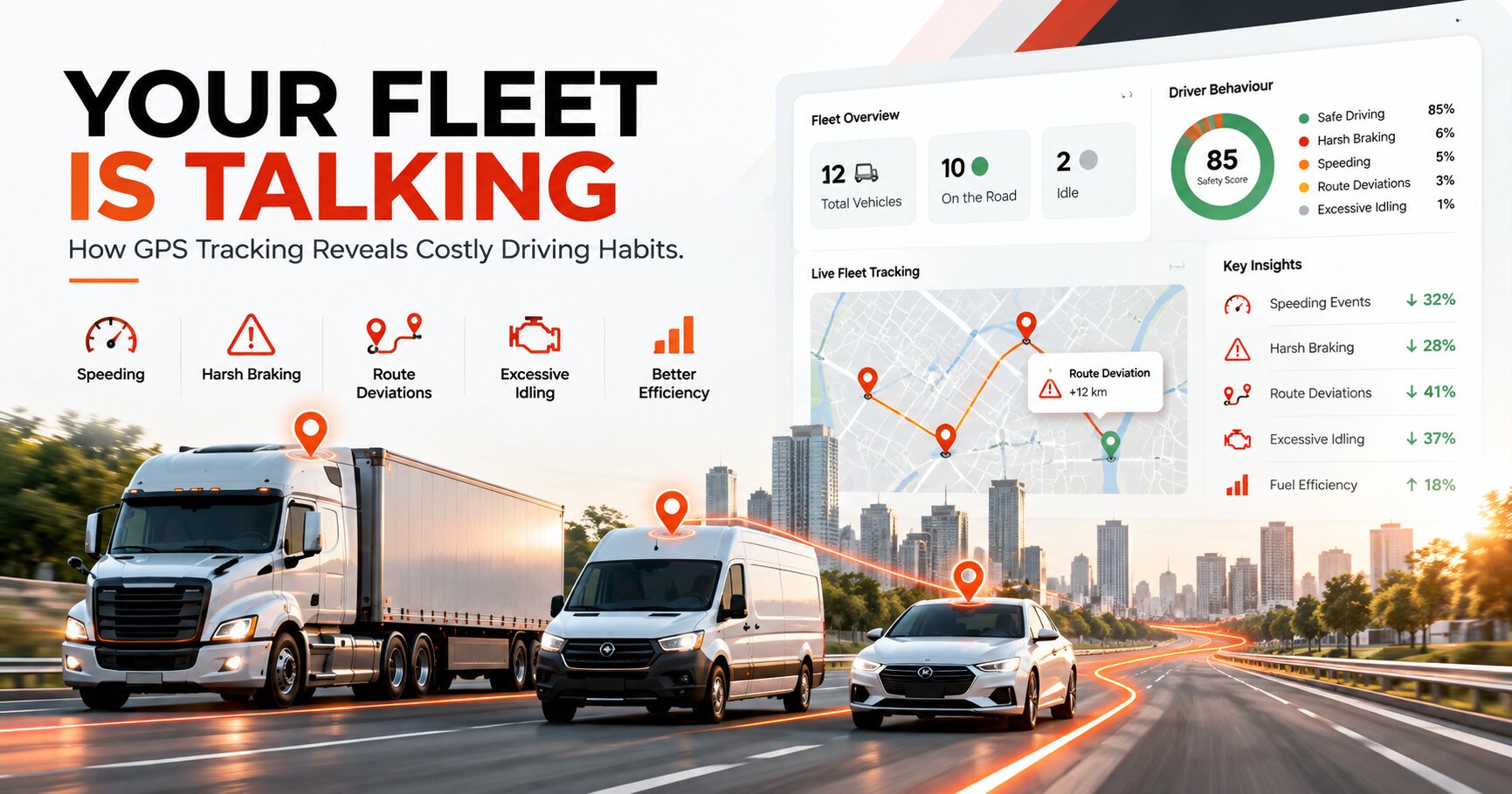
Managing a fleet is not simply about knowing where vehicles are located. For businesses operating company cars, delivery vans, trucks or motorcycles, the way those vehicles are driven can have a direct effect on fuel consumption, maintenance costs, road safety and overall productivity. Modern GPS tracking gives fleet owners access to information that can help them identify driving patterns that would otherwise remain hidden until they become expensive problems.
A vehicle may arrive at its destination on time while still being driven inefficiently along the way. Excessive speeding, unnecessary idling, aggressive acceleration, harsh braking and repeated route deviations can increase operating costs even when the vehicle appears to be completing its assigned work. When several drivers and vehicles are involved, these small inefficiencies can become significant across an entire fleet.
GPS tracking helps bring some of this activity into view. Depending on the tracking system installed, fleet managers can monitor vehicle speed, movement, routes and historical journeys from a central platform. Instead of relying entirely on what drivers report at the end of the day, management can review actual vehicle activity and identify patterns that require attention.
Speed monitoring is particularly valuable because excessive speed can affect more than road safety. Driving consistently at unnecessarily high speeds can contribute to higher fuel consumption, increased tyre wear and additional strain on vehicle components. For businesses operating several vehicles every day, these costs can accumulate quietly over time. Speed alerts can help fleet managers identify repeated behaviour and address it before it becomes part of normal driving culture.
Historical route playback provides another useful source of information. A vehicle may be assigned a straightforward delivery route but repeatedly take longer or unnecessary diversions. There may be legitimate reasons such as traffic, road closures or customer instructions, but frequent unexplained deviations can increase mileage, fuel consumption and journey time. Reviewing route history allows management to distinguish occasional operational changes from patterns that may require investigation.
Geofencing can further improve this visibility. A business can create virtual boundaries around offices, depots, customer premises or approved operating zones and receive alerts when vehicles enter or leave those areas. This gives management a practical way to monitor whether vehicles remain within expected operating locations without watching the tracking platform continuously.
Driver behaviour becomes even easier to understand when GPS tracking is combined with AI dashcam technology. Location data can show where and when something happened, while camera footage can provide visual context. Finatrack Global Ltd provides an AI Dashcam with Driver Monitoring System and Advanced Driver Assistance System technology at KSh 35,000, helping fleet operators gain additional visibility into driver behaviour and road activity.
For example, GPS information may show that a vehicle suddenly slowed down or deviated from its normal route. Camera information can help management understand whether the event was caused by traffic conditions, a road hazard, driver behaviour or another situation entirely. This reduces the need to make decisions based only on assumptions or incomplete explanations.
Better driver monitoring should not be viewed purely as a way of catching mistakes. The information can also be used to recognise good driving practices and improve training. A driver who consistently follows assigned routes, maintains appropriate speeds and avoids unnecessary vehicle use demonstrates behaviour that can support lower operating costs and safer fleet operations.
Fuel efficiency is another area where driver behaviour matters. Aggressive acceleration, unnecessary idling and poor route planning can increase fuel consumption. When GPS tracking is combined with Finatrack’s fuel monitoring solution, fleet managers can compare vehicle movement with fuel activity and build a clearer picture of why consumption may be higher on certain vehicles or routes.
Finatrack Global Ltd provides a fuel monitoring system at KSh 35,000 plus KSh 1,000 monthly maintenance, allowing businesses to monitor fuel levels and investigate unusual changes. When fuel data is considered together with GPS information, businesses can move beyond simply asking how much fuel was purchased and begin asking whether that fuel was being used efficiently.
Driver behaviour can also affect maintenance. Harsh driving places additional stress on tyres, brakes, suspension components and other parts of the vehicle. A fleet that consistently experiences premature wear may therefore need to look beyond the workshop and examine how vehicles are being driven. Tracking information can contribute to this assessment by providing another source of operational evidence.
For companies operating long-distance trucks, the benefits become even more significant. Management may have little direct visibility of what happens once a truck leaves the yard and begins a journey across several counties. GPS tracking, fuel monitoring and AI dashcams can work together to provide information about route movement, driver activity and fuel usage even when the vehicle is far from the main office.
The same principle applies to delivery fleets and company cars operating within Nairobi and other urban centres. A vehicle may make dozens of movements in a single day, making manual supervision unrealistic. Tracking technology allows management to focus on exceptions such as unusual routes, excessive speeds or vehicles operating outside approved areas rather than trying to follow every journey manually.
Finatrack Global Ltd provides a wired GPS tracker at KSh 15,000 as a one-off payment, with an alternative option of KSh 10,000 installation plus KSh 3,000 annual subscription. The solution can support features such as real-time tracking, route history, geofencing, speed monitoring and vehicle alerts depending on the system configuration.
The greatest value of fleet tracking is therefore not simply being able to point at a map and say where every vehicle is. The information can help businesses understand how those vehicles are being operated, identify inefficient patterns and make better decisions about drivers, routes, fuel and maintenance.
A well-managed fleet should produce information that management can use. When GPS tracking, fuel monitoring and AI dashcams are combined, fleet owners gain a broader view of both vehicles and driver behaviour, making it easier to identify problems before they become expensive.
Finatrack Global Ltd provides GPS tracking, AI dashcams, fuel monitoring and fleet management solutions for businesses operating company cars, delivery vehicles, motorcycles, trucks and other commercial fleets. Professional installation can be carried out at the company’s offices or at a customer’s convenient location.
For enquiries or professional installation, contact Finatrack Global Ltd on 0723 645 810, visit www.finatrack.co.ke, or visit the company at Vision Plaza, 1st Floor, Office 2, Mombasa Road, Nairobi.