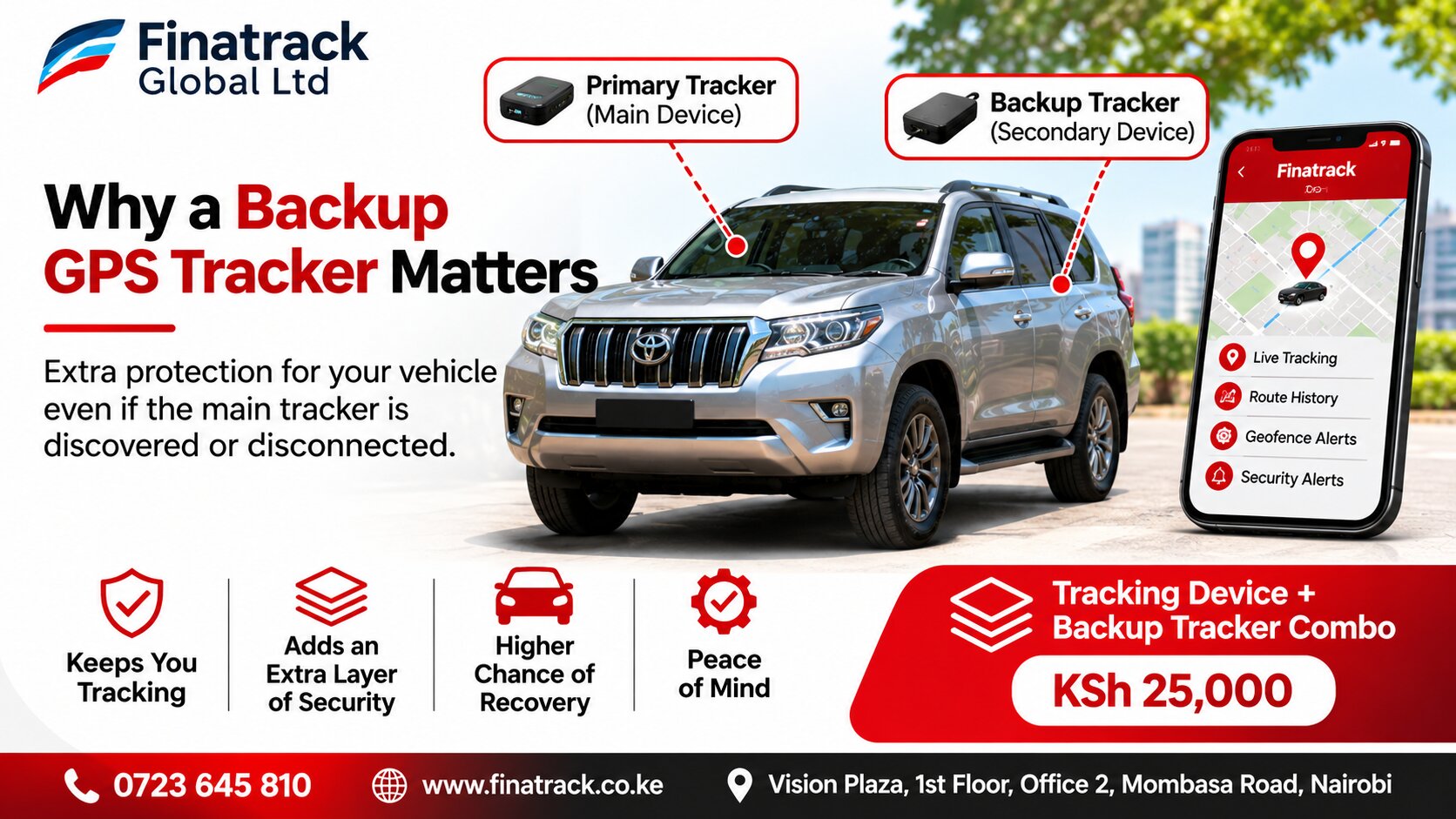
Vehicle security is no longer just about installing one device and assuming the problem is solved. As motorists become more aware of how vehicle theft happens, many are beginning to think in terms of layers. A primary GPS tracker is already an important security tool because it gives the owner visibility over the vehicle’s location, but there is one obvious weakness: what happens if that tracker is found, disconnected or damaged?
This is where a backup GPS tracker becomes valuable. Instead of depending on a single tracking device, the vehicle owner has a second source of location information hidden separately from the main tracker. The idea is simple. If the primary device stops reporting unexpectedly, the backup tracker may still provide another opportunity to locate the vehicle.
For vehicle owners in Kenya, especially those with high-value vehicles, company fleets or cars that regularly operate in unfamiliar areas, this layered approach is becoming more practical. A backup tracker does not replace the main tracking system. It complements it by adding redundancy, and in security, redundancy can make a major difference.
Why One Tracker May Not Always Be Enough
A wired GPS tracker is usually installed discreetly inside the vehicle and connected to the vehicle’s electrical system. When professionally installed, it can provide reliable real-time tracking, route history, geofence alerts, ignition status and other useful information. For normal daily monitoring, this kind of tracker is often more than sufficient.
The challenge comes when someone intentionally searches for it. A determined thief may know that modern vehicles often contain tracking devices, especially if the vehicle is expensive or belongs to a business. Once the thief gains access to the car, one of the first things they may do is search for suspicious wiring or electronic devices.
If the main tracker is discovered and disconnected, the vehicle owner may suddenly lose the location feed they were relying on. That does not mean GPS tracking has failed as a security concept. It simply shows why relying on a single device can create a single point of failure.
A backup tracker reduces that risk by giving the owner another tracking layer that is separate from the primary installation.
How a Backup GPS Tracker Works
A backup GPS tracker is usually installed or positioned in a different location from the main tracker. Depending on the device, it may operate using its own internal battery, SIM connectivity and independent power source. This separation is important because the purpose of the backup is to remain operational even if the primary tracker is interfered with.
For example, the main tracker may be professionally wired into the vehicle and used for everyday features such as ignition alerts, live tracking and route history. The backup tracker may then be placed in another discreet location where it is harder to discover. If the main tracker suddenly goes offline, the vehicle owner can check whether the backup tracker is still reporting.
The backup device is therefore not meant to perform exactly the same role as the main tracker in every situation. Instead, it acts as an additional security layer that increases the number of obstacles a thief has to overcome.
Why Backup Tracking Matters During Vehicle Theft
Vehicle theft can happen quickly. A thief who knows what they are doing may try to disable the visible or easily accessible security systems before moving the vehicle. If the main tracker is discovered early, the owner may lose valuable location information at a critical moment.
A hidden backup tracker can help reduce this risk. Even if the primary tracker stops transmitting, the backup device may still continue reporting its position depending on its battery level, network availability and configuration. This gives the vehicle owner another possible source of information when every minute matters.
The benefit becomes even more important when the vehicle is moved to another location before attempts are made to dismantle, alter or hide it. A backup tracker can provide an extra chance to identify that movement and support the recovery process.
No tracking device can guarantee recovery, but having two independent systems is generally stronger than depending entirely on one.
A Backup Tracker Can Also Help When the Main Tracker Develops a Fault
Not every tracking interruption is caused by theft. Sometimes a primary tracker may stop reporting because of a wiring issue, power problem, SIM issue or temporary technical fault. In these situations, a backup tracker can provide useful continuity while the main device is being checked.
This is particularly relevant for business vehicles that need consistent monitoring. A fleet manager may not want to lose visibility over a vehicle simply because one tracking unit has developed a technical problem. Having a secondary tracker provides another reference point and helps reduce monitoring gaps.
For private motorists, the same principle applies. If the main tracker suddenly appears offline, the owner can compare the status of the backup device before assuming the vehicle has been stolen or the system has completely failed.
Backup Trackers and Layered Vehicle Security
A backup tracker works best when it is part of a broader security strategy. Vehicle security should ideally combine prevention, detection, monitoring and recovery support.
A car alarm can help detect interference and attract attention. An immobiliser can make it more difficult to start the vehicle without authorisation. A wired GPS tracker can provide ongoing location visibility and alerts. A backup tracker adds redundancy in case the primary tracking device is compromised.
When these systems are combined, a thief has to overcome several different security layers rather than one. That increases the difficulty of the theft and may improve the vehicle owner’s ability to respond.
For higher-value vehicles, this kind of layered approach is often more sensible than relying on one expensive device and assuming it cannot fail.
Who Should Consider a Backup GPS Tracker?
A backup tracking device can be useful for many vehicle owners, but some situations make it especially relevant. Owners of high-value vehicles may want the additional protection because the financial loss from theft would be significant. Businesses with commercial fleets may also prefer backup tracking because vehicles are income-generating assets and downtime can be costly.
Contractors, logistics companies, delivery businesses, SACCOs and organisations operating vehicles over long distances can also benefit from additional tracking redundancy. Their vehicles often spend more time away from the owner’s direct supervision, which increases the value of reliable location monitoring.
Private motorists who regularly park in unfamiliar locations, apartment compounds, roadside areas or large public parking spaces may also feel more comfortable knowing that there is a second tracking layer available.
The decision ultimately depends on the value of the vehicle, the level of theft risk and how important continuous tracking is to the owner.
Backup Tracker vs Wireless Tracker: Are They the Same Thing?
The terms are sometimes used interchangeably, but they do not always mean exactly the same thing. A wireless tracker generally refers to a tracking device that does not require permanent wiring into the vehicle. It may use an internal rechargeable battery and can often be moved between vehicles.
A backup tracker refers more to the role the device plays within the security setup. A wireless tracker can therefore be used as a backup tracker if it is installed or positioned as a secondary device.
The advantage of a wireless backup tracker is flexibility. Because it does not depend on the vehicle’s main electrical system, disconnecting the car battery or tampering with the primary tracker may not immediately affect the backup device.
However, battery-powered trackers need to be charged and monitored properly. A backup tracker with a flat battery offers no protection, so vehicle owners should build regular charging and testing into their security routine.
Why Installation Location Matters
The effectiveness of a backup tracker depends partly on where and how it is installed. If both the main tracker and backup tracker are placed in the same obvious location, the benefit of redundancy is greatly reduced.
The secondary device should ideally be positioned separately and discreetly. The exact location depends on the vehicle design, tracker type and signal requirements. It should remain hidden while still allowing the device to receive GPS signals and communicate through the mobile network.
Professional installation can help because an experienced installer understands how to balance concealment, signal quality and accessibility. The objective is not simply to hide the device as deeply as possible, but to position it where it can continue operating effectively.
Vehicle owners should also avoid openly discussing the exact location of their tracking devices. The fewer people who know where the devices are installed, the better.
Regular Testing Is Essential
Installing a backup tracker and forgetting about it defeats the purpose. The device should be tested regularly to confirm that it is still operational, properly charged and visible on the tracking platform.
A simple monthly check can make a difference. Open the tracking application, confirm the location, verify the battery level if available and make sure the device is still communicating normally. If it uses a rechargeable battery, charge it before the battery becomes critically low.
For businesses, this checking process can be included in routine fleet inspections. A maintenance checklist can confirm the status of the primary tracker, backup tracker, alarm system and other vehicle security equipment.
The goal is to identify problems before an emergency happens, not during one.
Finatrack Tracking Device + Backup Tracker Combo
Finatrack Global Ltd offers a Tracking Device + Backup Tracker Combo at KSh 25,000 for vehicle owners who want stronger layered security. This setup combines a primary tracking solution with an additional backup tracker to provide another level of protection if the main device is interfered with.
The primary tracker can provide important everyday features such as live tracking, route history, geofencing, ignition monitoring and other security alerts depending on the solution installed. The backup tracker then adds redundancy by providing a second tracking point that can operate independently.
For customers who want even broader protection, Finatrack also provides advanced car alarms, wireless trackers, tracking tags, motorcycle trackers, AI dashcams and fuel monitoring systems.
Stronger Security Means Avoiding a Single Point of Failure
The main reason to install a backup GPS tracker is simple: one device can fail, be disconnected or be discovered. When vehicle security depends entirely on a single tracker, that tracker becomes a single point of failure.
A backup device gives the vehicle owner another opportunity to maintain visibility. It does not guarantee that a vehicle can never be stolen, but it creates an additional obstacle and improves the overall resilience of the security system.
For installation or enquiries, contact Finatrack Global Ltd on 0723 645 810, visit www.finatrack.co.ke, or visit our office at Vision Plaza, 1st Floor, Office 2, Mombasa Road, Nairobi.
When it comes to vehicle security, the strongest systems are rarely built around one device. They are built around layers, and a backup GPS tracker can be one of the most valuable layers you add.