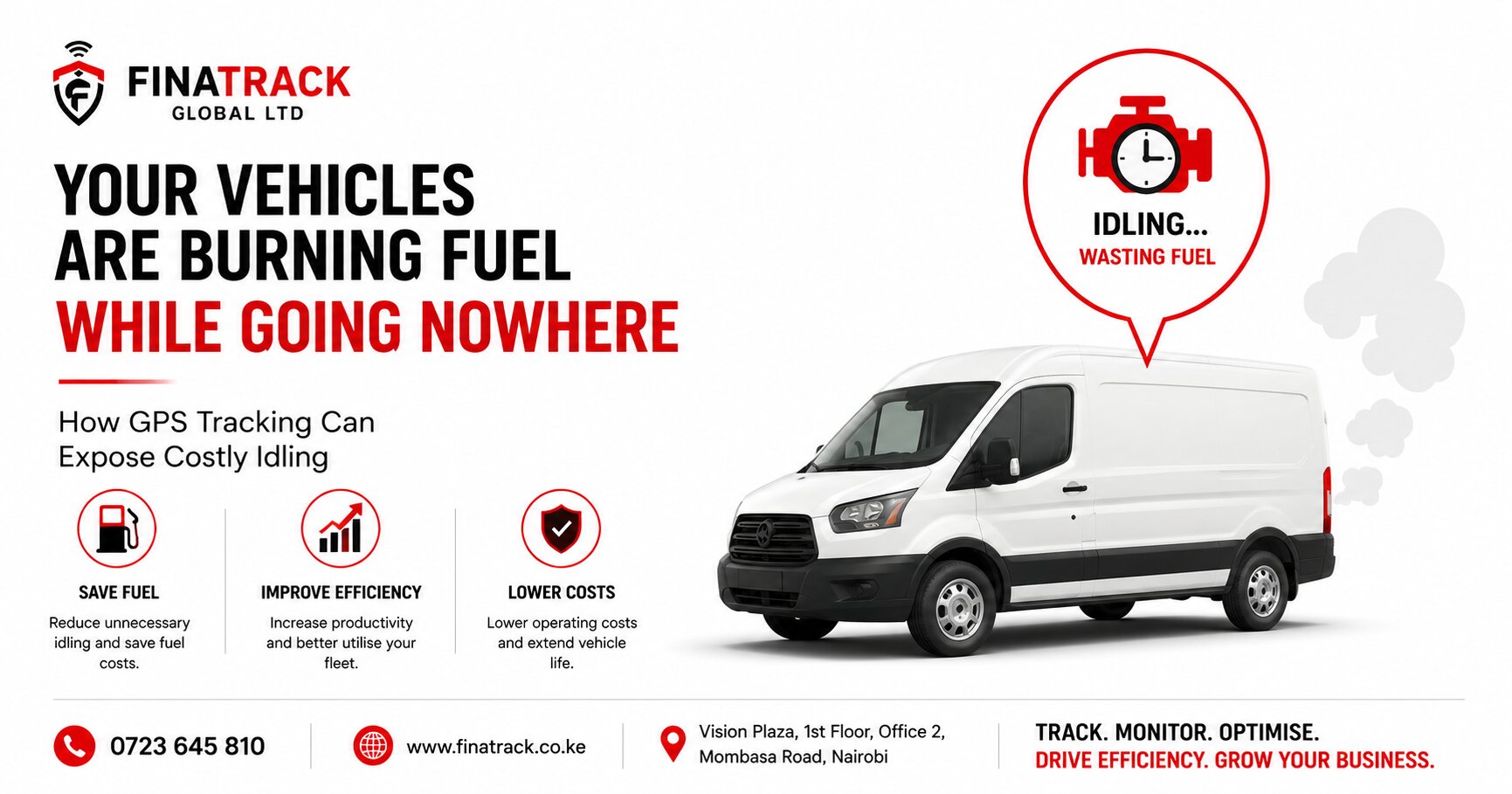
A company vehicle does not need to travel a single kilometre to consume fuel. Every time a driver leaves the engine running while waiting for a customer, loading goods, making a phone call or sitting outside the office, the business continues paying for fuel without gaining any additional distance. When this happens repeatedly across several vehicles, excessive idling can quietly become one of the most overlooked expenses in fleet operations.
For many Kenyan businesses, the problem is difficult to identify because fuel records usually show how much was purchased but not exactly how the vehicle was operating when that fuel was consumed. A manager may notice that fuel expenditure keeps increasing even though delivery volumes and monthly mileage have changed very little. GPS tracking and fleet telematics can provide the additional information needed to understand whether excessive idling is contributing to that difference.
Vehicle idling generally refers to periods when the engine is running while the vehicle remains stationary. Some idling is unavoidable because drivers may be waiting in traffic, loading goods, operating equipment or completing legitimate work that requires the engine to remain on. The management challenge is therefore not to eliminate every stationary minute, but to identify repeated periods where vehicles remain unnecessarily active without creating productive value.
Consider a delivery van that reaches a customer’s premises and remains parked for forty minutes while the driver waits for unloading. If the engine is switched off for most of that period, the financial impact from fuel is limited. If the engine continues running throughout the entire wait, however, the company is consuming fuel while the vehicle performs no additional transportation work.
The same situation can occur several times during one working day. A driver may idle for fifteen minutes at the warehouse, another twenty minutes outside a customer and thirty minutes while having lunch. Each event may appear insignificant in isolation, but the combined time across several vehicles can become substantial by the end of the month.
GPS tracking can help fleet managers identify these patterns by combining vehicle location, movement and ignition information depending on the tracking solution installed. When the system shows that ignition is active while the vehicle remains stationary for an extended period, management gains a clearer indication that idling may be occurring. Reviewing those events over time makes it easier to distinguish occasional legitimate waiting from repeated behaviour that deserves attention.
This is especially valuable because excessive idling is difficult to detect from fuel receipts alone. A receipt only confirms that fuel was purchased at a particular time and location. It does not explain whether that fuel was used to transport goods, sit in traffic, operate unnecessary engine time or support legitimate vehicle functions.
Mileage information provides useful context. If two similar vehicles cover approximately the same distance but one consistently requires more fuel, management has a reason to investigate how the vehicles are being operated. Mechanical condition, route differences and driving behaviour may all contribute, but idling should be part of the investigation.
The cost becomes more significant as the fleet grows. A business operating one vehicle may lose a relatively small amount of fuel to unnecessary idling, but a company with twenty vehicles multiplies the same behaviour across the entire operation. Small daily losses can therefore become meaningful monthly and annual expenses.
This is why fleet managers should focus on patterns rather than individual events. A vehicle idling for ten minutes once during the week may not deserve attention, especially if the driver was waiting for access to a customer’s premises. A vehicle repeatedly showing long stationary periods every working day may indicate an operating habit that can be improved.
Delivery fleets are particularly exposed to this problem because vehicles spend much of the day stopping and starting. Drivers may wait outside warehouses, apartment buildings, supermarkets and customer premises while goods are loaded or documents are processed. Some delays are unavoidable, but the engine does not always need to remain running throughout the entire waiting period.
GPS data can help identify locations where excessive waiting repeatedly occurs. If several vehicles regularly spend forty minutes at the same warehouse, the problem may not be driver behaviour at all. The business may have a loading process that needs improvement.
This distinction matters because effective fleet management should address the source of the cost rather than simply blaming drivers. If vehicles are waiting because paperwork takes too long, loading bays are poorly organised or customer procedures are inefficient, management should improve those processes. Tracking information gives the business evidence that can support that investigation.
Field service fleets face similar challenges. A technician may arrive early for an appointment and leave the engine running while waiting for the customer. Another employee may sit in the company vehicle completing reports between jobs, resulting in long periods where the car remains stationary but active.
When several technicians operate independently, supervisors may never physically observe these habits. GPS tracking provides central visibility and allows management to review how often vehicles spend extended periods stationary during the working day. The information can then support practical conversations about reducing unnecessary engine use.
Sales vehicles can also accumulate considerable idle time. A sales representative may leave the engine running while making calls, preparing quotations or waiting for the next customer meeting. Because the vehicle is assigned to one employee, the additional fuel consumption may gradually become accepted as part of normal operating costs.
Tracking data helps separate what is normal from what is avoidable. Management can compare vehicles performing similar work and identify unusually high stationary engine time. Where one vehicle consistently behaves differently from others, the pattern deserves closer examination.
Security patrol vehicles present another situation where idling needs careful interpretation. A patrol car may remain stationary at a strategic location while the driver monitors an area, and the engine may need to remain active for operational reasons. Eliminating that idling completely may therefore be unrealistic.
The objective should be understanding why the vehicle is idling and whether the duration is justified. GPS telematics provides the data, while managers apply knowledge of the operation. This combination produces better decisions than establishing one rigid rule for every vehicle.
Construction and project vehicles can be even more complicated. A pickup may remain stationary while workers use vehicle powered equipment, while other machinery may operate for long periods without travelling substantial distances. Mileage alone is therefore not enough to measure utilisation in these environments.
Managers need to consider operating time and the purpose of the vehicle. A stationary service truck supporting a project may still be producing value even when it is not moving. A pickup left running for an hour simply because nobody switched it off represents a different situation entirely.
This is one reason businesses should configure fleet monitoring around how their vehicles actually work. A distribution van, patrol vehicle and construction truck should not necessarily be judged by identical idling expectations. Policies need to reflect the operating realities of each fleet category.
Traffic congestion also deserves careful consideration in Kenya. A vehicle can remain stationary in Nairobi traffic while the driver has no practical option to switch off and restart the engine repeatedly. The tracking platform may record significant stationary periods even though the driver is still actively progressing through a congested route.
Location and trip history can help provide context. If the vehicle is stationary along a known congested corridor during peak hours and later continues along the same journey, the event may reflect traffic rather than avoidable idling. Managers should therefore avoid treating every stationary engine event as driver misconduct.
Repeated patterns become more informative. If one driver consistently records substantially more idle time than colleagues working similar routes during similar periods, management may investigate whether operating habits differ. Comparison helps create a fairer assessment than examining one vehicle without context.
Route planning can also influence idling. A delivery vehicle dispatched into heavily congested areas at the worst possible time may spend long periods stationary because the schedule itself is inefficient. Historical GPS data can help businesses understand which routes and time periods repeatedly create these delays.
Management can then adjust delivery schedules where commercially practical. Some customers may be served earlier in the morning, while others can be scheduled after peak traffic periods. Reducing congestion related engine time can improve both fuel efficiency and driver productivity.
Idling affects more than fuel expenditure. An engine that continues running is still accumulating operating time even though the odometer may remain unchanged. For some vehicles, repeated unnecessary engine hours can contribute to additional wear and maintenance requirements over time.
This is particularly relevant when businesses plan maintenance only according to mileage. A vehicle that travels relatively few kilometres but spends many hours running may be working harder than the odometer suggests. Managers should therefore consider actual operating patterns when assessing maintenance requirements.
The same issue appears in fleet replacement decisions. Two vehicles may show similar mileage while one has spent significantly more time operating while stationary. Looking only at kilometres can therefore provide an incomplete picture of how heavily each asset has been used.
Telematics helps provide additional context. The more accurately management understands vehicle utilisation, the better it can plan maintenance, replacement and fleet allocation. Tracking becomes valuable because it transforms activities that were previously invisible into information that can be measured.
Driver behaviour can also influence idling in ways that are easy to correct. Some employees leave engines running simply because it has become a habit, particularly when they expect to stop for only a few minutes. Those minutes can become much longer when a customer delays, paperwork takes time or another employee starts a conversation.
Clear fleet policies can help address this. Drivers should understand when the business expects engines to be switched off and which operational situations justify continued idling. The policy should remain practical enough that employees can follow it without interfering with legitimate work.
Training usually works better than punishment when the objective is changing routine behaviour. Showing drivers how idling contributes to the company’s fuel expenditure gives them a clearer reason to change. Fleet data can help management demonstrate the scale of the issue without turning the conversation into an accusation.
Businesses should also recognise circumstances where keeping the engine running may be appropriate. Vehicle safety, specialised equipment, extreme operating conditions or certain commercial activities may require continued power. Good policies acknowledge those exceptions rather than creating unrealistic targets.
Monitoring should therefore focus on excessive and unexplained idling rather than attempting to achieve zero idling. A realistic fleet management programme identifies avoidable waste while preserving legitimate operating requirements. This balance makes the policy easier for employees to accept and for managers to enforce consistently.
GPS tracking can also help identify vehicles left running after working hours. A company car parked at an employee’s residence or yard may remain active unexpectedly, creating fuel consumption or indicating that the vehicle is being used outside approved periods. Ignition and location information can provide useful context when these events occur.
Unexpected ignition activity should always be verified before conclusions are drawn. The vehicle may be undergoing maintenance, warming up before an authorised journey or being moved for legitimate reasons. Tracking provides information that prompts investigation rather than automatically proving misuse.
For larger businesses, exception based reporting can make idling management much easier. Fleet supervisors do not need to monitor every vehicle continuously throughout the day. Instead, they can focus on units showing unusually long stationary periods or repeated patterns that differ from the rest of the fleet.
This makes telematics more practical. The objective should not be creating another full time monitoring job for the fleet manager, but giving management useful information that highlights where attention is required. Good fleet management focuses on exceptions rather than watching moving icons all day.
A business may discover that most vehicles are operating efficiently while only a few contribute disproportionately to idle time. Addressing those specific vehicles can produce improvements without imposing unnecessary restrictions across the entire organisation. Data allows management to target the real problem.
Measuring progress is equally important. Once drivers are trained or routes are adjusted, management can compare idling patterns over subsequent weeks. If stationary engine time falls while service levels remain unchanged, the business has evidence that the intervention is working.
Fuel expenditure can also be compared over time. Several factors influence consumption, so management should not expect every reduction to be caused by idling alone. However, improved idling behaviour combined with stable mileage can contribute to a more efficient fleet.
The same measurement approach helps businesses calculate whether GPS tracking is creating operational value. A tracking system should not be judged only by whether it can display a vehicle’s location. The greater return comes when information leads to fewer unnecessary kilometres, lower idling, improved maintenance and better fleet utilisation.
Idling information can also reveal customer related inefficiencies. A distribution business may discover that one customer consistently keeps delivery vehicles waiting significantly longer than others. That delay consumes driver time and may contribute to additional fuel costs.
Management can then raise the issue commercially. Delivery windows can be renegotiated, loading procedures can be changed or pricing can be adjusted where prolonged waiting becomes part of the real cost of serving the customer. GPS data provides evidence to support those conversations.
Warehouses can benefit from the same analysis internally. If company trucks regularly queue for long periods before loading, management can review staffing, scheduling and bay allocation. Reducing those delays improves more than fuel efficiency because vehicles become available for additional productive work.
This demonstrates why idling should not be viewed only as a driver problem. Excessive stationary time may expose weaknesses in dispatching, customer processes, loading procedures and route planning. GPS tracking gives management the visibility needed to find those weaknesses.
Fleet utilisation can also improve when idle time is analysed correctly. A vehicle may appear busy because it leaves the office every morning and returns late, yet GPS data may show that several hours of the day are spent stationary between assignments. Management can then investigate whether scheduling could allow the same vehicle to complete more productive work.
This can affect decisions about fleet expansion. Before purchasing another vehicle, a business should understand whether existing assets are genuinely operating near capacity. If large amounts of time are being lost through waiting and poor scheduling, improving operations may create additional capacity without increasing the number of vehicles.
The opposite may also become clear. If vehicles show low avoidable idling, efficient routing and high productive utilisation but workloads remain excessive, management has stronger evidence that another vehicle may be required. Data gives the business confidence that expansion is solving a real capacity problem rather than masking inefficiency.
Idling analysis can therefore contribute to both day to day cost control and long term capital decisions. The information helps businesses understand not only how far vehicles travel but how effectively working hours are being converted into productive activity. That is a much more useful measure of fleet performance.
Tracking reliability remains essential if management intends to use this information. A device with unstable power or incorrect ignition detection may generate misleading data about when a vehicle is active. Professional installation and configuration are therefore important before businesses rely on telematics reports for operational decisions.
Ignition information should be tested during installation. The tracking platform should correctly recognise when the vehicle is switched on and off according to the system configuration. If ignition status remains permanently active or inactive, idling reports may become unreliable.
Trackers should also be checked after electrical repairs or battery replacement. A mechanic may disturb wiring or reconnect equipment incorrectly while performing unrelated work. Confirming normal tracker operation after workshop visits helps maintain the quality of fleet information.
Mobile network interruptions should also be understood. A tracker may temporarily stop transmitting information when communication coverage is weak, even though the vehicle continues operating. Depending on the device and configuration, records may upload after connectivity returns.
Fleet managers should therefore avoid assuming that every temporary gap represents missing activity. Historical data can often provide a clearer picture after the tracker reconnects. Understanding how the tracking system behaves prevents incorrect conclusions about vehicle utilisation.
Professional support from the tracking provider becomes valuable when reports appear unusual. A vehicle showing impossible ignition patterns or unexplained communication gaps should be technically checked before management uses the information to assess a driver. Accurate data is essential for fair fleet management.
For smaller Kenyan businesses, idling management does not need to become complicated. Management can start by looking for vehicles that frequently remain stationary with ignition active for long periods and then investigate the reason. Even a simple weekly review can uncover habits that were previously invisible.
Larger fleets can take a more structured approach by comparing vehicles, drivers, branches and operating periods. Managers can identify which departments generate the most stationary engine time and determine whether the cause involves driver behaviour, traffic, scheduling or customer operations. This turns telematics into a management tool rather than simply a security system.
The most important principle is to connect information with action. Knowing that a vehicle idled for two hours does not save the business any money by itself. Management must determine why the idling occurred and whether something can reasonably be changed.
Sometimes the solution will involve driver training. In other cases, it may require better delivery scheduling, faster warehouse loading, improved customer coordination or different route planning. GPS tracking helps identify where the opportunity exists, while management determines the appropriate response.
Finatrack Global Ltd provides professionally installed GPS tracking and fleet telematics solutions for Kenyan businesses seeking better visibility over vehicle activity and operating costs. Depending on the system installed, businesses can access location, trip history, ignition information, driver monitoring and other fleet management data that can help identify patterns such as excessive idling.
Professional installation can be arranged at the customer’s convenient location or at Vision Plaza, 1st Floor, Office 2, Mombasa Road, Nairobi. Businesses looking to improve fleet visibility can contact Finatrack Global Ltd on 0723 645 810 or visit www.finatrack.co.ke to discuss an appropriate tracking and fleet management solution.
A vehicle does not have to be moving to cost your business money. When engines spend unnecessary time running while vehicles remain stationary, fuel and operating value disappear without another kilometre being completed. GPS tracking makes those hidden periods visible, giving managers an opportunity to reduce waste, improve utilisation and get more productive value from every vehicle in the fleet.