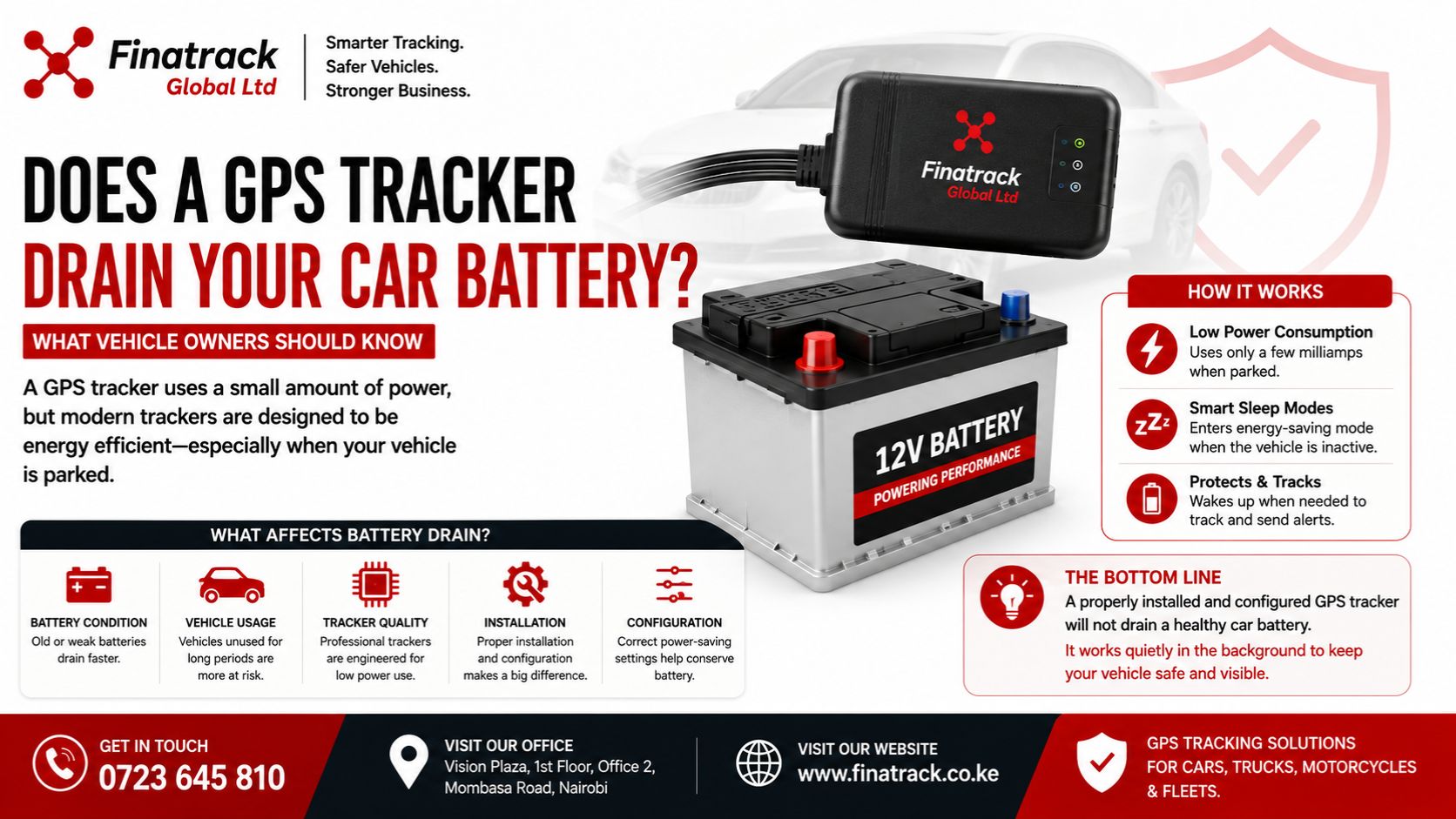
One of the most common concerns motorists have before installing a wired GPS tracker is whether the device will eventually drain the car battery. The concern is understandable because a professionally installed tracker normally remains connected to the vehicle’s electrical system even when the engine has been switched off.
The short answer is yes, a wired GPS tracker uses some electricity from the vehicle battery, but a properly installed and properly configured modern tracker is designed to use a very small amount of power, particularly while the vehicle is parked. Professional devices use power-saving modes specifically intended to reduce consumption when the vehicle is not moving.
The difference between normal tracker consumption and a genuine battery-drain problem is therefore important. A working GPS tracker should not be consuming power like headlights, an entertainment system or another high-demand vehicle accessory. Some current professional tracking devices specify parked-state consumption measured in only a few milliamps when operating in their deeper sleep modes.
For example, Teltonika’s FMC920 specification lists consumption below 2 mA at 12 volts in Ultra Deep Sleep, below 3 mA in Deep Sleep and below 8 mA in Online Sleep. Another current device, the FTM880, specifies considerably higher consumption in normal operation but drops to about 2.6 mA in Deep Sleep and below 1 mA in its lowest power-saving mode. These figures illustrate why tracker configuration matters almost as much as the hardware itself.
When the vehicle is being driven, the tracker needs to perform more work. It may be acquiring location information, monitoring ignition and movement and communicating records to the tracking platform. When the car remains stationary, compatible devices can enter different sleep modes that turn off or reduce selected functions to lower their demand on the vehicle battery.
This means a vehicle parked overnight should not necessarily have its tracker operating at exactly the same power level as a vehicle travelling along the highway. Proper configuration allows the device to recognise when the vehicle has stopped and enter a lower-power state after the required conditions have been met. Teltonika’s documentation specifically describes these sleep modes as a way of saving external battery power.
For most healthy vehicle batteries used regularly, the power required by a properly configured professional tracker is designed to be manageable. Problems are more likely to become noticeable when other factors already exist, such as an ageing battery, a vehicle that remains unused for extended periods, additional aftermarket electronics or an installation or configuration problem that prevents the tracker from entering its intended low-power state. This is a practical implication of the large difference between normal operating consumption and the much lower consumption specified for sleep modes.
Consider a car that is driven almost every day. When the engine is running, the vehicle’s charging system replenishes the battery while supplying the vehicle’s electrical requirements. A small tracker load while the vehicle is parked is therefore very different from the situation involving a car that remains untouched for several weeks.
If a vehicle spends long periods parked, every continuous electrical load becomes more relevant. The tracker may be only one of several devices drawing standby power, alongside the alarm, keyless-entry system, infotainment electronics, dashcam or other aftermarket accessories.
This is why blaming the GPS tracker immediately whenever a battery goes flat can lead to the wrong diagnosis. A battery may already be approaching the end of its useful condition, the charging system may not be replenishing it properly or another electrical accessory may be responsible for the majority of the drain.
The tracker should still be investigated, but it should be investigated as part of the vehicle’s complete electrical system rather than automatically assumed to be the cause.
Installation quality is particularly important. A GPS tracking device has specific requirements for power, grounding and ignition detection, and those connections need to be made correctly. A professional installation should also ensure that the device is operating in the configuration intended for that vehicle rather than remaining unnecessarily active while the car is parked.
A poor installation can create a very different experience from a professional one. Loose connections can cause intermittent operation, while inappropriate wiring can create electrical problems that customers may incorrectly interpret as a defective tracker.
The customer may notice that the car struggles to start after remaining parked, while the tracker repeatedly appears online and offline. That combination deserves technical inspection rather than guesswork.
Configuration can be just as important as the wiring. Professional trackers may offer GPS Sleep, Deep Sleep, Online Deep Sleep and Ultra Deep Sleep modes, each designed to balance power consumption against how much connectivity or functionality needs to remain available while the vehicle is stationary.
The lowest-power setting is not automatically the best setting for every customer. A private vehicle owner concerned mainly about long-term battery preservation may have different requirements from a high-risk commercial fleet that expects frequent communication even while vehicles are parked.
Security therefore involves a trade-off.
A tracker that remains more actively connected may consume more electricity but can offer greater immediate communication. A deeper sleep configuration can reduce power demand but may change how frequently selected functions remain active until the tracker wakes again. The correct balance depends on the device and the security requirement.
Movement and ignition are commonly used as wake-up conditions on compatible tracking devices. Teltonika’s FMB130 documentation, for example, describes the device leaving GPS sleep when movement is detected by the configured movement source or when ignition is switched on.
This allows the tracker to conserve energy while the vehicle is stationary and become more active again when the car starts moving.
Vehicle owners should also understand the difference between the car battery and the small backup battery contained in some GPS trackers. The main vehicle battery normally supplies the tracker during everyday operation, while an internal tracker battery may temporarily keep the unit operating if external power is lost.
That backup battery is not intended to power the entire vehicle. It exists primarily to give the tracker some level of continued operation when normal external power disappears. Some tracking devices are specifically designed with larger internal batteries to extend operation after external power loss.
This can become useful during vehicle theft or tampering. If somebody disconnects the main vehicle battery, a tracker with suitable backup capability may continue operating temporarily, depending on its battery condition, configuration and device design.
The internal battery itself should also be considered during long-term maintenance. Like other rechargeable batteries, its performance will not remain identical forever. Owners who rely heavily on backup power should have the tracking system inspected periodically rather than assuming the backup battery will provide the same endurance years after installation.
There are several warning signs that justify checking the installation. A vehicle battery repeatedly going flat after relatively short parking periods, unexplained tracker disconnections, a device that never appears to enter its normal parked state or electrical problems that began immediately after installation should all be investigated.
The correct response is not necessarily to remove the tracker.
A competent technician should first confirm that the tracker has been installed correctly, check its configuration and determine whether the battery problem persists independently of the tracking system.
The condition of the vehicle battery should also be tested. Installing a GPS tracker can sometimes coincide with an already weak battery reaching the point where starting problems become noticeable.
Replacing or disconnecting the battery is another moment when the tracking system should be checked. Once normal vehicle power has been restored, the owner should confirm that the tracker returns online, reports the correct location and continues receiving the expected power supply.
Businesses operating fleets should take an even more structured approach. A tracker that consumes only a small amount of electricity on one vehicle can still become an operational issue if several vehicles have weak batteries, spend long periods parked or have inconsistent installation standards.
Fleet managers should therefore monitor devices that repeatedly go offline and investigate vehicles experiencing unexplained battery problems. Maintenance records should show whether the battery, alternator, tracker or another accessory has already been inspected.
For vehicles that remain parked for extended periods, the tracking configuration deserves particular attention. Professional telematics devices are specifically designed with power-saving functions for stationary vehicles, and those functions should be matched appropriately to how the asset is used.
A weekend vehicle, seasonal vehicle or asset that sometimes remains parked for several weeks may require a different approach from a taxi or delivery vehicle that operates every day.
Motorcycles require similar consideration because their batteries are normally much smaller than those fitted to cars and commercial vehicles. Tracking equipment intended for motorcycles should therefore be selected and configured with the vehicle’s limited battery capacity in mind.
Some trackers designed for motorcycles and electric vehicles specifically include extremely low-power modes. Teltonika, for example, describes a power-off sleep function on its FMB930 designed to reduce external battery consumption to below 1 mA under that operating mode.
This demonstrates why the answer to the battery-drain question cannot simply be, “All trackers use the same amount of power.”
They do not.
Different devices, configurations and operating conditions can have substantially different consumption characteristics.
Vehicle owners should therefore ask their tracking provider several practical questions before installation. What happens to the tracker when the vehicle remains parked? Does the device support power-saving modes? Will it continue monitoring while ignition is off? Does it contain a backup battery? What should the owner do if the car remains unused for a long period?
A professional installer should be able to answer those questions according to the specific equipment being fitted.
Customers should also avoid judging installation quality only by whether the car appears on a map immediately after fitting. The system should work reliably after the vehicle has been switched off, parked overnight and used again the following day.
Good tracking is not simply about getting the device online.
It is about keeping it online without creating unnecessary problems for the vehicle.
A well-configured tracker therefore needs to balance two competing requirements. It should conserve battery power when the vehicle is inactive while remaining sufficiently responsive to provide the security and tracking functions expected by the owner.
Modern professional tracking hardware is designed with precisely this challenge in mind, which is why multiple sleep and low-power modes are common across vehicle telematics devices.
For the average motorist, the key message is straightforward.
A GPS tracker does draw power from the vehicle battery, but a properly installed and configured professional tracker should be designed to keep that consumption low, especially while the vehicle is parked. If a healthy car battery repeatedly becomes flat after tracker installation, the situation deserves proper electrical and tracker diagnostics rather than being accepted as normal.
Finatrack Global Ltd provides professionally installed GPS tracking and vehicle-security solutions for private cars, motorcycles and commercial fleets in Kenya. Customers experiencing battery or tracking issues can have the installation inspected to determine whether the tracker, wiring, configuration or another part of the vehicle’s electrical system requires attention.
Professional installation and technical support can be arranged at the customer’s convenient location or at Vision Plaza, 1st Floor, Office 2, Mombasa Road, Nairobi.
For GPS tracker installation and vehicle security solutions, contact Finatrack Global Ltd on 0723 645 810 or visit www.finatrack.co.ke.
Your GPS tracker needs power to protect and monitor the vehicle.
The important thing is making sure it uses that power intelligently.