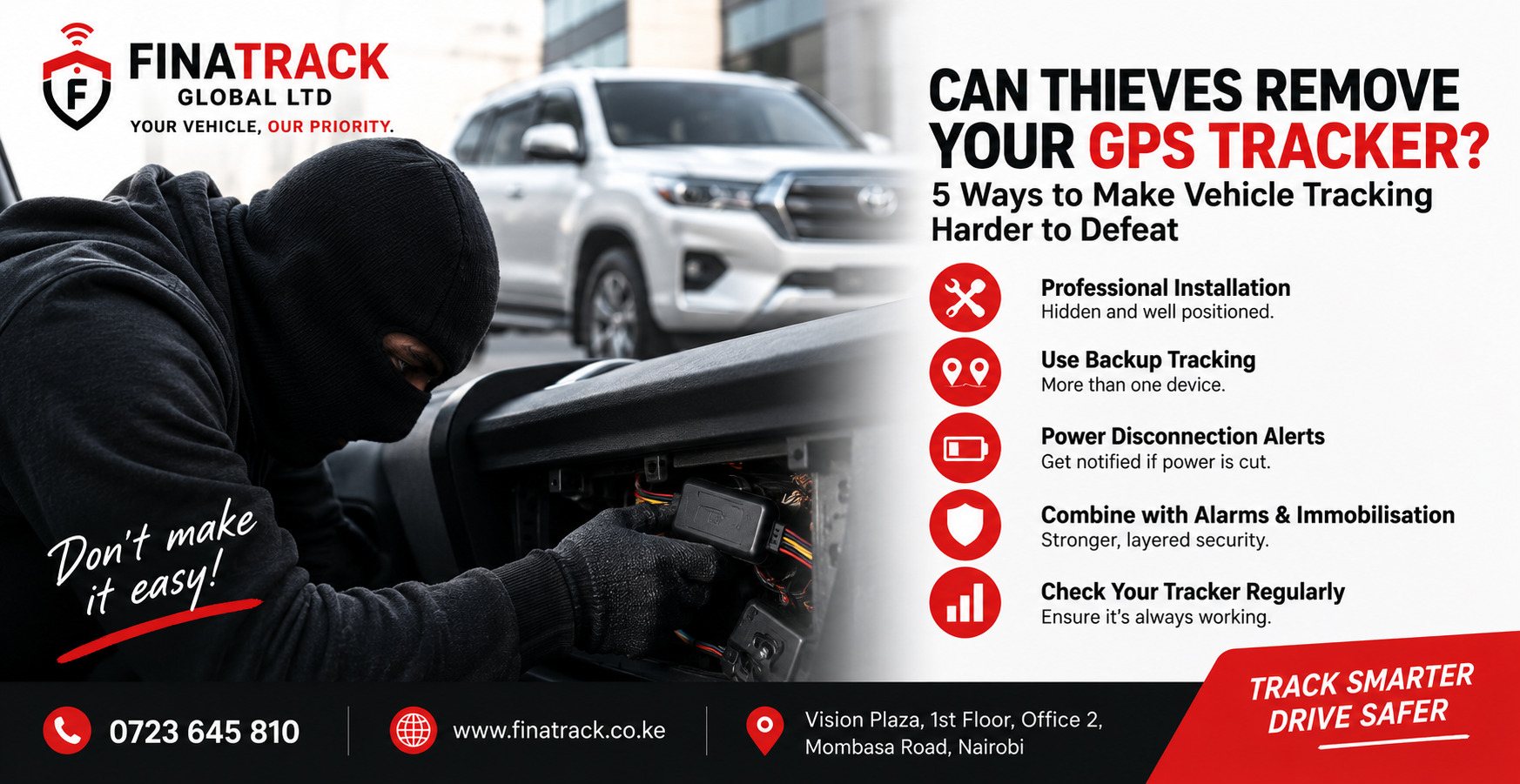
Installing a GPS tracker can significantly improve vehicle visibility and recovery capability, but many motorists eventually ask the same uncomfortable question: what happens if the thief finds the tracker? A tracking device is not magic, and a determined criminal who has enough time with a vehicle may attempt to locate, disconnect or interfere with it. This is why effective vehicle security should focus not only on installing a tracker but also on making the entire tracking system more difficult to defeat.
For Kenyan vehicle owners, this is especially important with higher value cars, commercial vehicles and vehicles that spend long periods away from secure parking. A basic tracker can provide useful everyday monitoring, but relying on one device as the entire security strategy creates a single point of failure. Professional installation, backup tracking and additional security layers can make the system considerably more resilient.
A GPS tracker normally needs power, satellite positioning and some form of communication to send vehicle information to a monitoring platform. A wired tracker typically receives power from the vehicle electrical system, while a wireless tracker operates using its own battery. Understanding these differences explains why thieves may attempt different methods of disrupting vehicle tracking.
One possibility is simply searching for the device and disconnecting it. Poorly installed trackers can be relatively easy to identify, particularly when wiring is obvious or the device has been placed where aftermarket equipment is commonly found. Professional installation therefore plays a much larger role in security than many motorists realise.
The objective is not to make the tracker permanently impossible to access. Authorised technicians may eventually need to inspect or replace it. The objective is to make the device difficult for an unauthorised person to identify quickly while maintaining reliable GPS and mobile communication.
This creates the first important protection principle: the tracker should be professionally and discreetly installed. A tracking device left hanging under the dashboard or connected using clearly visible wiring provides very little concealment. Even an inexperienced thief may recognise that something has been added to the vehicle.
A professional installer considers several factors when positioning the equipment. The device needs reliable power, suitable communication performance, protection from unnecessary heat or moisture and a location that does not interfere with normal vehicle systems. Concealment is important, but it should never be achieved at the expense of technical reliability.
Vehicle owners should avoid publicly discussing the precise location of their tracker as well. A mechanic may need to know that aftermarket security equipment is installed when performing relevant electrical work, but friends, casual drivers and unrelated technicians do not necessarily need to know exactly where the device sits. Security information should be shared only when there is a legitimate reason.
This becomes particularly important for company vehicles used by many employees. The more people who know the exact installation position, the greater the possibility that the information eventually reaches someone who should not have it. Fleet managers should therefore treat tracker placement as security information rather than ordinary vehicle knowledge.
Discreet installation also protects against opportunistic tampering. Someone who gains access to the vehicle may know that GPS tracking is probably installed but still have difficulty locating the actual device quickly. Time becomes an important security advantage because the tracker may continue transmitting while the person searches.
A second protection principle is avoiding dependence on one tracking device. A primary wired tracker is excellent for everyday monitoring, but higher risk vehicles can benefit from an independent backup tracker. If one device is discovered or loses power, the second device may continue providing location information.
This backup should operate independently from the main installation where possible. Placing two devices beside each other provides limited additional security because anyone finding the first tracker may immediately discover the second. Effective redundancy requires separation between security layers.
A wireless tracker can provide this independence because it has its own power source. Disconnecting the vehicle battery or cutting power to the wired tracker does not automatically switch off the wireless device. This makes wireless tracking particularly valuable as a backup rather than simply an alternative to wired tracking.
The wireless device still requires maintenance. Its battery must remain charged or within its expected service period, and its status should occasionally be checked. A backup tracker that ran out of power several months earlier provides little benefit when the primary device is compromised.
Vehicle owners should therefore create a simple routine for checking all tracking layers. Open the tracking application periodically, confirm that the wired tracker is reporting normally and verify that the backup device remains active. Security equipment should be treated as something that requires occasional attention rather than a one time installation.
A tracking tag can provide another layer depending on the technology being used. Tags may operate differently from conventional wired GPS tracking and can therefore create additional recovery opportunities. The strongest approach is not simply adding more devices but adding technologies that do not all depend on exactly the same point of failure.
This is particularly relevant when discussing signal interference. Many conventional GPS trackers use satellite positioning combined with cellular communication. If communication is deliberately disrupted, both a wired and wireless GPS tracker using the same communication method may experience difficulty transmitting information.
This means two conventional trackers do not automatically make a vehicle immune to jamming. Redundancy still helps against power loss or physical removal, but different types of interference may require different security technologies. Higher risk vehicle owners should discuss this with a professional provider rather than assuming that more devices always solve every threat.
The third protection principle is using power disconnection information where supported. A wired tracker can sometimes recognise when its normal external power supply disappears and generate a notification through the tracking platform. This can provide an early warning that the vehicle battery or tracker wiring has been disturbed.
A power disconnection alert does not automatically mean somebody is removing the tracker. Mechanics routinely disconnect batteries during repairs, battery replacement and electrical work. The importance of the event depends on when and where it happens.
If the owner receives a power loss alert while the vehicle is parked at a workshop during an authorised battery replacement, there may be little reason for concern. The same alert arriving at 2 a.m. while the car is supposed to be parked at home deserves much faster verification.
The sequence of events can also provide valuable information. Unexpected ignition activity followed by vehicle movement and then power loss creates a different security picture from an isolated battery disconnection. Tracking systems are most useful when owners look at several events together rather than reacting to each notification separately.
Some wired trackers also contain small internal backup batteries. Depending on the device, configuration and battery condition, this may allow the tracker to continue operating temporarily after external power disappears. The owner should understand whether the installed device includes this capability rather than assuming every wired tracker behaves the same way.
Backup power should not be treated as unlimited operation. The purpose is usually to maintain tracking temporarily and provide additional time during a power interruption. Once the internal battery is exhausted, the tracker may stop communicating unless vehicle power is restored.
This reinforces the value of an independent wireless device. The wired tracker backup battery may provide temporary resilience, while the wireless tracker provides a separate power source designed specifically for independent operation. Different layers address different weaknesses.
The fourth protection principle is combining GPS tracking with physical vehicle security. A tracker is most useful after movement occurs, but the better outcome is preventing the vehicle from being driven away in the first place. Car alarms, immobilisation and sensible key control can make theft more difficult before the tracker becomes the primary recovery tool.
An alarm provides an immediate local response when someone interferes with the vehicle. Depending on the system installed, intrusion, vibration or unauthorised access can trigger the siren. This may attract attention and discourage a thief before the vehicle leaves the parking area.
A hidden cut off or immobilisation system adds another obstacle. Even if the thief manages to enter the car, operating it becomes more difficult. The exact installation should be designed professionally for the particular vehicle rather than using a generic wiring method across every model.
A GPS tracker and alarm therefore perform different functions. The alarm focuses on deterrence and intrusion awareness, while the tracker provides remote visibility. Combining the two creates a stronger security strategy than asking one device to perform every role.
Remote immobilisation can provide another capability where supported by the wired tracking system. An authorised user may be able to prevent the vehicle from continuing normal operation under appropriate conditions. This feature can be valuable during theft recovery, but it must be used with road safety in mind.
Attempting to stop a moving vehicle in heavy traffic or at high speed can create additional danger. Immobilisation should therefore be used according to the system design and appropriate recovery procedures. The objective is recovering the vehicle safely, not creating another road emergency.
Physical key security also deserves attention. A sophisticated GPS system cannot prevent unauthorised use if someone has easy access to the vehicle keys. Businesses should control spare keys carefully and know which employees are authorised to drive each vehicle.
Private owners should take the same precaution. Spare keys should not be left casually inside the vehicle or in predictable locations. Technology works best when basic security habits support it.
The fifth protection principle is checking the tracker regularly rather than assuming it is always working. One of the biggest risks in vehicle security is false confidence. A motorist may believe the car is protected because a tracker was installed two years earlier without realising that the device stopped communicating weeks ago.
The simplest check is the last update time. If the car has been driven recently but the application shows the last report was several days ago, something may be wrong. The problem could involve connectivity, subscription status, power or the device itself.
Trip history provides another quick check. Recent journeys should appear normally when the tracker is functioning and communicating according to its configuration. Missing trips or large communication gaps deserve investigation.
This becomes particularly important after workshop visits. Battery replacement, dashboard work, alarm installation and other electrical repairs can accidentally disturb GPS wiring. The car may leave the garage mechanically fine while the tracker remains disconnected.
Owners should therefore open the tracking application after significant vehicle repairs. Confirm a fresh location update, start the vehicle and complete a short journey where practical. The tracker should return to normal operation before the vehicle is considered fully protected again.
Businesses can formalise this process. A fleet vehicle returning from workshop maintenance can be checked for both mechanical readiness and tracker health before being returned to service. This prevents missing telematics data and security visibility for weeks after an otherwise successful repair.
Subscription status should also be reviewed. A tracker can remain perfectly installed but stop providing normal remote monitoring if the required connectivity or platform service expires. Vehicle owners should understand any ongoing service requirements associated with their system.
Keeping contact details current is equally important. Renewal reminders may be sent to an email address or phone number that belonged to an employee who has since left the company. Businesses should ensure tracking accounts are connected to current authorised personnel.
Account security itself forms part of vehicle security. A tracker may be physically difficult to find, but weak login credentials can create another vulnerability. Tracking usernames and passwords should not be shared widely across an organisation.
Only people with a legitimate operational reason should have access to detailed vehicle location. Former employees, previous drivers and contractors should have access removed when they no longer require it. The tracking platform contains sensitive information about where company assets travel and park.
Vehicle owners should also change account credentials when purchasing a used car that already contains a tracker. The previous owner should not continue seeing the vehicle location simply because the old login was never replaced. Ownership of the tracking account should follow legitimate ownership of the vehicle.
The same principle applies when selling a tracked car. The tracker can be removed professionally and transferred to another vehicle, or the account can be handed over properly if the device remains installed. The previous owner should no longer maintain unnecessary access after the sale.
A professional vehicle security strategy therefore goes much further than asking whether a thief can physically remove a tracker. The more important question is what happens if one security layer fails. If disconnecting one device immediately removes every form of vehicle visibility, the system has very little redundancy.
A stronger setup assumes that individual layers can be defeated. The alarm may be ignored, the wired tracker may lose power or the thief may discover one device. Another layer should still create difficulty or provide information.
This concept is especially important for high value SUVs and luxury vehicles. The financial exposure associated with losing these vehicles can justify greater security investment. A wired tracker, advanced alarm, immobilisation and independent backup tracker may provide a more suitable arrangement than a single inexpensive device.
Commercial vehicles also deserve consideration because their value extends beyond the purchase price. A stolen delivery van can interrupt customer service, a truck can disappear with cargo and a project pickup can halt field work. Businesses should therefore consider the operational cost of losing the vehicle as well as its resale value.
Financed vehicles may have additional tracking requirements from lenders. A bank, SACCO or microfinance institution may require professional installation and specific documentation. Owners should confirm those requirements rather than assuming any portable tracker will satisfy them.
Motorcycles present their own security challenge because the available installation space is smaller and theft can occur very quickly. The correct tracker and installation method should therefore be selected specifically for motorcycle use. A device designed for a car should not automatically be assumed suitable for every motorbike.
Fleet owners should also avoid installing the exact same security configuration in every vehicle simply for convenience. High risk vehicles may deserve additional backup tracking while lower risk vehicles use a standard wired solution. Security investment should reflect asset value, usage and exposure.
Driver education can strengthen the system as well. Employees should know how to respond when unusual tracking alerts appear and who to contact when they suspect theft or tampering. Technology provides information, but people still need to act on it appropriately.
More than one authorised person should understand the fleet tracking platform. If the only administrator is unavailable during a security incident, valuable time can be lost trying to recover passwords. Access should remain controlled but practical enough for the organisation to respond.
During a suspected theft, the owner should avoid personally pursuing the vehicle simply because a location is visible on the application. People involved in vehicle theft may be dangerous, and a location pin does not mean the recovery area is safe. Tracking information is most useful when shared with appropriate authorised responders.
The last reported location should always be considered together with its timestamp. A vehicle displayed on a map may have moved since that position was transmitted, particularly if the tracker has gone offline. The owner should determine whether the information is live or historical before acting on it.
A sudden offline status during theft can have several explanations. Power may have been removed, the vehicle may have entered weak network coverage, the tracker could have been physically damaged or communication may be experiencing deliberate interference. The events immediately before the device went offline can provide useful context.
Depending on the tracker, historical data may become available later after connectivity returns. This can help reconstruct where the vehicle travelled during a communication interruption. Customers should understand how their particular tracker handles offline data rather than assuming all devices behave identically.
Vehicle owners should also be cautious about advertising detailed security arrangements publicly. Saying that the vehicle is GPS tracked is different from publishing photographs showing exactly where devices are installed or describing the full security configuration. Security is stronger when unnecessary technical details remain private.
The same applies to workshops and car washes. Staff may legitimately need access to the vehicle, but they do not automatically need detailed information about every tracking layer. Only disclose what is necessary for the work being performed.
A reputable tracking installation should balance concealment with serviceability. The device should be difficult for an unauthorised person to locate quickly while still allowing an authorised technician to diagnose problems later. Extreme concealment that makes maintenance impossible is not necessarily professional installation.
Owners should also avoid assuming that the newest or most expensive tracker automatically creates the strongest security. The quality of the installation, maintenance and wider security strategy can be just as important as the hardware itself. A sophisticated device connected carelessly can perform worse than a simpler tracker installed professionally.
The monitoring platform matters too. The user should be able to check vehicle status quickly and understand important information such as location, last update and recent journeys. Complicated software that the owner does not know how to use provides limited value during an emergency.
Customer training should therefore form part of the installation process. The owner should know how to log in, identify whether the tracker is online, check the latest location and review trip history. Where immobilisation is available, the correct procedure should also be understood.
For businesses, training should include fleet administrators and any authorised security personnel. They should know which alerts require action and which are normal operational events. A well configured system reduces panic while improving response to genuine security problems.
Regular testing is particularly important for security features that are rarely used. An immobilisation function that has not been tested in years may not perform as expected after unrelated vehicle repairs. Safe periodic verification gives the owner greater confidence.
The alarm should be tested as well. Sirens, remotes and sensors can develop faults over time, while workshop work can affect wiring. Security systems should not be assumed to remain perfect simply because they were installed professionally at the beginning.
Wireless backup trackers need their own schedule. Depending on the device, the owner may need to recharge it or confirm its battery state periodically. The backup should be treated as an active security component rather than something hidden and forgotten.
Finatrack Global Ltd currently provides several vehicle tracking and security options that can be combined according to risk. A wired GPS tracker is available at KES 15,000, while a wireless GPS tracker is also available at KES 15,000. Customers who want a stronger combination can use both technologies or discuss additional alarm and vehicle security layers according to their needs.
For motorists looking to combine tracking with intrusion protection, Finatrack Global Ltd also provides an advanced car alarm system with hidden cut off at KES 7,500. A wired GPS tracker plus advanced alarm combination is available at KES 20,000, creating a practical layered security package for vehicle owners who do not want to depend on tracking alone.
Customers protecting higher risk vehicles can consider combining primary wired tracking with an independent wireless tracker or tracking tag. The appropriate configuration should depend on vehicle value, usage and the owner’s security priorities rather than simply installing every available device.
Professional installation can be arranged at the customer’s convenient location or through Finatrack Global Ltd at Vision Plaza, 1st Floor, Office 2, Mombasa Road, Nairobi. Vehicle owners can contact 0723 645 810 or visit www.finatrack.co.ke to discuss an appropriate vehicle tracking and security solution.
A thief may be able to find and remove a GPS tracker, which is exactly why good vehicle security should never depend entirely on one hidden box. Professional concealment, independent backup tracking, power loss awareness, alarms, immobilisation and regular tracker checks create a much stronger defence. The objective is not to promise that a vehicle can never be stolen, but to make defeating its security more difficult and to preserve as many opportunities as possible to maintain visibility and support recovery.