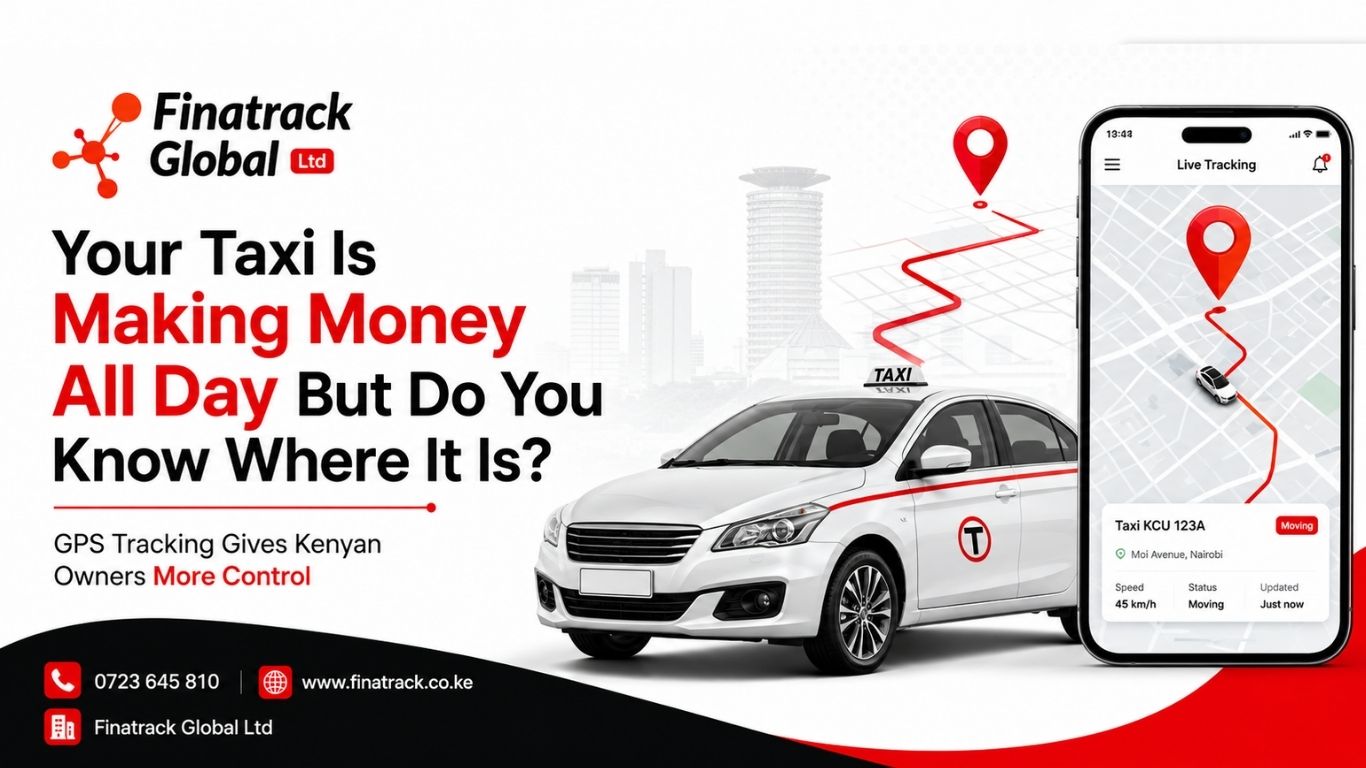
Taxi and ride-hailing vehicles can spend most of the day away from their owners. A car may leave home early in the morning, operate across Nairobi for several hours and return late at night after covering hundreds of kilometres. For owners managing one or several vehicles driven by other people, this creates a simple but important management problem: you may own the vehicle, pay for maintenance and carry the financial risk, yet have limited visibility over how the car is actually being used.
GPS tracking can help close that gap by giving vehicle owners access to location, trip history, mileage and other operational information depending on the tracking system installed. Instead of relying entirely on phone calls and driver explanations, the owner gains an independent record of how the vehicle is moving. This can improve security while also providing useful information for maintenance, mileage control and day-to-day vehicle management.
The need becomes even greater when an owner has leased a vehicle to a driver for taxi or ride-hailing work. The owner may receive an agreed daily or weekly payment, but the car can still be exposed to long operating hours, poor driving, unnecessary mileage and unauthorised use. Without tracking information, many of these issues only become visible when the vehicle requires expensive repairs or fails to return at the expected time.
A GPS tracking platform allows the owner to check the vehicle’s current or most recently reported location without repeatedly calling the driver. If the car is operating in Westlands, Kilimani, Embakasi or another part of Nairobi, the owner can confirm its general movement from the tracking system. This gives the owner visibility without unnecessarily interrupting the driver during normal work.
Location information becomes particularly valuable when communication with the driver suddenly stops. A phone may be switched off, run out of battery or become unreachable, leaving the owner uncertain about where the vehicle is. The tracking platform can provide the last reported location and help the owner understand whether the vehicle is still moving, parked or offline.
The last update time should always be checked together with the map. A vehicle icon may appear at a particular location even when the tracker has not communicated for several hours. This means the owner should not assume that the vehicle is still exactly where the icon appears without first confirming how recent the information is.
Trip history provides even more useful information because taxi and ride-hailing vehicles normally complete many journeys during a working day. The owner can review where the vehicle travelled, how much distance it covered and where long stops occurred. Over several weeks, these records can create a clearer picture of the real workload being placed on the vehicle.
This matters because mileage directly affects vehicle ownership costs. A ride-hailing car can accumulate kilometres much faster than a privately used vehicle, bringing forward servicing, tyre replacement, brake maintenance and other repairs. An owner who waits for the driver to report mileage may discover maintenance requirements later than expected.
GPS mileage records can help the owner plan servicing based on actual use. A vehicle covering 4,000 or 5,000 kilometres within a relatively short period should not be managed like another car that only moves occasionally. Understanding actual utilisation helps the owner budget for maintenance and reduce the risk of breakdowns caused by delayed servicing.
High mileage is not automatically a problem because a taxi is expected to work. The important question is whether the kilometres being accumulated are commercially justified and whether the vehicle is being maintained appropriately. GPS tracking helps the owner understand how quickly the vehicle is being consumed as a business asset.
Unauthorised personal use is another concern for vehicle owners who lease cars to drivers. A driver may be allowed to operate during agreed hours or within agreed conditions, but the vehicle may continue being used late at night, during rest days or for trips unrelated to the intended business arrangement. Each additional journey increases fuel consumption, mileage and wear.
Trip history can make these movements visible. The owner can see when the vehicle travelled and whether activity continued outside the expected operating schedule. The purpose should not be to assume wrongdoing automatically, but to make vehicle-use agreements easier to enforce with actual information.
Clear agreements remain essential. An owner should define whether the driver can use the vehicle for personal journeys, whether the car may leave Nairobi and whether there are restrictions on operating hours. GPS tracking works best when it supports an existing business arrangement rather than being used as a substitute for clear rules.
Geofencing can provide another layer of control. A virtual boundary can be created around a selected area, allowing the owner to identify when the vehicle enters or leaves that zone depending on the system configuration. This can be useful where the vehicle is expected to operate mainly within Nairobi or another agreed territory.
Crossing a geofence should not automatically be treated as misuse because ride-hailing work can legitimately take drivers outside normal areas. Airport transfers, long-distance customer requests and other assignments may explain unusual movement. The value of the alert is that the owner becomes aware of the change and can verify it if necessary.
For owners with several taxi vehicles, GPS tracking becomes even more useful because management becomes increasingly difficult through phone calls alone. A small fleet of five or ten cars can generate a large amount of movement every day. A central platform allows the owner or fleet manager to view several vehicles together and identify which ones are active, parked or experiencing communication problems.
This can help with vehicle allocation as well. Some cars may be working intensively while others spend long periods inactive. Understanding utilisation can help the owner decide whether vehicles should be reassigned, whether a driver is making effective use of the asset or whether the fleet is larger than the current business demand requires.
Vehicle security remains one of the strongest reasons for tracking taxis and ride-hailing cars. These vehicles operate in many different areas, carry unfamiliar passengers and may be parked in locations the owner has never personally visited. This increases the importance of having remote visibility over the vehicle.
If the car is stolen or disappears unexpectedly, the tracking system can provide current or recent location information depending on whether the tracker remains powered and connected. The owner can use this information to support appropriate security and law-enforcement procedures rather than relying only on the driver’s description of where the vehicle was last seen.
The owner should not personally pursue a suspected stolen vehicle simply because its position is visible on a map. GPS tracking provides information that can support recovery efforts, but personal safety should remain the priority. Recovery should be coordinated through appropriate security and law-enforcement channels.
A wired GPS tracker can provide the primary monitoring system, but some owners may benefit from layered security. A separate wireless tracker or tracking tag can provide an additional recovery layer if the main tracker is discovered or interfered with. An alarm or immobilisation system can add another barrier against unauthorised vehicle use.
Layered security is particularly relevant for vehicles that operate almost continuously and are driven by people other than the owner. No single device should be expected to handle every security risk. Using different systems together can reduce dependence on one tracker remaining undiscovered and operational during a theft attempt.
Power-disconnection alerts can provide useful information where supported by the tracking system. If someone disconnects the battery or interferes with tracker power, the owner may receive a notification depending on the installed device and configuration. The same event can also occur legitimately during repairs or battery replacement, so the circumstances should always be checked.
Ignition information can also help owners understand vehicle activity. A car that should be parked overnight but shows unexpected ignition activity may deserve attention. When ignition information is combined with location and movement data, the owner gains a clearer picture of what is actually happening.
Driver behaviour is another area where GPS telematics can add value. Ride-hailing and taxi drivers spend long periods on the road and may sometimes feel pressure to complete more trips or reach customers quickly. This can lead to speeding or aggressive driving that increases accident risk and vehicle wear.
Depending on the tracking system, the owner may be able to review repeated speeding, harsh braking or acceleration events. One isolated event should not automatically be treated as poor driving because Kenyan road conditions can require sudden reactions. Repeated patterns across many journeys provide more useful information for driver coaching.
Driving style also has financial consequences. Aggressive acceleration and braking can contribute to higher fuel consumption and faster wear on tyres, brake pads and suspension components. A vehicle that is being driven harshly every day may cost significantly more to maintain over time.
AI dashcams can provide additional context for owners who require more advanced monitoring. GPS data can show that a harsh-braking or speeding event occurred, while video may help explain what happened on the road. This can be especially useful after accidents or disputed incidents.
Taxi and ride-hailing owners should also pay attention to vehicle downtime. A car that is not operating is usually not generating income, yet ownership costs such as insurance and depreciation continue. Tracking information can help owners understand whether a vehicle is spending more time parked than expected and whether there may be an operational problem requiring attention.
A long stationary period may have many explanations. The driver could be waiting for a passenger, resting, dealing with a mechanical problem or simply experiencing a slow business period. GPS tracking provides the information needed to identify the pattern, while the owner still needs to understand the reason behind it.
Breakdowns can also be managed more efficiently when the vehicle’s location is known. A driver may experience a mechanical problem in an unfamiliar part of Nairobi or outside the city and struggle to provide precise directions. The tracking platform can provide the latest reported position to help coordinate a mechanic or recovery service.
Maintenance planning becomes even more important when several drivers use the same vehicle. One driver may be careful about reporting mechanical problems while another may continue operating the vehicle until the fault becomes serious. Mileage and tracking information give the owner an independent basis for deciding when the vehicle should be inspected.
Fuel management can also benefit from GPS information, although tracking should not be confused with direct fuel measurement. Trip history and mileage help the owner compare fuel expenditure with how far the vehicle actually travelled. If fuel costs increase sharply while mileage remains similar, mechanical condition, idling or driving behaviour may deserve investigation.
For owners who require more detailed control on suitable vehicles, dedicated fuel-monitoring solutions can provide additional data. The need for such technology depends on the type of vehicle and fleet operation. A small taxi fleet may gain more value initially from reliable trip, mileage and driver information before adding more advanced telematics.
GPS tracking can also help owners verify whether a vehicle has left the agreed operating area for long-distance travel. A driver may accept a customer journey from Nairobi to another county, which can be legitimate, but such trips may affect maintenance, fuel and the owner’s risk exposure. Tracking gives the owner visibility over the movement rather than discovering the additional mileage later.
Owners should also understand what happens when mobile network coverage becomes weak. The tracker may still be able to determine the vehicle’s position using satellite signals while temporarily being unable to send that information to the tracking server. In such situations, the vehicle can appear offline even though the tracker itself has not necessarily failed.
Depending on the tracker and its configuration, trip information may be stored and uploaded after network communication returns. The owner should therefore understand the difference between a temporary communication gap and a genuine tracker fault. A car that remains offline for several days in a normally well-connected area should be investigated.
Regular tracker checks are especially important for commercial vehicles because they operate almost every day. A car may continue working normally even though its tracker has stopped communicating. If nobody checks the platform, the owner may discover the problem only when the vehicle goes missing.
The simplest routine is to check the last update time, review one recent trip and confirm that the location appears reasonable. Fleet owners can perform the same review across several cars and identify devices that have not reported recently. Problems can then be addressed while the vehicle is still available.
Trackers should also be checked after workshop visits. Battery replacement, dashboard work, alarm installation or electrical repairs can accidentally disturb tracker wiring. Before returning the car to commercial service, the owner should confirm that the tracking system is online and reporting normally.
Professional installation remains particularly important for taxi vehicles because they can operate for many hours every day. Poor wiring may initially appear acceptable but later develop intermittent problems due to vibration, heat and regular use. A professionally installed device should have stable power, secure wiring and appropriate placement.
The owner should also receive a proper system handover. Understanding the difference between online, offline, ignition ON, ignition OFF and last update prevents confusion later. The owner should know how to access trip history and who to contact when the tracker behaves unusually.
Privacy and transparency should also be considered when another person is driving the vehicle. The driver should understand that the company or owner is tracking the vehicle for legitimate purposes such as security, mileage management, maintenance and protection of the asset. Clear communication reduces unnecessary conflict and makes expectations easier to manage.
The goal should be to manage the vehicle rather than unnecessarily monitor the driver’s personal life. Tracking access should remain limited to authorised people, particularly where several staff members are involved in fleet management. Vehicle-location information is valuable business data and should be treated accordingly.
For individual owners, GPS tracking can provide reassurance that a vehicle being used by another driver remains visible. For taxi companies or entrepreneurs operating several cars, the same technology can become a broader management tool supporting security, mileage control, driver supervision and maintenance planning.
The greatest value comes from using the information consistently rather than only opening the tracking application during an emergency. Trip records can reveal mileage trends, driver behaviour can show where coaching is needed and utilisation data can help determine whether each car is working enough to justify its costs. GPS tracking therefore becomes part of running the vehicle as a business asset.
Finatrack Global Ltd provides professionally installed GPS tracking and vehicle-security solutions for taxi owners, ride-hailing vehicle owners and businesses operating commercial vehicle fleets in Kenya. Depending on the solution selected, customers can access real-time location, trip history, ignition monitoring, geofencing and other vehicle-management features.
Professional installation can be arranged at the customer’s convenient location or at Vision Plaza, 1st Floor, Office 2, Mombasa Road, Nairobi. Taxi and ride-hailing vehicle owners seeking stronger security and better visibility can contact Finatrack Global Ltd on 0723 645 810 or visit www.finatrack.co.ke to discuss the appropriate tracking solution.
A taxi vehicle can work from morning until late at night without the owner being physically present for a single journey. GPS tracking gives the owner a clearer picture of how that asset is being used, allowing security, mileage, maintenance and driver decisions to be based on information rather than assumptions.