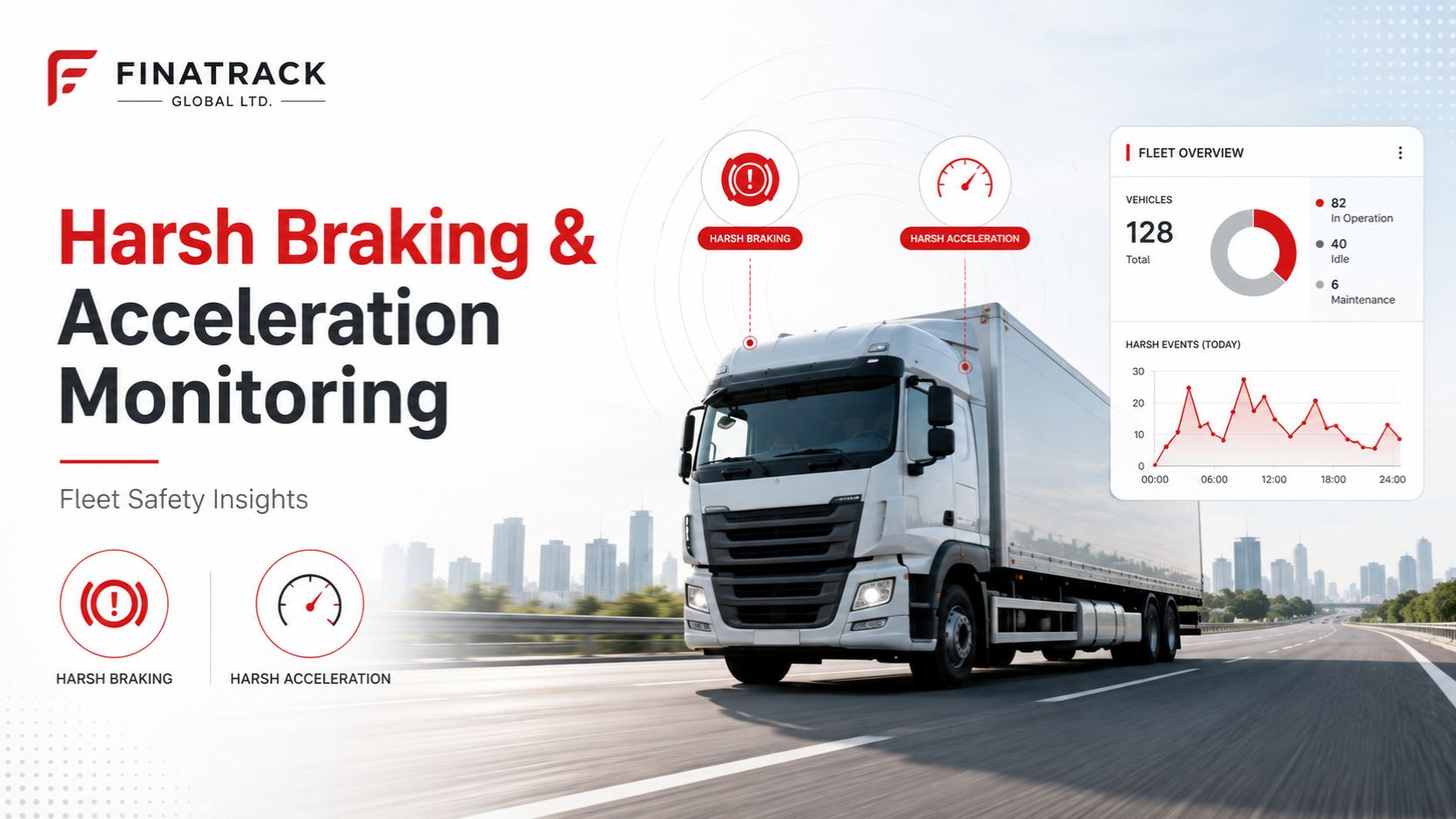
A vehicle can reach its destination on time and still be driven in a way that increases risk, fuel consumption and operating costs. For fleet managers, this is why location tracking alone is no longer enough. Knowing where a company vehicle is provides visibility, but understanding how that vehicle is being driven can reveal problems that may eventually lead to accidents, excessive fuel use and unnecessary wear.
Harsh braking and rapid acceleration are two of the most useful behaviours to monitor because they can provide an early indication of how a driver is operating a vehicle. Modern telematics systems can use accelerometers and vehicle data to detect when acceleration or braking exceeds configured thresholds. Teltonika telematics devices, for example, provide eco-driving functionality that can identify harsh acceleration, harsh braking and harsh cornering after the system has been properly configured and calibrated.
A single harsh braking event does not necessarily mean that a driver is unsafe. A pedestrian may suddenly enter the road, another vehicle may brake unexpectedly or the driver may have to react to an emergency. The value of telematics comes from identifying repeated patterns rather than treating every event as evidence of poor driving.
If one driver repeatedly records substantially more harsh braking events than other drivers operating similar vehicles on comparable routes, the pattern deserves attention. It may indicate that the driver follows other vehicles too closely, approaches junctions too quickly or fails to anticipate changing road conditions. It could also reveal a difficult route where traffic behaviour regularly forces drivers to brake suddenly.
This is why harsh driving information should provide the beginning of an investigation rather than the conclusion. Fleet managers should compare the event with location, speed, route and other available information before deciding what happened.
Commercial transport research has long treated hard braking and hard acceleration as important driving events. The US Federal Motor Carrier Safety Administration has used onboard monitoring systems to capture events including hard braking, hard acceleration and swerving when studying commercial drivers and safety-critical events. This reflects the broader principle that sudden changes in vehicle movement can help identify situations that deserve closer safety review.
For Kenyan businesses operating trucks, delivery vans, sales vehicles and service fleets, the practical advantage is visibility. A fleet manager sitting at the office cannot accompany every driver throughout the working day. Telematics can provide an electronic record of driving events across the entire fleet, allowing management to focus attention on the vehicles and drivers generating unusual patterns.
Harsh acceleration is one such pattern. Rapid acceleration can occur when a driver attempts to reach speed unnecessarily quickly, repeatedly races away from junctions or operates aggressively in stop-and-go traffic. Although occasional acceleration may be unavoidable, repeated events can indicate a driving style that is less efficient and potentially harder on the vehicle.
Fuel consumption is one of the clearest financial reasons to monitor this behaviour. The US Department of Energy notes that aggressive driving involving speeding, rapid acceleration and braking can reduce fuel economy by between 15 and 30 per cent at highway speeds and between 10 and 40 per cent in stop-and-go traffic, depending on the vehicle and operating conditions.
These figures should not be treated as a guaranteed saving for every fleet because actual fuel performance depends on factors such as vehicle type, load, route, traffic and mechanical condition. They nevertheless demonstrate why smooth driving can have a meaningful effect on operating costs.
For a business running one vehicle, the difference may appear relatively small. Across twenty, fifty or one hundred commercial vehicles, repeated aggressive acceleration and braking can contribute to a substantial amount of unnecessary fuel consumption over time.
Monitoring these events therefore allows the business to identify where driver coaching may produce measurable savings. Rather than issuing general instructions asking every driver to use less fuel, management can focus on employees whose driving data shows repeated aggressive behaviour.
Harsh braking can also provide information about following distance and anticipation. A driver who continuously waits until the last moment before slowing down may create more braking events than one who observes traffic conditions early and reduces speed gradually.
This does not mean every braking event represents driver error. Nairobi traffic, unexpected matatu movements, pedestrians and changing road conditions can all require sudden reactions. Location and frequency therefore matter when interpreting the information.
A driver who records several braking events around the same congested junction may simply be operating in difficult traffic. Another driver generating repeated harsh braking on open highway sections deserves a different type of review.
GPS information helps create this context. The fleet manager can identify where the event occurred and examine the route being travelled. When speed data is available, management can also determine how fast the vehicle was moving before the event.
This is where telematics becomes significantly more useful than receiving an isolated alert. The business can examine vehicle location, speed, time, trip history and driving behaviour together, producing a more complete picture of how the event occurred.
Finatrack Global Ltd positions its fleet telematics solutions around driver behaviour analytics, route insights, vehicle utilisation and reporting for businesses and corporate fleets. These types of tools allow fleet operators to move beyond basic location tracking and begin using vehicle data to manage operational performance.
Driver coaching is one of the strongest practical applications. Instead of confronting a driver with a vague accusation of driving aggressively, a manager can discuss specific patterns recorded during actual journeys.
The conversation may show that the employee needs better defensive driving habits. It may also reveal that unrealistic delivery schedules are encouraging drivers to rush between customer locations. In other cases, repeated braking events could expose a route that consistently creates safety problems.
This distinction is important because telematics should help management improve the operation rather than simply create another disciplinary tool. Technology can identify what happened, but managers still need to understand why.
A good driver-management programme therefore looks at trends over time. A driver may receive coaching after repeatedly triggering harsh acceleration events. Management can then review subsequent weeks to determine whether those events decline.
That creates a measurable improvement process. Instead of simply telling drivers to change, the company can see whether coaching is actually producing a different result.
The same approach can be applied across branches or teams. A logistics company may discover that drivers based at one location consistently record more aggressive driving events than those operating elsewhere. This may indicate differences in supervision, routes, delivery pressure or local traffic conditions.
Benchmarking can help fleet managers identify these patterns. Drivers operating similar vehicles and routes can be compared against reasonable fleet averages rather than against unrealistic expectations.
Vehicle type should also be considered. A loaded commercial truck responds differently from a small passenger vehicle. Thresholds used for driver behaviour monitoring should therefore be configured appropriately rather than assuming that every vehicle should generate identical acceleration and braking characteristics.
Technical configuration matters for this reason. Telematics devices can use calibrated accelerometer information and defined limits to determine when an event should be recorded. Teltonika’s fleet devices, for example, allow thresholds relating to maximum acceleration and braking to be configured as part of their eco-driving functionality.
Poorly configured thresholds can create too many alerts. If normal braking repeatedly triggers warnings, fleet managers may eventually start ignoring notifications altogether.
The opposite problem is equally serious. Thresholds that are too generous may fail to identify behaviour the business genuinely wants to monitor.
Professional configuration is therefore important when introducing driver behaviour monitoring. The goal is not to produce the largest possible number of alerts. It is to produce information that management can actually use.
Fleet managers should also consider combining acceleration and braking information with speeding data. A driver who occasionally records one harsh braking event may not present a major concern. A driver who regularly speeds, accelerates aggressively and brakes harshly creates a much stronger risk pattern.
Harsh cornering can add another dimension. Telematics systems can monitor lateral vehicle movement as well as acceleration and braking, providing businesses with another indicator of how vehicles are being handled. Teltonika specifically identifies aggressive acceleration, harsh braking, harsh cornering and overspeeding as driving behaviours that can affect fuel consumption and vehicle life.
This becomes particularly relevant for commercial trucks carrying cargo. Aggressive manoeuvres do not only affect the vehicle. They may also affect the load being transported, particularly where goods are fragile or improperly secured.
Passenger transport operators have another concern. Sudden braking and acceleration can reduce passenger comfort and may create additional safety risks for people standing or moving inside the vehicle.
Businesses should therefore establish clear driver standards before introducing monitoring. Employees should know what the company considers acceptable driving and why telematics information is being collected.
Transparency matters because driver behaviour data can be associated with identifiable employees. Businesses should explain that the objective is fleet safety, efficiency and asset protection, and access to the information should be limited to people who genuinely require it for legitimate operational purposes.
Managers should also avoid treating telematics as infallible. Electronic systems can produce unusual readings because of incorrect installation, poor calibration or exceptional road conditions. Serious disciplinary decisions should therefore consider the wider evidence rather than relying blindly on a single recorded event.
Video telematics can provide particularly useful context in these situations. A road-facing camera may show that harsh braking occurred because another vehicle suddenly changed lanes. A driver-facing camera may help establish whether distraction contributed to the event.
FMCSA research has used onboard monitoring systems and video together when studying safety-critical driving events, including hard braking and other aggressive manoeuvres. The principle is useful for commercial fleets because data identifies an event while video can help explain the circumstances surrounding it.
Maintenance is another reason to pay attention to driving style. Repeated aggressive vehicle operation can contribute to unnecessary stress on tyres, brakes and other vehicle components. Teltonika’s green-driving guidance specifically links aggressive acceleration, braking and cornering with fuel consumption and vehicle life.
For fleet managers, this means driver behaviour can influence costs beyond diesel. Two identical vehicles may produce different maintenance outcomes when one is consistently driven more aggressively than the other.
Telematics can help management identify these differences before simply concluding that one vehicle is mechanically unreliable. If a particular truck repeatedly experiences accelerated component wear while also recording significantly more harsh driving events, driver behaviour becomes one factor worth investigating.
The data can also support preventative maintenance discussions. Workshop records, mileage, route information and driver behaviour can be reviewed together rather than treating maintenance and fleet tracking as completely separate systems.
Insurance and accident risk provide another consideration. No telematics system can guarantee that a collision will be prevented, but monitoring behaviour gives businesses an opportunity to identify patterns associated with unsafe operation before a serious incident occurs.
This is an important shift from reactive fleet management to preventative management. Without telematics, management may first learn that a driver has developed risky habits after an accident. With driver behaviour monitoring, repeated events can create an earlier signal that coaching or further investigation is needed.
The strongest fleets therefore do not use harsh braking and acceleration reports merely to create monthly rankings of good and bad drivers. They use the information to understand the operation.
Which drivers require coaching?
Which routes generate the most aggressive events?
Are delivery schedules encouraging unnecessary rushing?
Does one vehicle behave differently from comparable vehicles?
Are fuel costs higher among drivers with repeated aggressive driving events?
These questions turn telematics information into management intelligence.
Finatrack Global Ltd provides GPS tracking and fleet telematics solutions for businesses in Kenya, including driver behaviour analytics, vehicle utilisation information, route insights and reporting.
For fleet managers, harsh braking and acceleration should therefore not be viewed as isolated numbers on a dashboard.
They are signals.
One event may mean very little.
Repeated events can tell a story about driver behaviour, road conditions, fleet policies and vehicle efficiency.
The purpose of telematics is to help management understand that story early enough to improve it.
For professional GPS fleet tracking and driver behaviour monitoring solutions in Kenya, contact Finatrack Global Ltd on 0723 645 810 or visit www.finatrack.co.ke.