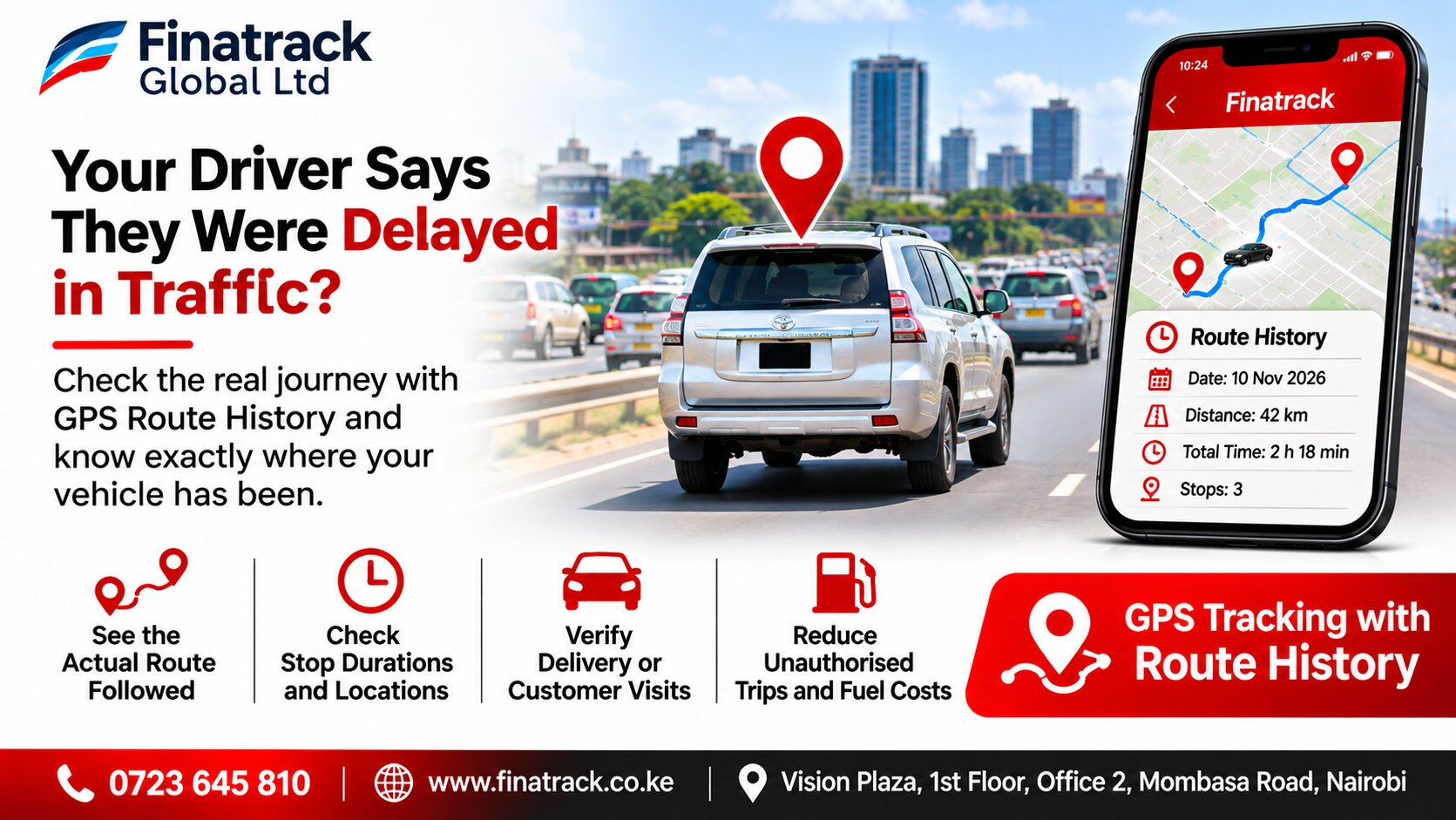
For many businesses, knowing where a vehicle is right now is useful, but understanding where it has been can be even more important. A driver may report that a delivery was delayed because of traffic, that a customer visit took longer than expected or that a vehicle followed a certain route during the day. Without reliable records, managers often have to depend entirely on verbal explanations, phone calls and manual logbooks. GPS route history changes that by providing a digital record of a vehicle’s movement over a selected period.
For businesses in Kenya that operate sales vehicles, delivery vans, logistics trucks, staff transport vehicles, field service cars or contractor fleets, route history can provide valuable accountability. Instead of calling a driver repeatedly to ask where they are or where they have been, a manager can review the vehicle’s actual movement on a tracking platform. This does not mean every delay is suspicious, but it gives businesses better information when they need to understand what happened during a journey.
What Is GPS Route History?
GPS route history, sometimes called historical playback, is a feature that allows a vehicle owner or fleet manager to review where a tracked vehicle travelled over a previous period. Depending on the tracking system, the user may be able to see the route followed, the time the vehicle moved, locations where it stopped and other information linked to the journey.
This is different from live tracking. Live tracking shows where the vehicle is now, while route history helps explain how it got there. If a company vehicle was expected to travel from the office to a customer site and return, historical playback can show whether that route was followed, whether the vehicle made additional stops and how long it remained in different locations.
For managers, this creates a much clearer operational record than relying on memory or handwritten journey logs.
Can Route History Show Whether a Driver Was Really Delayed in Traffic?
Route history can help provide context, although it should not be treated as absolute proof of why a delay occurred. If a vehicle spent a long period moving slowly along a congested route, the GPS data may support the driver’s explanation that traffic caused the delay. If the vehicle instead spent an extended period stationary in an unexpected location, the manager may have a reason to ask additional questions.
The strongest conclusions come from combining several pieces of information. Route history can show the path taken, while stop duration, speed data and timestamps can provide additional context. A business should therefore avoid using one isolated GPS point to make accusations and instead review the journey as a whole.
This evidence-based approach can reduce unnecessary disputes. Drivers who genuinely encountered traffic or operational delays can have data supporting their explanation, while repeated unexplained detours or unauthorised stops become easier to identify.
Route History Can Reduce Constant Phone Calls
One of the most common challenges in fleet management is the need to repeatedly call drivers for updates. A manager may want to know whether a delivery has arrived, whether a sales representative has reached a customer or whether a company vehicle has returned to the office. When several vehicles are involved, constant phone calls become inefficient and distracting.
GPS tracking reduces this dependence on verbal updates because managers can check vehicle location directly. Route history then provides a record of what happened after the journey is complete. Instead of asking a driver to remember exactly where they were several hours earlier, the manager can review the recorded route and use it as a reference during discussions.
This can make communication more efficient while allowing drivers to concentrate on their work instead of responding to frequent location checks.
Identifying Unauthorised Detours
Route history can also help businesses identify journeys that fall outside approved routes. A company vehicle may be assigned to make deliveries in one area but travel several kilometres in another direction before returning. In some situations, the detour may be legitimate because of traffic, a customer request or a road closure. In others, it may indicate personal use of the company vehicle or poor route discipline.
Historical playback allows the manager to examine these movements after the fact and determine whether they form part of a repeated pattern. If the same vehicle regularly makes unexplained deviations, the business can investigate further and establish clearer operating rules.
This is particularly useful for companies where vehicle mileage directly affects fuel costs, maintenance expenses and productivity. Unnecessary detours increase more than just journey time; they also add kilometres, fuel consumption and wear to the vehicle.
GPS Route History for Sales and Field Teams
Companies with sales representatives and field staff often face a different accountability challenge. The employee may leave the office with several customer visits planned, but management may have limited visibility over how the day was spent. Repeated phone calls can feel intrusive, while manual visit reports may not always provide enough information.
GPS route history can give the business a clearer operational picture by showing the movement of the assigned company vehicle throughout the day. Managers can see whether the vehicle travelled to the expected areas, how long it remained at different locations and when it returned.
However, GPS tracking should be used responsibly. Businesses should have clear policies explaining how company vehicles are monitored and why. The goal should be operational accountability, safety and efficient use of business assets rather than unnecessary surveillance.
Delivery and Logistics Businesses Can Verify Routes
For logistics and delivery companies, route history can be particularly valuable because customer service often depends on accurate delivery timelines. When a customer asks why a delivery was late, the business needs more than a guess.
Historical tracking can help show whether the vehicle followed the expected route, where delays occurred and whether the driver made unplanned stops. If the vehicle reached the customer site but remained there for an extended period, that may indicate delays in loading or unloading rather than a driving issue.
Over time, this information can help a company identify routes that regularly cause delays and improve scheduling. A business may discover that a particular road is consistently congested at certain times, allowing dispatch teams to adjust departure times or choose alternative routes.
Route History Can Help Control Fuel and Mileage
Every unnecessary kilometre costs money. When vehicles make unauthorised trips or take inefficient routes, the business pays through additional fuel use, maintenance and depreciation. Route history gives managers a way to compare actual vehicle movement with planned activity.
If two vehicles are performing similar work but one consistently travels significantly farther, management can investigate whether route planning, driver habits or operational requirements explain the difference. This does not necessarily mean misconduct, but it provides a basis for improving efficiency.
When combined with fuel monitoring, the information becomes even more useful. Managers can compare distance travelled with fuel consumption and identify vehicles that may be operating inefficiently.
Historical Playback Can Help Investigate Incidents
Route history is also valuable after unexpected events. If a vehicle is involved in an accident, receives a customer complaint or appears in an unauthorised location, the manager can review previous movements to understand what happened before the incident.
A business may want to know what time the vehicle arrived at a location, which route it took beforehand and whether it stopped anywhere unusual. When combined with an AI dashcam, route history can provide both location data and video evidence, creating a more complete picture of the event.
This can support internal investigations, insurance discussions and driver coaching. The information is especially useful because it is recorded automatically rather than being reconstructed later from memory.
Geofencing Can Complement Route History
Route history explains where a vehicle has been, while geofencing can help notify the manager when the vehicle enters or leaves selected areas. These two features work well together.
For example, a business can create a geofence around its office, warehouse or customer site. When a vehicle enters or leaves that zone, the tracking system may generate an alert depending on the configuration. Later, route history can be reviewed to understand the full journey.
For companies managing several vehicles, this combination can reduce the need for manual check-ins and provide a clearer record of vehicle activity.
GPS Data Should Be Used Fairly
Tracking technology provides powerful information, but managers should interpret it carefully. GPS data can show where a vehicle was and how it moved, but it may not always explain the full reason behind a stop or delay. A driver may have stopped because of a mechanical problem, customer instruction, police check, traffic incident or safety concern.
The best fleet management approach is therefore to use GPS data as evidence for a conversation rather than as an automatic accusation. Managers can review the journey, ask the driver for context and make decisions based on the complete situation.
This approach improves accountability without creating unnecessary conflict between employees and management.
Finatrack GPS Tracking Solutions
Finatrack Global Ltd provides GPS tracking solutions for private motorists and businesses that want greater visibility over vehicle movement. Features such as live tracking, route history, geofencing, speed alerts and ignition monitoring can help fleet managers supervise company vehicles more effectively and reduce reliance on constant phone calls.
Our Wired GPS Tracker is available at KSh 15,000 one-off with no annual subscription, or customers can choose KSh 10,000 installation plus KSh 3,000 annual subscription. Finatrack also provides wireless tracking devices, backup trackers, fuel monitoring systems, AI dashcams, motorcycle trackers and advanced car alarm systems.
For businesses managing multiple vehicles, these technologies can be combined to improve accountability, security and fleet efficiency.
Better Accountability Starts With Reliable Information
When a driver says they were delayed in traffic, GPS route history can help provide context. It can show the route followed, where the vehicle stopped and how the journey progressed. Used responsibly, this information can reduce disputes, improve fleet management and help businesses understand how their vehicles are actually being used.
For enquiries or installation, contact Finatrack Global Ltd on 0723 645 810, visit www.finatrack.co.ke, or visit our office at Vision Plaza, 1st Floor, Office 2, Mombasa Road, Nairobi.
You do not have to depend entirely on phone calls and memory to understand where a company vehicle has been. With GPS route history, the journey can speak for itself.