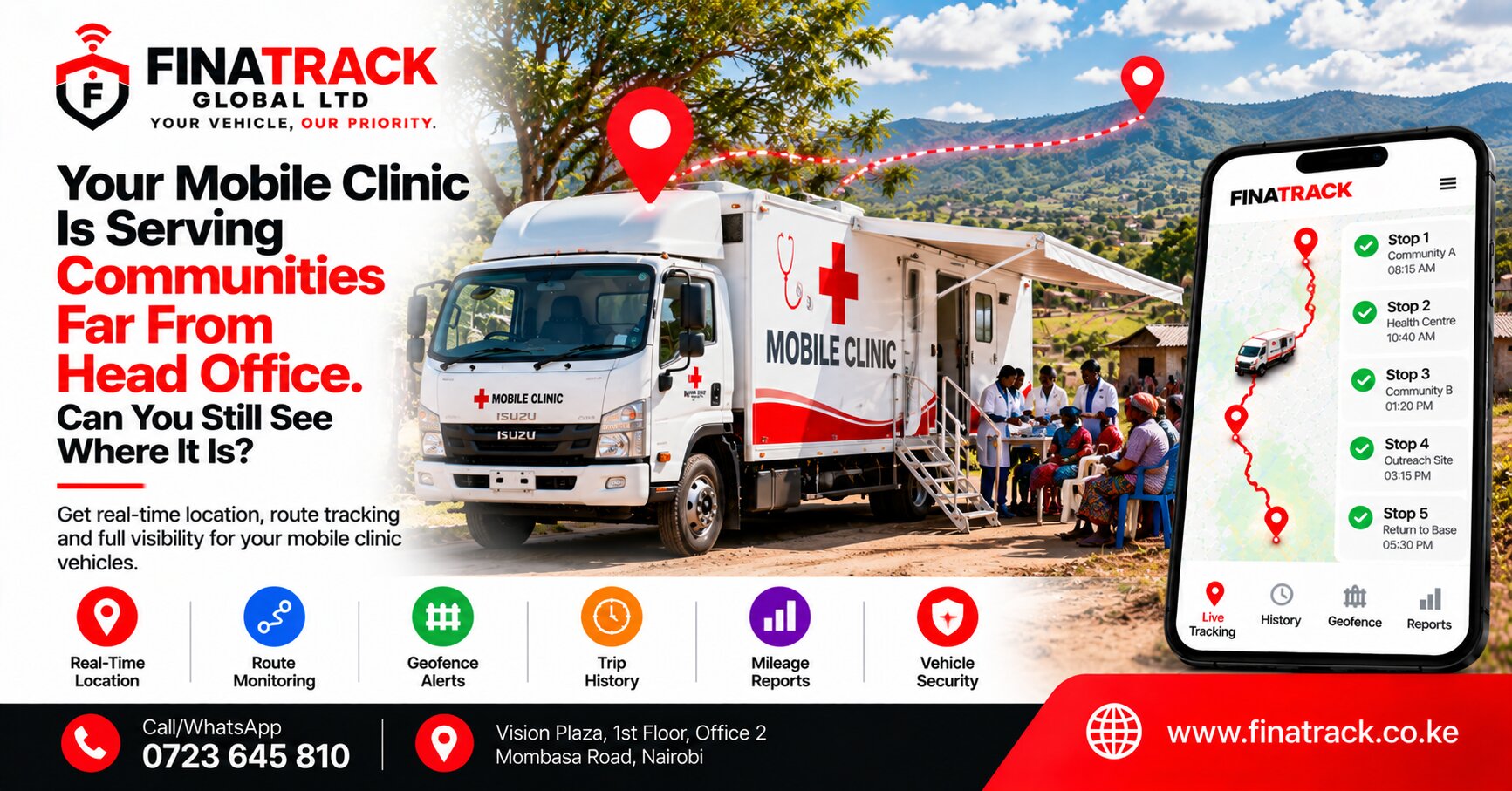
Mobile clinics play an important role in taking healthcare services closer to communities that may be far from hospitals, clinics and major towns. NGOs, county programmes, private healthcare providers and outreach organisations often send vehicles hundreds of kilometres from their main offices to support medical camps, vaccination programmes, screening exercises and community health projects. Once these vehicles are in the field, however, management still needs to know where they are, how they are being used and whether they are following the intended programme routes.
A professionally installed GPS tracker for mobile clinics in Kenya can give authorised managers access to the vehicle’s current or most recently reported location from a phone or computer. Instead of repeatedly calling drivers or field teams to ask where the vehicle has reached, the organisation can review the tracking platform and get a clearer picture of its movement. This can be particularly useful when a mobile clinic is operating across several counties or moving between remote communities where direct supervision from head office is difficult.
Trip history can provide additional value after the outreach activity has been completed. Management can review the route taken, the distance travelled and the locations where the vehicle stopped during the day. If a mobile clinic was scheduled to visit several communities in Machakos, Kajiado or another county, for example, the tracking history can help confirm that the vehicle travelled through the expected areas. GPS data does not prove that medical services were delivered at each stop, but it can provide useful operational evidence that supports programme reports and field documentation.
Geofencing can also help organisations monitor important locations. Virtual boundaries can be created around health centres, outreach sites, programme offices or other key areas, allowing the tracking system to record when the vehicle enters or leaves those locations depending on the setup. This can make it easier for coordinators to understand when a mobile clinic arrived at a scheduled area and when it departed, without requiring someone at head office to watch the map throughout the day.
Mileage information can support maintenance planning, which is particularly important for vehicles operating far from major workshops. A mobile clinic travelling long distances on rural roads may accumulate kilometres much faster than a vehicle operating mainly within Nairobi. GPS mileage records can help fleet managers identify which vehicles are approaching service intervals so that maintenance can be planned before a breakdown interrupts an outreach programme. The tracking system does not replace mechanical inspection, but it provides another useful record of how intensively the vehicle is being used.
GPS tracking can also support better coordination when plans change. A mobile clinic may finish one outreach session earlier than expected, while another location may require additional support. If management can see where the available vehicles are, it becomes easier to decide which unit can reasonably respond without creating unnecessary travel. In the event of a breakdown or other operational problem, the latest reported location can also help the organisation coordinate assistance, recovery or a replacement vehicle.
Vehicle security is another important consideration because mobile clinics can carry medical equipment, supplies and other valuable assets. A GPS tracker provides an additional layer of visibility if the vehicle moves unexpectedly or is taken outside its intended operating area. For organisations managing higher-value vehicles or programmes in remote areas, a wired tracker can also be combined with wireless backup tracking, tracking tags or other security solutions depending on the level of risk and the organisation’s operational needs.
Finatrack Global Ltd provides professionally installed GPS tracking and fleet-management solutions suitable for NGOs, healthcare organisations, mobile clinics and outreach programmes operating across Kenya. Depending on the selected system, authorised users can access vehicle location, trip history, mileage, geofencing and selected alerts through the tracking platform. Finatrack’s wired GPS tracker is available at KES 15,000, with professional installation available at the office or at a convenient customer location. Organisations seeking better visibility over mobile clinic vehicles can contact 0723 645 810 or visit www.finatrack.co.ke. When healthcare vehicles are operating far from head office, GPS tracking can provide the visibility needed to manage routes, maintenance, security and field operations with greater confidence.