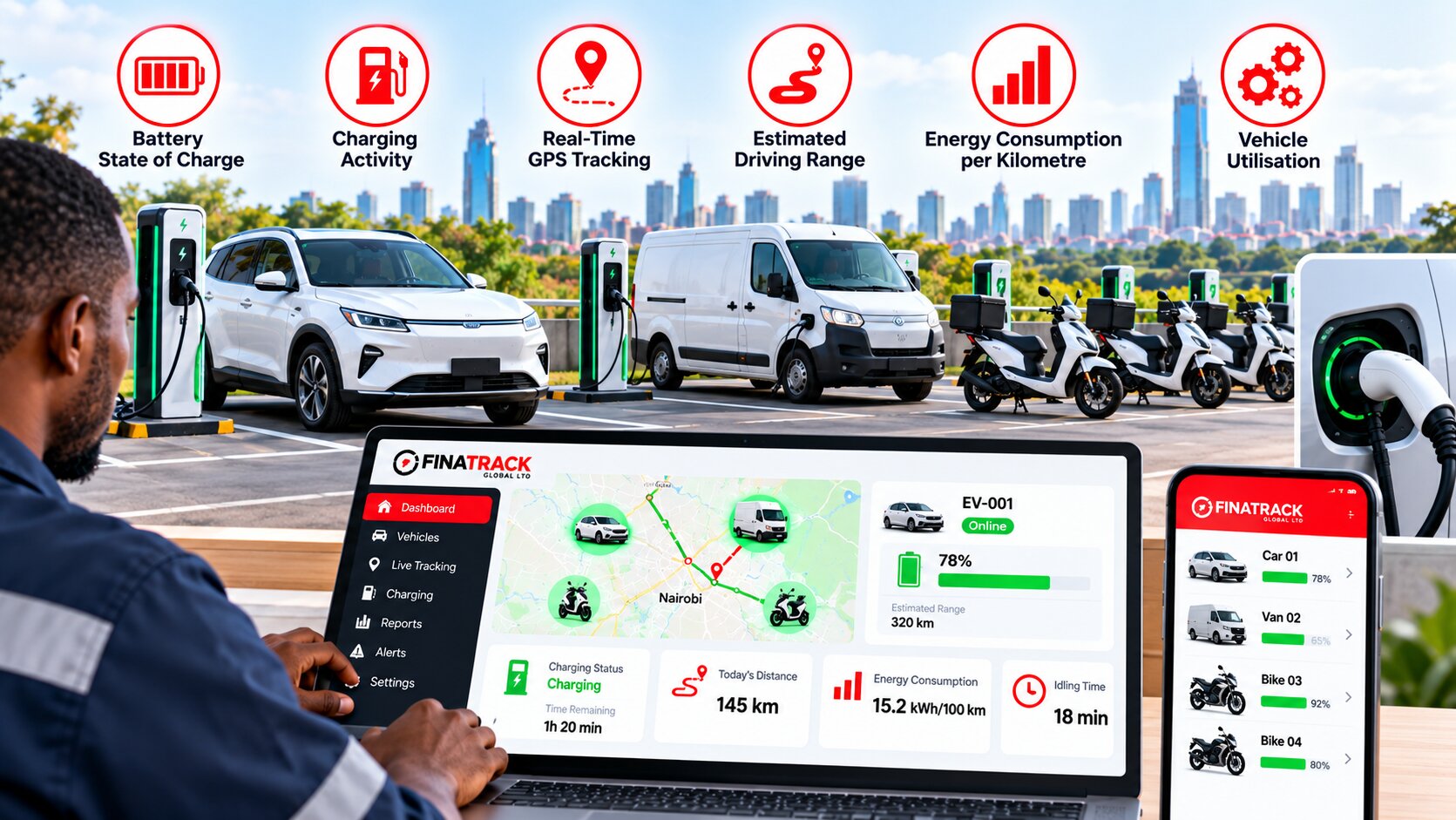
For decades, fleet managers have measured vehicle efficiency using fuel. They track litres purchased, kilometres travelled, fuel consumption per 100 kilometres and suspicious changes in tank levels. Electric vehicles change that conversation completely. There is no petrol or diesel tank to monitor, but the need for operational visibility does not disappear. For businesses adopting electric cars, motorcycles, vans and buses, electric vehicle fleet tracking in Kenya increasingly means monitoring location, battery charge, charging activity, range, utilisation and driver behaviour together.
This is becoming a more relevant question in Kenya as electric mobility moves from a niche transport option toward a larger part of the national transport strategy. Kenya officially launched its National Electric Mobility Policy on February 3, 2026, creating a national framework for expanding electric mobility, charging infrastructure, investment, local assembly and supporting regulation. The Ministry of Roads and Transport reported that Kenya had cumulatively registered 39,324 electric vehicles by 2025, compared with 1,378 in 2022, with electric motorcycles contributing strongly to that growth.
For a fleet manager, the first major replacement for the traditional fuel gauge is battery state of charge, normally expressed as a percentage. Knowing that a vehicle is at 72 percent charge can be operationally similar to knowing how much fuel remains in the tank, but the interpretation is different. The important question is not simply how much energy remains, but whether that charge is enough to complete the vehicle’s next assignment and reach an appropriate charging point afterwards.
This makes remaining driving range particularly important. An electric delivery van may leave the depot with a high battery percentage, but its usable range can change depending on driving conditions, load, speed, traffic, terrain, air-conditioning use and vehicle efficiency. Fleet managers therefore need to think in terms of energy available versus work remaining, rather than relying only on a percentage displayed on the dashboard. Where supported by the vehicle or telematics integration, estimated range can become one of the most useful operational indicators.
Location remains just as important for an electric fleet as it is for petrol or diesel vehicles. GPS tracking can show where the vehicle is, where it has travelled, how long it has remained at different locations and whether it has left an assigned area. An electric vehicle may require different planning, however, because a route decision can influence whether the vehicle reaches a suitable charging point before the battery becomes too low. Combining GPS information with charging plans can therefore help dispatchers make better route decisions.
Charging activity becomes the EV equivalent of refuelling. A fleet manager should know where vehicles are charging, how often they charge and how long they remain connected. A van that spends two hours at a charger during a busy delivery period has a different operational impact from one that charges overnight while the vehicle would otherwise be parked. Businesses moving to electric fleets should therefore begin treating charging time as part of fleet scheduling rather than seeing it as a separate energy issue.
Charging infrastructure is still an important consideration in Kenya. At the launch of the National Electric Mobility Policy, government officials acknowledged that charging infrastructure remained concentrated around Nairobi and needed to expand into other towns. EPRA’s electric-vehicle charging guidelines also recognise charging accessibility as one of the factors affecting faster EV adoption and set out considerations for public and private charging stations and battery-swapping facilities.
This means route planning can become more important for an electric fleet operating outside major urban areas. A diesel truck may have access to numerous filling stations along a long-distance corridor, while an electric vehicle may need more deliberate charging planning. Fleet managers should know which routes have dependable charging options, how far the vehicle normally travels between charges and how much reserve energy should remain when it reaches its destination.
For electric motorcycles, battery swapping creates another management model. Instead of waiting for a battery to charge, a rider may exchange a depleted battery for a charged one at a swapping station. From a fleet-management perspective, the important measurements can include vehicle location, distance travelled, battery changes and productive trips completed between swaps. The telematics strategy should therefore reflect the specific type of electric vehicle rather than assuming every EV operates in the same way.
Energy consumption per kilometre is another metric that can gradually replace traditional litres-per-100-kilometre comparisons. Electric vehicles commonly measure energy in kilowatt-hours, and a fleet can compare how much electrical energy different vehicles require to complete similar work. Where the necessary vehicle data is available, a manager may discover that one EV consistently uses more energy than comparable vehicles operating similar routes.
As with fuel vehicles, the explanation may not automatically be a mechanical fault. Driver behaviour can influence electric-vehicle efficiency. Aggressive acceleration, sustained high speeds and inefficient route choices can increase energy use, while smoother driving may help extend usable range. GPS and telematics information such as speed patterns, trip history and harsh-driving events can therefore remain valuable even when the vehicle no longer consumes a drop of diesel.
Idling also changes meaning in an electric vehicle. A conventional vehicle may burn fuel while the engine runs stationary, whereas an EV can remain parked without a traditional engine idling in the same way. However, energy can still be consumed by climate control, refrigeration systems, lighting and other electrical equipment. Fleet managers should therefore move away from thinking only about engine-on time and consider stationary energy consumption where the vehicle and telematics system make that information available.
Battery temperature can also matter, although this type of information generally requires integration with the vehicle’s own systems rather than a basic standalone GPS tracker. Batteries operate within designed temperature ranges, and thermal-management systems help protect performance and longevity. Businesses considering advanced EV telematics should therefore ask which battery and powertrain parameters can actually be accessed from the specific vehicle model through CAN bus, manufacturer APIs or another compatible integration.
This is an important distinction because GPS tracking alone does not automatically provide all electric-vehicle battery information. A conventional tracker can still provide valuable location, movement, route history, geofencing and utilisation information, but battery state of charge, charging status and detailed energy information may require deeper integration with the vehicle. Fleet managers should understand this before assuming that installing any GPS device will automatically expose every EV parameter on the dashboard.
Maintenance planning also changes with electric vehicles. EVs have fewer traditional engine-related service items, but they still require tyres, brakes, suspension, cooling systems and other components to be monitored. High annual mileage remains important, and GPS data can continue supporting maintenance scheduling by showing how far each vehicle has travelled. Tyre management may become particularly important because vehicle weight, driving style and torque characteristics can influence tyre wear.
Utilisation becomes another crucial measurement. An electric vehicle may appear inexpensive to operate per kilometre but still represent a poor investment if it spends most of the working day parked. Fleet managers should compare trips completed, kilometres travelled, charging downtime, productive hours and vehicle availability. This helps the business determine whether its EVs are being deployed effectively rather than judging success only from lower fuel expenditure.
Charging cost should also be connected to fleet activity. A company that operates its own chargers can compare electricity consumed with kilometres travelled and jobs completed. Businesses using public charging may also need to understand the cost differences between charging locations and charging times. Over time, management can begin calculating an energy cost per kilometre or per delivery, creating an EV equivalent of the fuel-cost metrics traditionally used in fleet management.
For businesses operating mixed fleets, the challenge becomes even more interesting. A company may have diesel trucks, petrol pickups, electric delivery vans and electric motorcycles operating at the same time. Management should avoid comparing them using only one metric. Instead, a modern fleet dashboard can bring together fuel consumption for combustion vehicles, electrical-energy consumption for EVs, mileage, utilisation, driver behaviour and maintenance information so that each vehicle can be judged according to the work it performs.
Security also remains important. An electric vehicle can still be stolen, taken outside an authorised route or used after working hours. GPS tracking, geofencing, route history and movement alerts therefore remain relevant regardless of the powertrain. For high-value EV fleets, businesses may also consider layered tracking using a professionally installed primary tracker together with an independent wireless tracking device or tracking tag where appropriate.
Fleet managers should pay particular attention to vehicles operating close to their maximum practical range. A driver who repeatedly returns to the depot with very little battery remaining creates less operational flexibility if traffic, an emergency assignment or a charging-station problem occurs. Telematics can help businesses identify routes where the energy margin is consistently too small and consider changing the assignment, charging schedule or vehicle allocation.
Historical data becomes increasingly useful as the fleet gains experience. After several months, management can determine how much charge particular routes normally require, which drivers achieve better efficiency and how charging patterns affect productivity. These internal benchmarks can be more useful than generic manufacturer range figures because they reflect the company’s actual vehicles, routes, payloads and operating environment.
Kenya’s EV ecosystem is also still developing. In August 2026, the State Department for Transport and the International Finance Corporation announced a new cooperation programme to support implementation of the National Electric Mobility Policy, including work on regulation, institutional frameworks, private-sector investment and charging infrastructure. This suggests that businesses adopting electric fleets today should expect the operating environment, charging network and regulatory framework to continue evolving.
For fleet operators, that makes flexible telematics particularly valuable. A monitoring system should not be designed only around today’s vehicle technology. Businesses may increasingly need platforms that can combine GPS information with vehicle APIs, battery data, charging records, driver monitoring and other connected-vehicle information. The objective is to create a fleet-management system that can adapt as the vehicles themselves become more connected.
Finatrack Global Ltd provides GPS tracking, fleet management, AI dashcam and vehicle telematics solutions for businesses in Kenya. Finatrack’s wired GPS tracker is available at KES 15,000, providing location monitoring, route history, geofencing and other vehicle information depending on the configured solution. Businesses moving into electric mobility can use GPS tracking as the foundation for vehicle visibility while considering deeper vehicle-data integrations where battery and charging information is required.
For professional installation and enquiries, call or WhatsApp 0723 645 810 or visit www.finatrack.co.ke. Moving from petrol or diesel to electricity does not reduce the need for fleet monitoring; it changes what fleet managers should measure. Instead of focusing only on litres, modern electric fleets increasingly need visibility over battery charge, remaining range, charging time, energy consumption, location, utilisation and driver behaviour. The companies that understand those metrics early will be better positioned to turn electric vehicles from a new technology into productive business assets.